ToupTek HOPE D60 - Full-format 60mm f/4.66 PAPO refractor for astrophotography
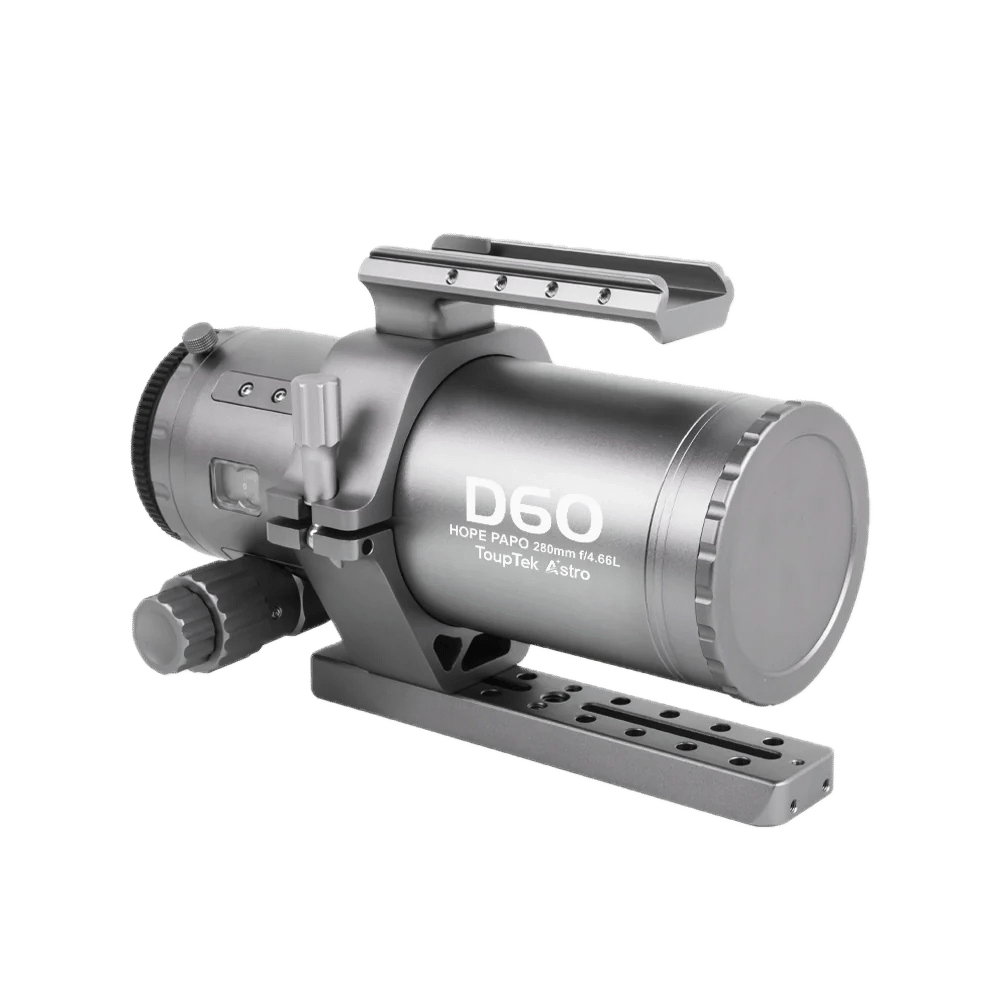
The ToupTek HOPE D60 is a true astrograph in a compact format: an apochromatic telescope with a 60 mm diameter and 280 mm focal length (f/4.66), equipped with a PAPO (Planar Apochromatic) optics with 5 elements and a integrated field corrector. It effortlessly covers a full-format sensor (44 mm image circle) while delivering spot stars from center to corner, without the need for additional correctors or complicated backfocus calculations.
Designed above all for the’deep sky astrophotography, Yet the HOPE D60 remains accessible to beginners who want an instrument that's easy to set up and easy to upgrade. Its short, robust tube 3-inch focuser and its M48/M54 interfaces make it an excellent companion for both modern astro cameras and hybrid photo cameras.

What is the PAPO optical formula?
The formula PAPO (Planar Apochromatic) of the HOPE D60 is a 5-lens apochromatic lens specially developed for astrophotography:
- 5 elements in 3 groups (PAPO) combining glass SD (low dispersion) and lanthanum, for a virtually no chromatic aberration and color fidelity.
- Flat design (planar) with integrated field corrector - the field curvature is compensated for in the optics, resulting in a perfectly flat field to the edge of a full-format sensor.
- The corrector is integrated into the optical train (and not added as an accessory), which:
- reduces the risk of mechanical tilt and play,
- simplifies the optical chain,
- avoids stacking rings and external correctors.
In concrete terms, the PAPO formula offers round, highly concentrated stars, with uniform sharpness across the entire field. Optical tests show a spot RMS radius below 1.1 µm at center and 2.3 µm at full-format edge We're very close to the diffraction limit. What's more, the system maintains an almost identical focus over several wavelengths, guaranteeing a common focus for RGB and stars without colored bangs.

Optical performance: punctual stars and a perfectly illuminated field
The HOPE D60 is designed as a fast, perfectly corrected astrograph for modern sensors:
- f/4.66 ratio 280 mm short focal length for a large field and a highly efficient light collection. Ideal for extensive nebulae, large galactic fields, HII regions, etc.
- Full-format field (44 mm) : The image circle comfortably covers 24×36 mm sensors with sharp stars right to the corners.
- Relative illumination > 90 % at 22 mm The difference in brightness between the center and edge of the sensor is < 10 %, which greatly limits vignetting and allows for smooth, easy-to-correct flats.
- High MTF HOPE D60 typically exceeds 0.95 to 10 lp/mm and remains above 0.85 to 30 lp/mm, with little sagittal/tangential variation - a sign of excellent resolution and uniform contrast throughout the image.
- Minimum longitudinal aberration : focus curves as a function of wavelength are very narrow, guaranteeing a common focus from blue to red and a sharp image for the various filters.
The combination of these features results in images that are very pricked, even and without soft corners, even on large or very demanding sensors (fine pixels).
Simple backfocus and flat native field
Thanks to the integrated flattener, The HOPE D60 functions as a ready-to-use astrograph:
- Recommended backfocus: 55 mm from threaded outlet (tolerable ~50 to 58 mm, 55 mm being the target value).
- No need for calculate complicated distances nor do we need to add an external corrector: we simply use a standard chain (camera adapter + rings) to reach 55 mm.
- This approach reduces the probability of tilt, flexion or mechanical misalignment often introduced by the stacking of accessories.
Note: as focus and backfocus are optimized for a direct photographic chain, the use of a angled return for visual is not recommended on this model - the HOPE D60 is truly designed as a pure astrophoto instrument.
Mechanical Design: Precise 3-inch focuser and sturdy tube
The HOPE D60 is not only optically accomplished, it is also mechanically meticulous:
- 3-inch rack-and-pinion focuser, with a 30 mm stroke, setting fast + gear ratio 1:10 for ultra-precise focusing, adapted to modern cameras and autofocus.
- Graduated scale and focuser window Easy to find the ideal position with your different setups.
- CNC-machined aluminum construction Rigid tube, very good collimation retention, stability against temperature variations and vibration.
- Blackened and baffled inner tube Stray light suppression to improve contrast and image cleanliness.
- Retractable mist guard Protects the front lens, reduces fogging and folds away to save space.
- 360° rotating ring (CAA) : allows you to rotate the camera/filter wheel assembly without dismantling, to adjust framing without upsetting the entire optical train.
- Multifunction handle with slots for accessories (finder, mini-guidescope, ASIAIR/StellaVita, etc.).
- Integrated dovetail bar with pre-drilled slots for easy adaptation to your collars and plates.
Ultra-compact format for easy transport
Despite its performance, the HOPE D60 remains extremely compact :
- Length approx. 255 mm fog shield retracted.
- Space-saving design allows fit in a photo bag or a small carrying case.
- Perfect for lightweight setups with travel mounts, nomadic overnights, or as a second wide-field tube.
M48 & M54 interfaces and extended compatibility
The focuser's output is designed for easy integration into modern astrophotography chains:
- M48 adapter included standard: perfect for most astro cameras and for T-rings on hybrid/DSLR bodies.
- Optional M54 adapter available for larger-format sensors or optical trains requiring a wider passage (less mechanical vignetting).
- Compatible with many filter wheels, OAG and focus motors market, thanks to standardized interfaces.
The HOPE D60 is also designed to operate with motorized focusers of different brands, simplifying integration into a fully automated setup (autofocus, long sequences, remote, etc.).
Examples of configurations and uses
Thanks to its versatility, the HOPE D60 covers a wide range of applications:
- Deep sky wide field astrophotography extended nebulae, molecular cloud complexes, regions around the galactic plane, large open clusters, etc.
- Lunar and solar astrophotography (with suitable filter): excellent resolution and contrast thanks to apochromatic optics and flat field.
- Use as a «super telephoto lens» When paired with a DSLR/hybrid body, the HOPE D60 becomes a 280 mm f/4.66 lens very high quality, also useful for daytime photography (animals, landscapes, etc.).
- Nomadic setup light-weight HAE/Star Adventurer/equivalent mount, cooled or uncooled color camera, HOPE D60, StellaVita or ASIAIR controller - a minimalist but high-performance kit.
Who is the ToupTek HOPE D60 designed for?
The HOPE D60 is equally well suited to the ambitious beginner who wants a simple, high-performance, scalable instrument, than to the’experienced astrophotographer looking for a fast, perfectly flat and very compact full-format astrograph. Its 5-element PAPO optical design, 3″ focuser, and modern interfaces make it an ideal telescope for getting the most out of today’s cameras and camera bodies—whether in the field, in a fixed setup, or on the go.