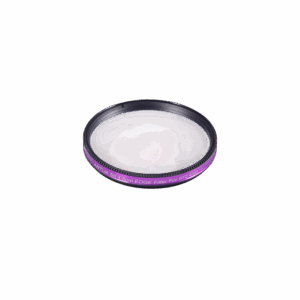
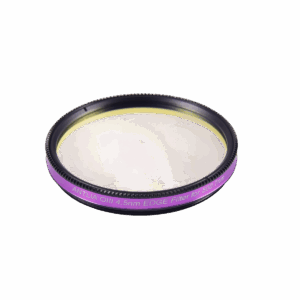
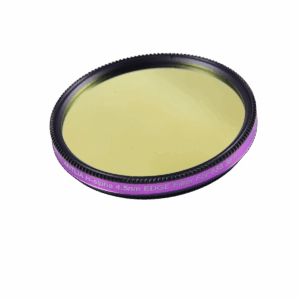
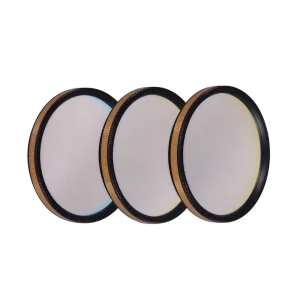
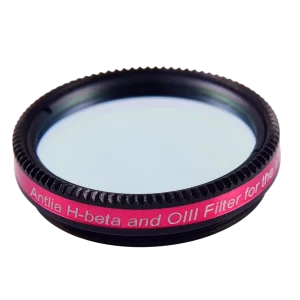
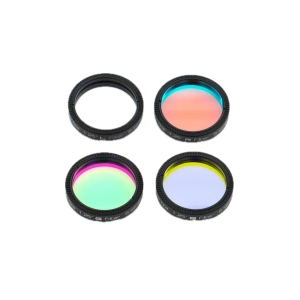
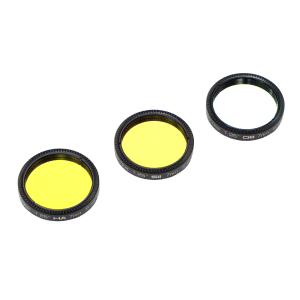
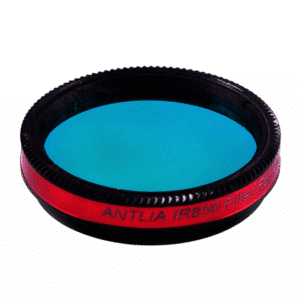
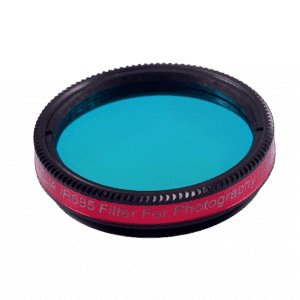
With a monochrome camera, the two families complement each other. LRGB filters, such as the Antlia LRGB-V Pro Kit, are used for galaxies, reflection nebulae, and clusters, which emit across the entire spectrum: they perform best under a dark sky. Narrowband Hα, OIII, and SII filters, such as the SHO Antlia 3 nm Pro Kit, isolate the lines in emission nebulae and remain effective both in urban areas and when the Moon is present.
With a color camera, a dual-band filter such as the'Antlia ALP-T Dual-Band 3 nm Ha and OIII plays this role in emission nebulae. The'Antlia Triband RGB Ultra II and the Quad-Band allow more light to pass through and produce a more natural rendering of stars and galaxies under a light-polluted sky. Under a dark sky, we tend to photograph galaxies and clusters without this type of filter. For astrophotography, we recommend Antlia filters: a single, non-adhesive substrate, high out-of-band rejection, and steep-flank profiles that minimize halos. See our LRGB and SHO filters and our multiband filters.
An emission line, such as Hα at 656.3 nm or OIII at 500.7 nm, is much narrower than the filter band: whether the band is 7 nm or 3 nm wide, the filter transmits almost all of the signal. The sky background (light pollution, the Moon, atmospheric luminescence), on the other hand, is a continuum, and the proportion of light transmitted is proportional to the bandwidth. Switching from 7 nm to 3 nm therefore reduces the background by a factor of approximately 7/3, or 2.3, while the signal remains nearly the same.
The photon background noise is equal to the square root of the background: it decreases by a factor of √2.3, or approximately 1.5. When this noise dominates—in the city or under the Moon—the RSB gains nearly 50 % per exposure, the equivalent of 2.3 times the integration time. The stars, which also emit a continuum, are attenuated by the same ratio and appear fainter. In Hα, a 3-nm band also blocks the NII line at 658.3 nm, which a 7-nm filter allows to pass. Under a very dark sky, the gain is reduced because readout noise becomes more significant: you need to extend the individual exposure times to take advantage of it, for example with the Antlia H-alpha Pro 3 nm filter (gear ratio greater than 88 %, OD5 lock).
An interferential filter is designed for light passing through it perpendicularly. In a very wide beam, the rays arrive at an angle, and the transmission band shifts toward shorter wavelengths: with a 3-nm filter, part of the line falls outside the band, and the signal drops. Antlia therefore pre-shifts its Highspeed versions by 1.2 nm toward the red: the Antlia H-alpha Pro High-Speed 3 nm Filter is centered at 657.5 nm and has a range from f/2.6 to f/3.6.
An interference filter blocks light by reflecting it, not by absorbing it. The sensor, its window, and the filter’s surfaces therefore act as partial mirrors. A small fraction of the light from a bright star travels back and forth between the sensor and the filter, between the two surfaces of the filter, or between two stacked filters, and then returns to the sensor out of focus: it forms a diffuse ring or disk around the star. This artifact is most noticeable in narrow-band images, where the background is very dark.
The distance to the sensor also matters: the diameter of the halo is roughly twice the distance from the filter to the sensor divided by the f/D ratio. A filter placed farther away produces a large, faint halo, while a filter placed closer produces a smaller but more concentrated halo. The real solution is a properly treated filter—and only one filter in the optical path.
These filters are effective only for emission nebulae and planetary nebulae; they do not improve the image of galaxies and clusters.
They perform best with an exit pupil (ocular focal length divided by the f/D ratio) ranging from about 2.5 to 7 mm, tending toward the upper end of this range for OIII and especially for H-beta. On an f/6 Dobsonian, this corresponds to eyepieces ranging from about 15 to 40 mm. See our filters for the display.
On the Moon, a Celestron lunar filter reduces glare during the lit phases and makes viewing more comfortable. The Baader Skyglow Neodymium is the most versatile: it enhances Jupiter’s cloud bands and the Great Red Spot, the dark regions of Mars, and the lunar terrain, while maintaining a natural color balance. Traditional color filters have a stronger effect on a single color, at the cost of a significantly darker image: they are best suited for instruments with a large aperture.
See our planetary filters.
See our sun filters.
At Lunt, the number indicates the effective diameter of the blocking filter in hundredths of a millimeter: B400 = 4 mm, B600 = 6 mm, B1200 = 12 mm, B1800 = 18 mm, B3400 = 34 mm. Placed in the angled mirror assembly, near the focal point, the blocking filter retains only one of the peaks transmitted by the standard and contains filters necessary for the system’s safety. It must allow the entire image of the Sun to pass through, which measures approximately the focal length divided by 107 to 109 depending on the season: 3.2 mm at 350 mm, 5.5 mm at 600 mm, 8.3 mm at 900 mm. A blocker that is too small cuts off the edge of the disk and darkens the periphery; a larger one does not improve the bandwidth, only the field of view.
The Lunt LS60MT Standard Kit (420 mm) comes with a B600 for visual observation; for imaging, Lunt recommends the B1200. The Lunt LS152THa B1800 (900 mm) leaves room for the sensors. At Coronado, the figure is given directly in millimeters: a BF10 is 10 mm and covers up to 1,000 mm of focal length. The Quark incorporates a 12-mm stopper behind a ×4.3 Barlow lens: DayStar only guarantees the entire disk is in focus at focal lengths below approximately 450 mm.
An energy-rejection filter (ERF) is placed in front of the objective lens and reflects ultraviolet, infrared, and most of the visible light outward: heat does not enter the tube and does not affect the etalon or the blocker. It is never an observation filter: it does not replace either the etalon or the blocker. Regarding the Quark, DayStar states:
Antlia Solar Discover kits operate without additional reduction up to 100 mm; beyond that, the'Antlia Solar Discover Dualband ERF (25 nm around Hα and CaK/CaH) protects the system and limits heat-induced band shifts. The 2-inch version is intended for use with telescopes with a maximum aperture of 110 mm.