CHF 199.00incl. Swiss VAT
Reference CAM-0049-1
Will be ordered for you
Delivery time: 5 to 7 business days
Estimated shipping: Between November 10 and 11, 2026







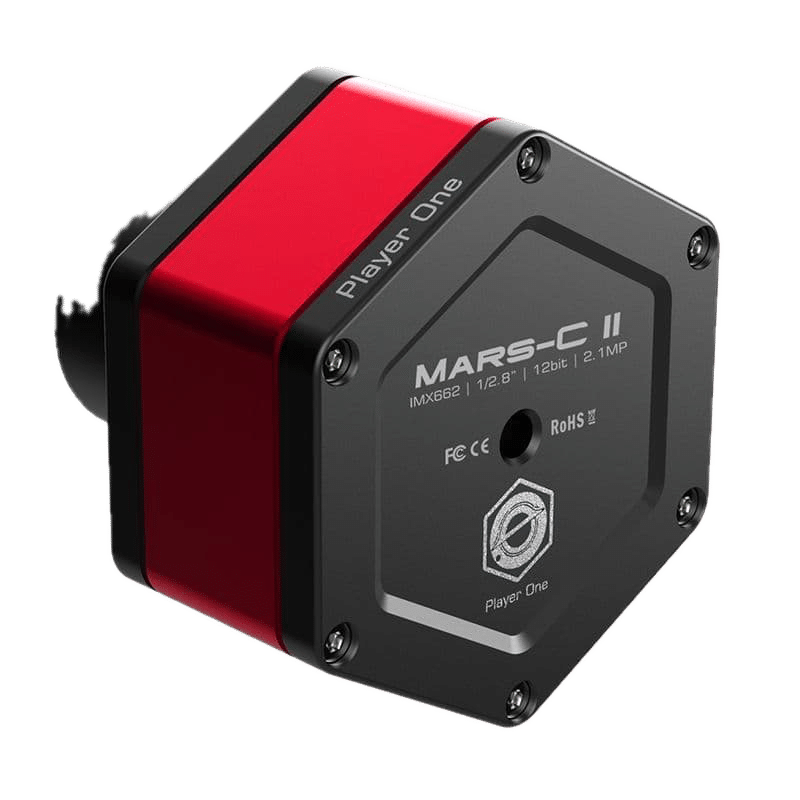
La Mars-C II is a planetary color camera USB 3.0 developed by PO, integrating the brand-new Sony IMX662 sensor in 1/2.8”. Designed for’planetary imagery, lunar and’EAA, the company stands out for its high sensitivitya exceptional well capacity and above all a total absence of amp glow, This is a major advantage when it comes to obtaining clean, easy-to-process images.
The Mars-C II is based on Sony STARVIS 2, CMOS backlit architecture (BSI) optimized for low light levels. The sensor IMX662 offer :
This large well capacity makes it possible to better manage the bright areas of planets while retaining fine detail, especially on Jupiter, Saturn and March.
One of the major strengths of Player One Mars-C II is its dark frame totally free of amp glow. Even when the curves are pushed hard, the background remains clean and uniform. This translates into :
Thanks to its interface USB 3.0, the Mars-C II reaches up to 108 frames per second at RAW8 (10-bit ADC) at full resolution. It also features a 256 MB DDR3 cache memory, a Player One exclusive on planetary cameras, which :
The camera retains excellent performance even on a USB 2.0, which makes it highly tolerant of modest computer configurations.
The Mars-C II incorporates DPS (Dead Pixel Suppression), which analyzes darks to map faulty pixels and dynamically correct them during acquisition. It also features overvoltage and overcurrent protection, to guarantee the safety of the camera and your equipment.
The camera adopts the signature Player One design: a hexagonal body combining rigidity and elegance, with a high-end matte red and black finish. Equipped with :
The name “Mars”, engraved on the case, corresponds to the sensor format (1/2.8”), according to Player One Astronomy's own planetary nomenclature.
Visit Player One Mars-C II IMX662 is ideal for :
It is fully compatible with popular software packages such as FireCapture, SharpCap and sensor analysis tools (active HCG at gain 210).
Player One Mars-C II, IMX662 planetary camera, IMX662 color camera, USB3 planetary camera, Jupiter Saturn Mars camera, high-resolution lunar camera, STARVIS 2 astrophotography, EAA planetary camera
La Player One Mars-C II est destinée à l'imagerie planétaire, lunaire et solaire (Soleil uniquement avec un filtre adapté) par « lucky imaging » : on filme quelques minutes jusqu'à 108 images/s puis on empile les meilleures images. Avec des pixels de 2,9 µm, visez un rapport F/D d'environ f/9 à f/15 sur les planètes, avec une lentille de Barlow si nécessaire. Elle sert aussi de caméra d'autoguidage.
Le Sony IMX662 (STARVIS 2) offre un bruit de lecture de 0,7 e⁻ et 54 ke⁻ de capacité de puits pour des pixels de 2,9 µm, une bonne sensibilité dans le proche infrarouge et aucun amp glow. Avec 108 images/s en 1936 × 1100, c'est l'un des meilleurs capteurs à petit prix pour les planètes et le guidage.
Non : elle est alimentée par son câble USB. Aucune alimentation externe n'est nécessaire.
Le backfocus de la caméra est de 12,5 mm. Raccordement : 1,25″ ; M42 × 0,75.
Oui : sa fenêtre est seulement antireflet. Ajoutez un filtre UV/IR-cut ZWO 1,25″ pour des images nettes et des couleurs justes. Pour les planètes basses sur l'horizon, un correcteur de dispersion atmosphérique ZWO ADC améliore nettement la netteté.
La fiche du fabricant (en anglais) est disponible ici : fiche Player One Mars-C II.