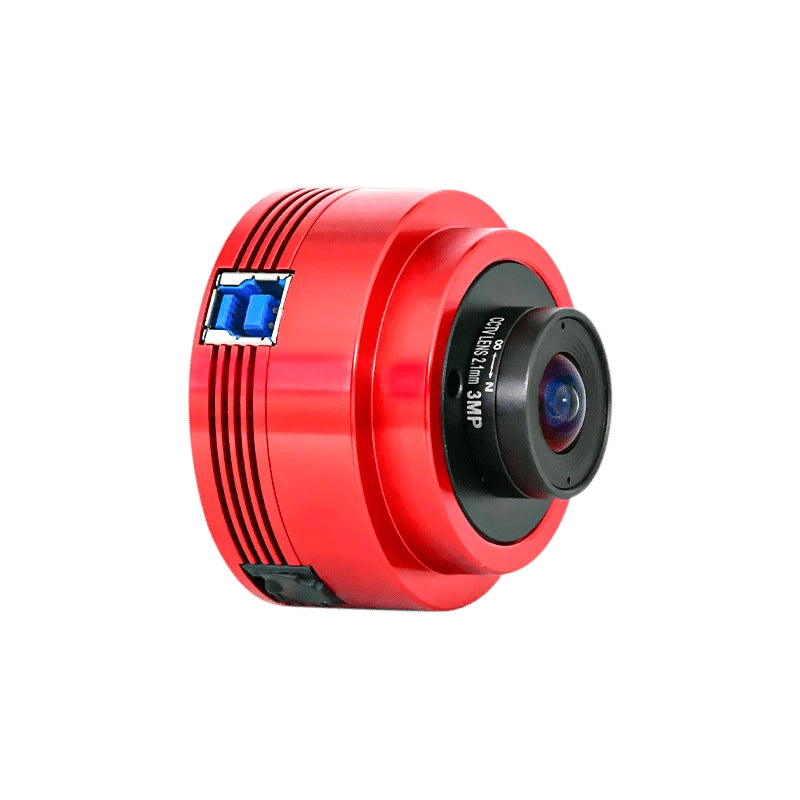
Sony IMX715 8.46-megapixel color camera with 1.45 µm pixels, for imaging planets and lunar details without systematic focal length magnification. Its USB 3.0 interface and 256 MB DDR3 buffer support video recording, while its small sensor requires you to check the field of view before creating a lunar mosaic.
CHF 161.10incl. Swiss VAT
Part Number ZWO-A152436







The ASI715MC is designed for astronomers who want to capture the colors of the planets in a single sequence, without having to take a series of images through red, green, and blue filters. Its Sony IMX715 sensor, with a resolution of 3864 × 2192 pixels, offers 8.46 megapixels on a surface area of just 5.6 × 3.2 mm. The distinguishing feature of this model is therefore its 1.45 µm pixel pitch, rather than a wide field of view.
Small pixels provide fine resolution of the image even at moderate focal lengths. Before adding a powerful Barlow lens, evaluate the results obtained with the native focal length, the instrument’s aperture, and local turbulence. Highly magnifying a planet can make the image darker and require more gain without revealing new details. Proper focus and correctly adjusted optics remain more useful than an artificially enlarged disk on the screen.
For the Moon, the available resolution allows for the preservation of a great deal of detail in a portion of the surface, but the sensor’s modest physical dimensions limit the field of view at long focal lengths. Photographing the entire disk may require a shorter focal length or a mosaic. Conversely, for a small planet that occupies few pixels in the full image, a narrow region of interest avoids unnecessarily capturing a vast black background.
ZWO announces a USB 3.0 interface and a 256 MB DDR3 buffer. This buffer supports image transfer; it does not replace a computer or a sufficiently fast storage device. The spec sheet lists a frame rate of 45.1 frames per second. The actual frame rate depends, among other factors, on the readout format, the selected field of view, and the exposure time: base your settings on the actual recorded signal rather than solely on this advertised maximum.
The manufacturer specifies a minimum read noise of 0.72 electrons and a charge capacity of 6,030 electrons. These two values should not be interpreted as constant performance across all gain settings. When observing Jupiter or illuminated lunar terrain, monitor the histogram and avoid saturation. Capturing a sequence of images and then selecting and stacking the best ones allows you to work with the frames least affected by turbulence.
This model is suitable for a compact color setup dedicated to planets and lunar details, with fine sampling and no systematic amplification. ZWO also mentions small deep-sky objects, but this sensor is not intended for capturing large nebulae in a single image: the field of view depends on the physical dimensions and focal length, not just the number of megapixels. Finally, accurate color reproduction requires proper demosaicing and appropriate color balance; the “MC” suffix does not guarantee a final image that is ready for publication.
Documentation: ZWO official data sheet.
La ZWO ASI715MC est destinée à l'imagerie planétaire, lunaire et solaire (Soleil uniquement avec un filtre adapté) par « lucky imaging » : on filme quelques minutes jusqu'à 45,1 images/s puis on empile les meilleures images. Avec des pixels de 1,45 µm, visez un rapport F/D d'environ f/4 à f/7 sur les planètes, avec une lentille de Barlow si nécessaire.
Le Sony IMX715 a les plus petits pixels de notre gamme : 1,45 µm. Il atteint un échantillonnage fin à des rapports F/D courts (environ f/4 à f/7), donc sur de petits instruments sans Barlow. En contrepartie, sa capacité de puits est faible (6,03 ke⁻).
No: It is powered by its USB cable. No external power source is required.
The camera's back focus is 12.5 mm. Mounts: 1.25", 2", and M42 × 0.75.
The manufacturer's manual (in English) is available here: manuel ZWO ASI715MC (PDF).