More products from the brand :Player One

Neptune-C II Player One

CHF 194.46incl. Swiss VAT

Reference CAM-0052

Will be ordered for you
Delivery time: 5 to 7 business days
Estimated shipping: Between November 10 and 11, 2026

Free shipping in Switzerland on orders of 200 CHF or more
14 days to request a return
Credit Card · TWINT · PayPal · Invoice · Klarna
Free pickup in Nyon · credit card or cash
Product description

Product description

Neptune-C II: Next-Generation Planetary Color Camera

Visit Neptune-C IIdeveloped by Player One Astronomyis a new-generation planetary color camera featuring the Sony IMX464 CMOS sensor. It is designed to offer exceptional performance, particularly for planetary imaging, solar observation and infrared capture.

Main Features

  • Sony IMX464 CMOS sensor :
    • 1/1.8" format
    • 4.2-megapixel resolution (2712 x 1538 pixels)
    • Pixel size 2.9 µm
    • 9 mm diagonal
    • Full Well depth: 12 ke
    • Frame rate: up to 93 FPS at full resolution

Technological Highlights

  • Ultra-low playback noise : Only 0.7 e-, or 47% less than the IMX178, for sharper, clearer images.
  • Infrared sensitivity : Capable of capturing IR wavelengths with IR850 or CH4 filters, ideal for infrared imaging.
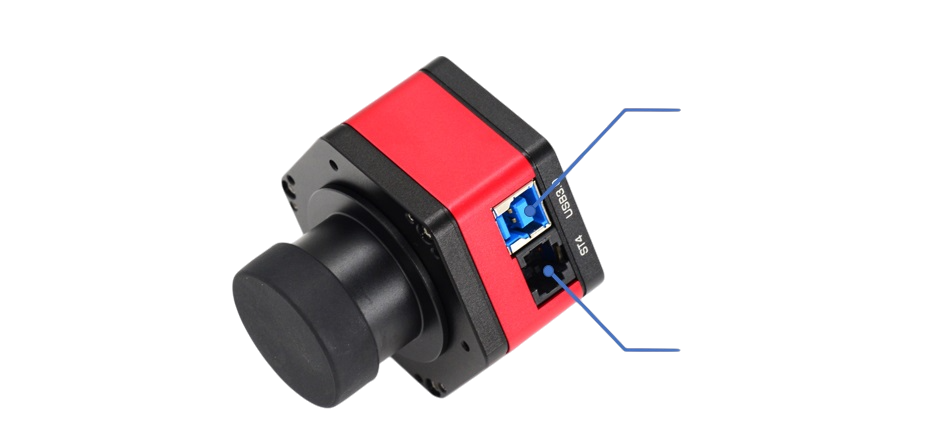
  • Hexagonal design: Red and black finish with textured surface for ergonomic grip and modern look.
  • Versatility : Can be used as a monochrome camera with appropriate filters for more detailed observations.

Applications

Visit Neptune-C II is ideal for :

  • Planetary imaging
  • Solar observation
  • Infrared capture
  • Meteor tracking

Conclusion

With its advanced performance and innovative design, the Neptune-C II has established itself as an essential tool for demanding astrophotographers looking for quality and versatility in their observations.

Back to the sections
Frequently asked questions

Frequently asked questions

À quel usage la Player One Neptune-C II est-elle destinée ?

La Player One Neptune-C II est destinée à l'imagerie planétaire, lunaire et solaire (Soleil uniquement avec un filtre adapté) par « lucky imaging » : on filme quelques minutes jusqu'à 93 images/s puis on empile les meilleures images. Avec des pixels de 2,9 µm, visez un rapport F/D d'environ f/9 à f/15 sur les planètes, avec une lentille de Barlow si nécessaire.

En quoi le capteur de la Player One Neptune-C II se distingue-t-il ?

Le Sony IMX464 garde les pixels de 2,9 µm de l'IMX462 sur un capteur plus grand (1/1,8″ au lieu de 1/2,8″) : plus de champ pour la Lune et pour garder les planètes dans le cadre malgré la turbulence, avec 0,7 e⁻ de bruit et 93 images/s.

La Player One Neptune-C II a-t-elle besoin d'une alimentation ?

Non : elle est alimentée par son câble USB. Aucune alimentation externe n'est nécessaire.

Quel backfocus faut-il respecter avec la Player One Neptune-C II ?

Le backfocus de la caméra est de 12,5 mm. Raccordement : 1,25″ ; M42 × 0,75.

Faut-il un filtre pour photographier les planètes avec la Player One Neptune-C II ?

Oui : sa fenêtre est seulement antireflet. Ajoutez un filtre UV/IR-cut ZWO 1,25″ pour des images nettes et des couleurs justes. Pour les planètes basses sur l'horizon, un correcteur de dispersion atmosphérique ZWO ADC améliore nettement la netteté.

Où trouver plus d'informations sur la Player One Neptune-C II ?

La fiche du fabricant (en anglais) est disponible ici : fiche Player One Neptune-C II.

Technical specifications

Technical specifications

Technical specifications

Sensor
Sony IMX464
Couleur / monochrome
Color
Sensor Size
1/1,8″
Sensor Dimensions
7,9 × 4,5 mm
Sensor diagonal
9 mm
Resolution
4.2 Mpx
Définition en pixels
2712 × 1538
Pixel size
2.90 µm
Shutter
Déroulant
Convertisseur ADC
12 bits
Playback noise
0.7 e⁻
Capacité du puits
12 ke⁻
Rendement quantique max
90 %
Cooling
No
Buffer memory
256 MB DDR3
Interface
USB 3.0 / USB 2.0
Port ST4 (autoguidage)
Yes
Speed
93 images/s
Backfocus
12.5 mm
Filetage / raccordement
1,25″ ; M42 × 0,75
Protective window
Antireflet (AR Plus), Ø 21 × 1,1 mm
Diamètre du boîtier
66 mm
Poids de la caméra
180 g
Power supply
Alimentée par le câble USB
Usages de la caméra
Planétaire, Solaire, Lunaire
Documentation

Products in the same category

[category_menu_mobile]