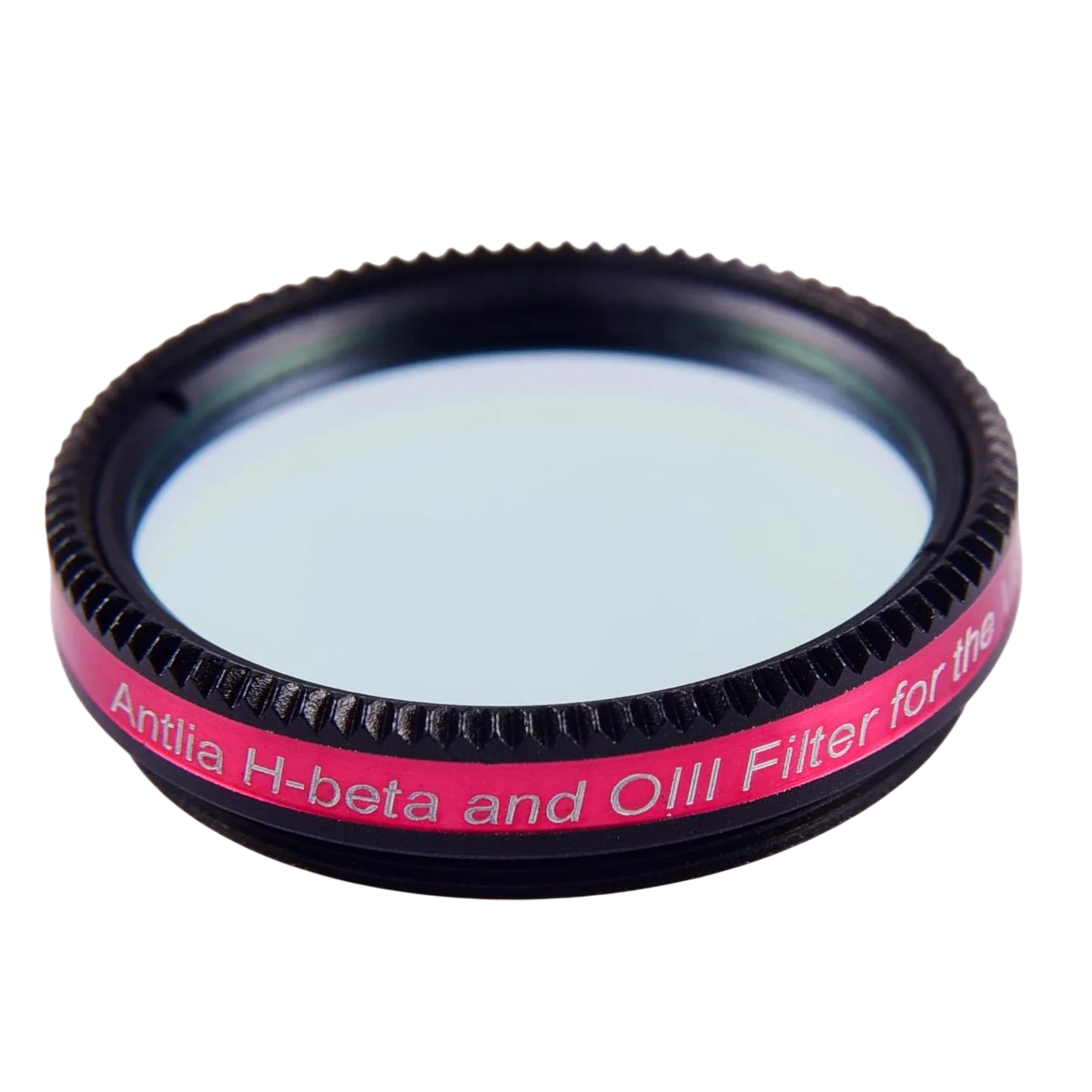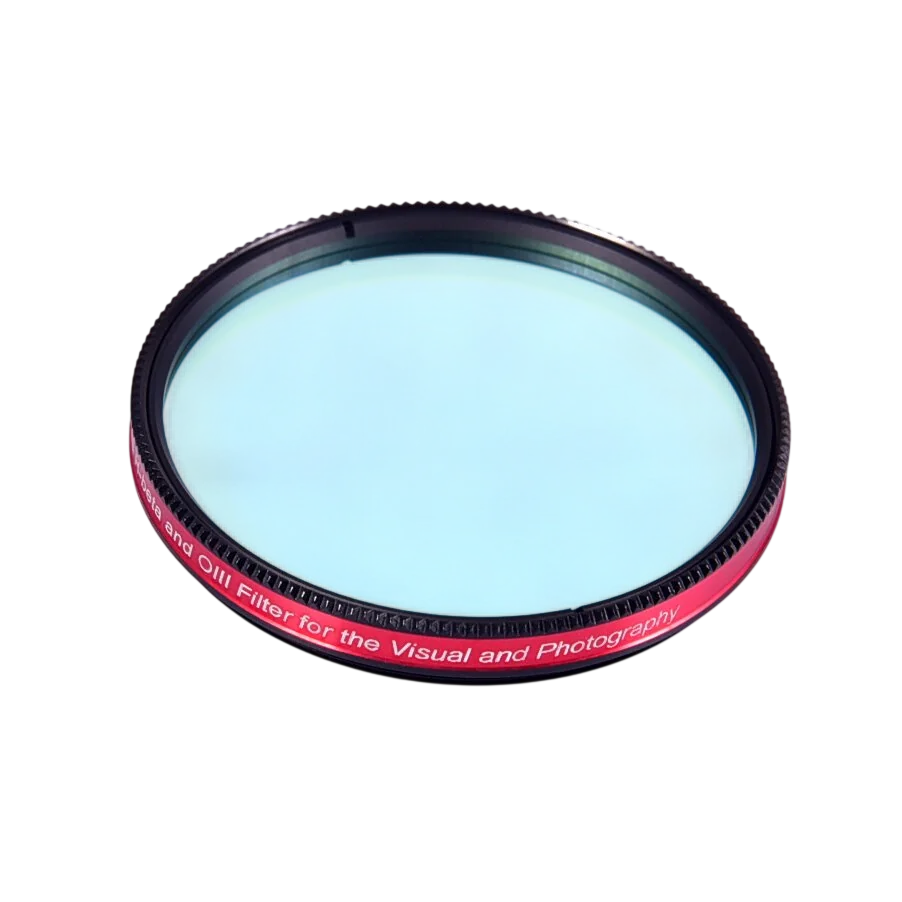
The Antlia HB-OIII filter is designed for nighttime observation of nebulae and for deep-sky astrophotography. It transmits the OIII lines at 500.7 and 495.9 nm, as well as the H-beta line at 486.1 nm. This spectral selection is intended to increase the contrast between nebulae that emit in these lines and the sky background.
CHF 84.94 – CHF 127.84Price range: CHF 84.94 through CHF 127.84







The Antlia HB-OIII filter is designed for nighttime observation of nebulae and for deep-sky astrophotography. It transmits the OIII lines at 500.7 and 495.9 nm, as well as the H-beta line at 486.1 nm. This spectral selection is intended to increase the contrast between nebulae that emit in these lines and the sky background.
Antlia specifies a transmission of over 90 % for each of the three spectral bands listed in its technical table. Blocking of unwanted wavelengths is specified at OD4 over the range from 300 to 1000 nm. This extension into the infrared spectrum also meets the needs of photographic cameras. The HB-OIII is therefore a distinct product from the narrow-band H-beta Pro filter and the ALP-T photographic filters: its documented use combines night observation and photography.
The manufacturer cites planetary nebulae, supernova remnants, emission nebulae, and diffuse nebulae. In particular, it cites the Lace of Cygnus, the Dumbbell Nebula, and the Orion Nebula as examples of objects that can benefit from this filtering. Usage is described for both light-polluted and dark skies. For visual observation, Antlia recommends a large-aperture telescope to gather more light, given the eye’s sensitivity at night.
The product listing offers a 1.25″ mounted filter or a 2″ mounted filter. The former uses an M28.5 × 0.6 thread; the latter uses an M48 × 0.75 thread. Each option corresponds to a single filter in the selected diameter. The slim mount is designed to preserve the effective aperture; it features a black anodized finish and laser engraving. The format selected must match the available mounting slot in the optical accessories being used.
The filter is manufactured on a single, non-bonded optical substrate with a thickness of 2 mm ± 0.05 mm. Antlia specifies a surface quality of 60/40, a transmitted wavefront of λ/4 or better, and parallelism of less than 30 arcseconds. For photography, the manufacturer lists astronomical cameras and SLR cameras. Solar observation and solar imaging are excluded from the recommended uses. Never look at the Sun through the HB-OIII: its suitability for nighttime observation does not constitute solar protection.
| Transmitted lines | H-beta 486.1 nm; OIII 495.9 and 500.7 nm |
|---|---|
| Transmission | > 90 % with three stripes |
| Blocking | OD4, 300 to 1,000 nm |
| Thickness | 2 mm ± 0.05 mm |
| Formats | 1.25″ mounted, M28.5 × 0.6; 2″ mounted, M48 × 0.75 |
| Usage | Nighttime stargazing and astrophotography—never solar |