CHF 499.00incl. Swiss VAT
Will be ordered for you
Timeframe: 10 days to 3 weeks
Estimated shipping: Between November 18 and 23, 2026







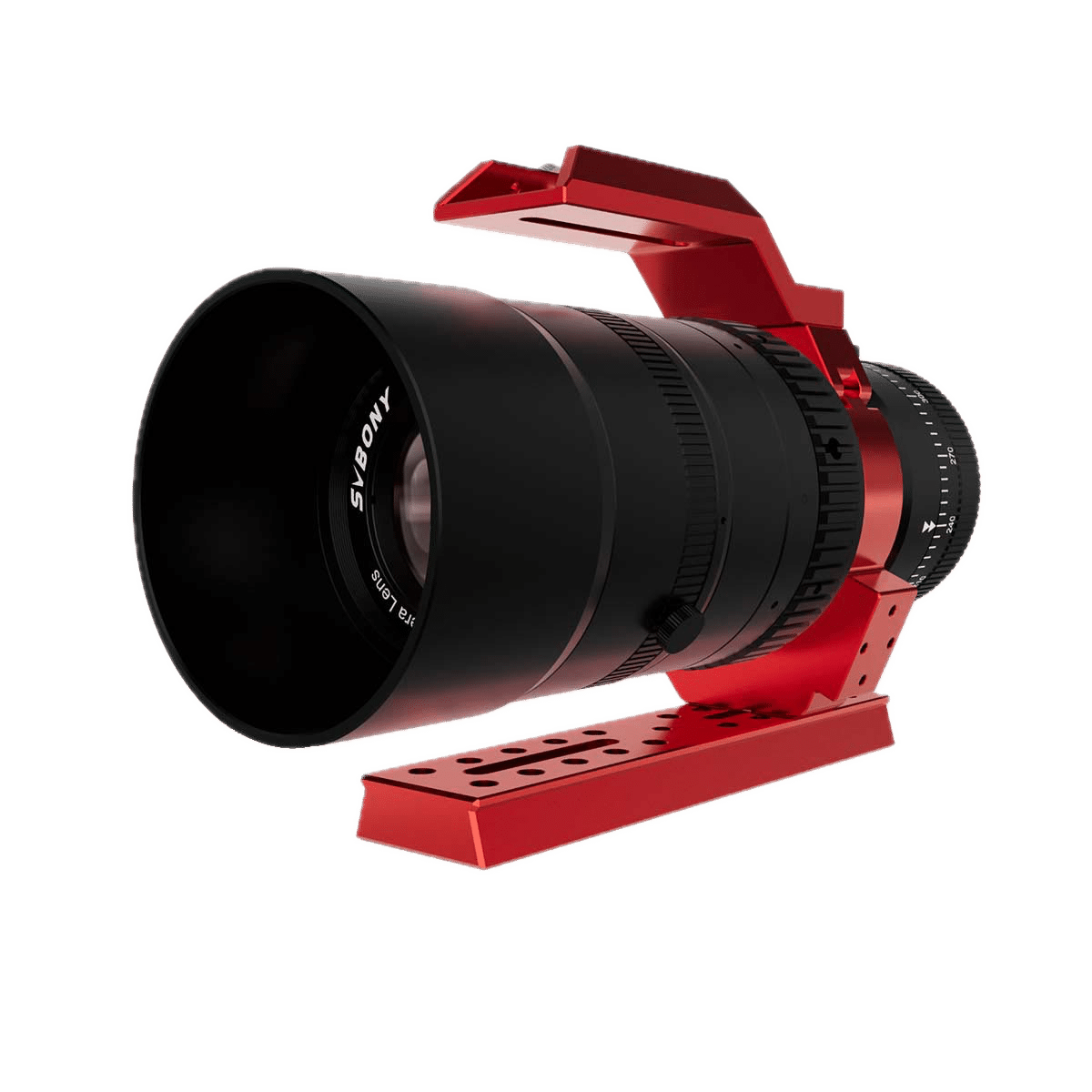
Compact, fast and designed for the deep sky, the SVBONY SV555 is a Petzval-type astrograph.
offering a flat image over a useful 44 mm circle (full format). With its 243 mm focal length and
With its variable aperture from f/4.5 to f/22, it covers a wide field, ideal for large nebulae,
HII regions, stellar clouds and object-rich constellations. Its 5-lens design in
3 groups, including triplet and ED lenses, deliver fine stars and excellent chromatism
controlled, without the need for additional corrector.
The SV555 uses a modern Petzval formula: a lens unit at the front and a corrector unit at the rear.
back to flatten the field. The combination includes a triplet and ED (Extra-low) lenses.
Dispersion) to minimize chromatic aberration and preserve round stars right up to the corners.
full format. In the field, this translates into fast pointing, efficient MAP and rough handling.
with no separate corrector to add or space out.
The rear ends in an M48x0.75 male thread: you can screw on a filter wheel directly,
a 2″ filter drawer or a housing adapter (T-ring M48). The supplied PCB adopts a
Vixen/Arca-Swiss type for easy mounting on many photo heads, equatorial heads, etc.
or travel frames. The 360° rotation with lock makes framing easy, and focusing
helical stitch for fine, stable adjustment.
The SV555 is a full-frame wide-frame that's simple and efficient: screw it on, frame it, shoot it. Its
243mm focal length and bright f/4.5 open up a wide range of targets, even on short nights.
Star rendering, native flatness and M48 connection make it an excellent choice for entry (or
progress) in deep-sky astrophotography with true image quality, without the addition of a corrector.
The SVBONY SV555 is a Petzval-style telescope with ED lenses, featuring a 54 mm aperture and a 243 mm focal length (f/4.5), designed primarily for deep-sky astrophotography. Its focal length is optimized for very wide fields of view: the Milky Way, the large nebular complexes in Cygnus, Orion, and Cepheus, and mosaics spanning several degrees. At f/4.5, it is very fast and gathers light quickly, making it ideal for faint nebulae and narrowband imaging.
With an APS-C camera featuring 3.76 µm pixels (Sony IMX571 sensor), you get approximately 3.19″ per pixel for a field of view of 5.5° × 3.7°. This is a wide field of view typical of wide-angle imaging; a camera with 2.9 µm pixels will provide finer star detail if desired. The 44 mm image circle covers full-frame sensors (24 × 36 mm): a full-frame mirrorless camera will also work.
No. Its optical design (Petzval design with ED glass) inherently produces a flat field, with sharp stars all the way to the corners, without the need for an external flattener.
M48×0.75 rear thread.
The tube weighs about 2.5 kg; with the camera, filter wheel, and guide scope, expect it to weigh around 4 kg: a small equatorial or harmonic travel mount is sufficient. A refractor requires no collimation: once balanced, it’s ready to use as soon as it reaches operating temperature.