More products from the brand :Player One

Player One Uranus-M

CHF 389.00incl. Swiss VAT

Reference CAM-0054-1

Will be ordered for you
Delivery time: 5 to 7 business days
Estimated shipping: Between November 11 and 12, 2026

Free shipping in Switzerland on orders of 200 CHF or more
14 days to request a return
Credit Card · TWINT · PayPal · Invoice · Klarna
Free pickup in Nyon · credit card or cash
Product description

Product description

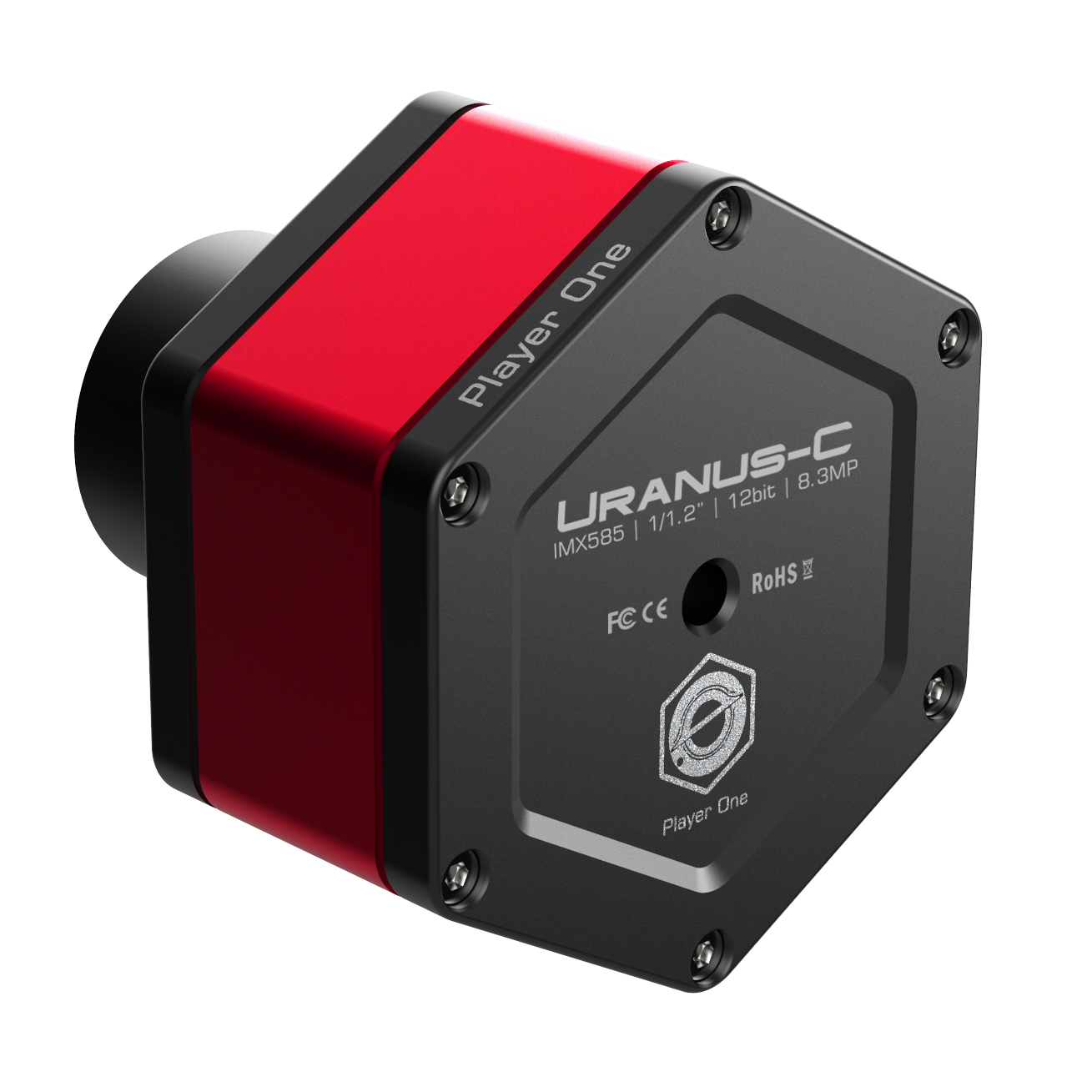
Player One Uranus-M (IMX585)

The Player One Uranus-M is the monochrome version based on the Sony IMX585 sensor in the 1/1.2″ format. It’s a rare combination: a highly sensitive, modern STARVIS 2 sensor, 8.3 MP of usable resolution (3856×2180), 2.9 µm pixels, very deep charge wells (~47 ke-), and above all, a dark perfectly clean (zero amp-glow). In practice: it's fluid for high-frame-rate planetary, formidable in EAA, and surprisingly comfortable for fast deep-sky lucky imaging.

Why I recommend it

  • Sensitivity + dynamics STARVIS 2 in back-illuminated, 47 ke- well and peak QE around ~91 % to make the most of your narrow filters.
  • No amp-glow clean sky background, simpler stacking and shorter processing times.
  • High speed up to ~47 FPS at full resolution (RAW8), and much more in ROI to freeze turbulence.
  • 256 MB DDR3 buffer stable transfers, fewer lost images, even over USB 2.0 if required.
  • Meticulous mechanical control : 2ᵉ generation tilt plate (front/rear) to round out stars on the field and integrated blackout foam against lateral leakage.
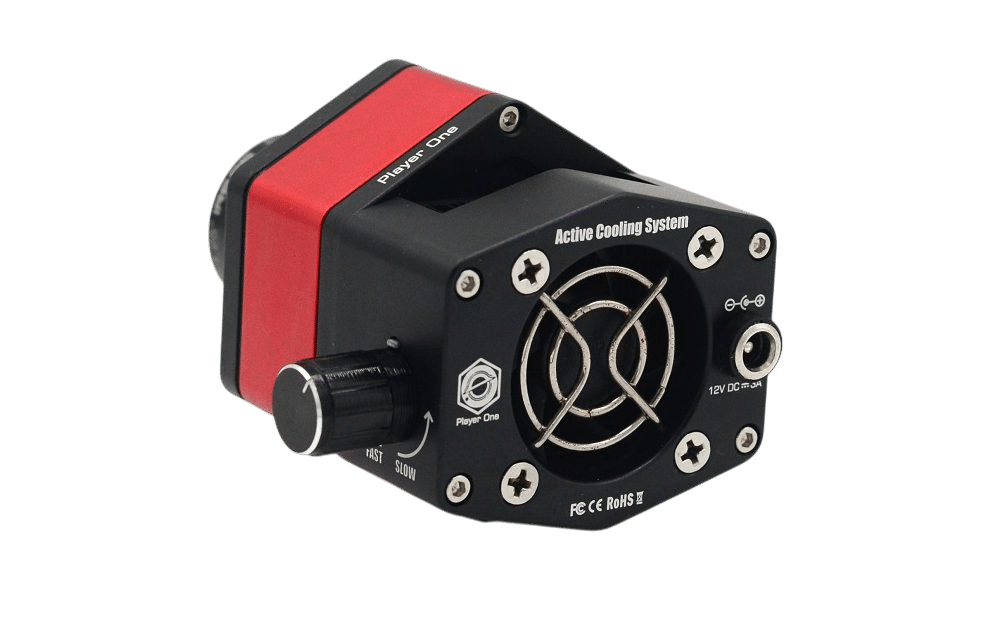
  • Intelligent thermal management The latest technology: body with passive dissipation (PCS) and the option of adding ACS (active air cooling) to stabilize temperature during long sessions.
  • Integrated safety overvoltage/overcurrent protection to protect the camera and the rest of the setup.

Usage scenarios (concrete)

  • Planetary/high-resolution Tight ROI on Jupiter/Saturn/Moon, frame rates >100 FPS at 2560×1440 and much higher at smaller ROI.
  • EAA live stacking of short exposures, clean background without amp-glow, fine stars thanks to 2.9 µm pixels.
  • Lucky imaging deep sky 1-10 s exposure bursts on globular clusters, bright NPs, compact galaxies.
  • Solar/Hα (with suitable filtration) High sensitivity for high flow rates and contrast of protuberances.

What this means for treatment

  • Less time spent correcting gradients and amp-glow artifacts; "cleaner" stacks right out of pre-processing.
  • More latitude to push the stretch thanks to a high load well and very low reading noise (down to ~0.7 e-).
  • The tilt plate reduces perceived field curvature: stars are better held in corners with fast optics.

Recommended accessories (in my experience)

  • ACS - Active Cooling System air-cooling module to be added to the PCS to stabilize temperature (useful for solar, EAA or deep-sky lucky imaging).
  • 1.25″ / 31 mm Filters (Unmounted) 2.9 µm fine sampling enhances the value of high-quality narrow SHO/LRGB filters.
  • Compact filter wheel/drawer rapid L/Ha/OIII/SII shift to planetary HR lunar and NP.
  • Fast SSD for high-speed RAW recording.

Software & driver compatibility

Drivers and software are supplied by Player One; the camera works with popular capture suites via dedicated drivers (see "Drivers & Software" page). Always install the latest versions before using the camera for the first time.

Start-up tips

  • Activate HCG mode (~gain 210) to minimize playback noise while maintaining usable dynamics.
  • Use ROIs adapted to the apparent size of the target: smaller = faster = more "clean" images to sort.
  • On tripod/light mount, keep the optical train compact: 1.25″ nosepiece, short filter drawer and thin rings to stay close to 12.5 mm backfocus.
  • In EAA, avoid saturation: wells of 47 ke- = margin, but keep a balanced histogram for colours/contrast specific to the live stack.

What's delivered (typical)

  • Uranus-M (IMX585) mono camera
  • USB 3.0 cable
  • Standard plugs & adapters (1.25″ / T2)
  • Documentation (driver & manual links)

In a nutshell

If you're looking for a modern, fast, sensitive, amp-glow-free mono, the Uranus-M ticks all the boxes. It simplifies processing, delivers impressive frame rates and offers rare flexibility: pure planetary, comfortable EAA and lucky deep-sky imaging... all with the same camera. It's exactly the kind of product I like to offer: high-performance, consistent and designed for real nights.

Back to the sections
Frequently asked questions

Frequently asked questions

What is the Player One Uranus-M designed for?

The Player One Uranus-M is designed for planetary, lunar, and solar imaging (the Sun only with a suitable filter) using «lucky imaging»: you record for a few minutes at up to 47 frames per second, then stack the best images. With 2.9 µm pixels, aim for an F/D ratio of approximately f/9 to f/15 for planetary imaging, using a Barlow lens if necessary. It is also suitable for assisted observation (EAA): short exposures stacked in real time on bright deep-sky objects.

What makes the Player One Uranus-M's sensor stand out?

The Sony IMX585 (STARVIS 2 technology) combines very low readout noise (0.7 e⁻), high well capacity for 2.9 µm pixels (47 ke⁻), and high sensitivity in the near-infrared. With no amp glow and a fast frame rate (47 frames/s), it is a highly versatile sensor, suitable for everything from planetary to deep-sky imaging, offering excellent value for the price.

Does the Player One Uranus-M require a power supply?

No: It is powered by its USB cable. No external power source is required.

What backfocus setting should be used with the Player One Uranus-M?

The camera's back focus is 12.5 mm. Mount: 1.25"; M42 × 0.75.

Color or monochrome: Which version of the Player One Uranus-M should you choose?

The monochrome version is more sensitive and produces better results in narrowband, but it requires a filter wheel. The color version, the Player One Uranus-C, produces a color image in a single exposure.

Where can I find more information about the Player One Uranus-M?

The manufacturer's data sheet (in English) is available here: Player One Uranus-M Spec Sheet.

Technical specifications

Technical specifications

Technical specifications

Sensor
Sony IMX585
Color / black-and-white
Monochrome
Sensor Size
1/1.2″
Sensor Dimensions
11.2 × 6.3 mm
Sensor diagonal
12.85 mm
Resolution
8.3 megapixels
Resolution in pixels
3856 × 2180
Pixel size
2.90 µm
Shutter
Roll-up
ADC Converter
12 bits
Playback noise
0.7 e⁻
Well Capacity
47 ke⁻
Maximum quantum efficiency
91 %
Cooling
No
Buffer memory
256 MB DDR3
Interface
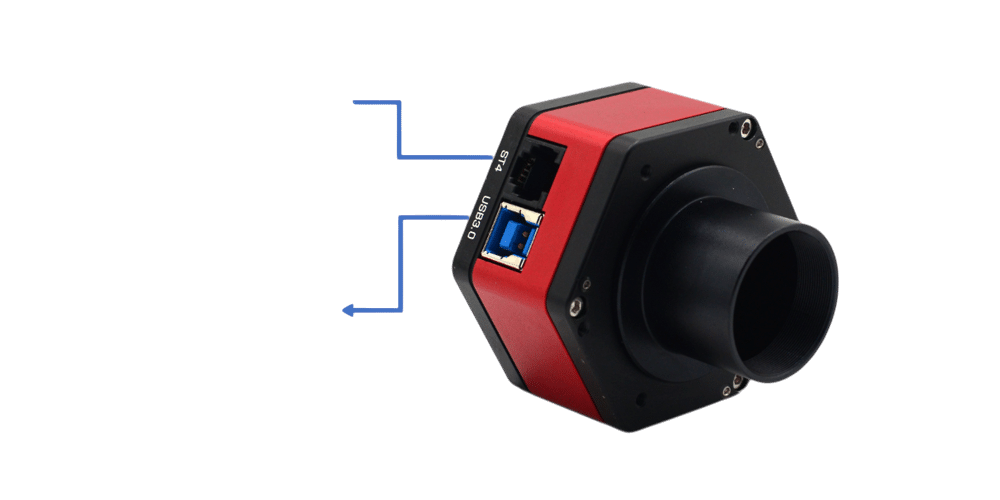
USB 3.0 / USB 2.0
ST4 Port (autoguiding)
Yes
Speed
47 frames per second
Backfocus
12.5 mm
Threads / Connections
1.25"; M42 × 0.75
Protective window
Anti-reflective (AR Plus), Ø 32 × 2 mm
Case diameter
66 mm
Camera weight
160 g
Power supply
Powered by the USB cable
Camera Uses
Planetary, Deep Sky, Solar, Lunar
Documentation

Products in the same category

[category_menu_mobile]