ZWO ASI220MM Mini: Find a guide star, then track it
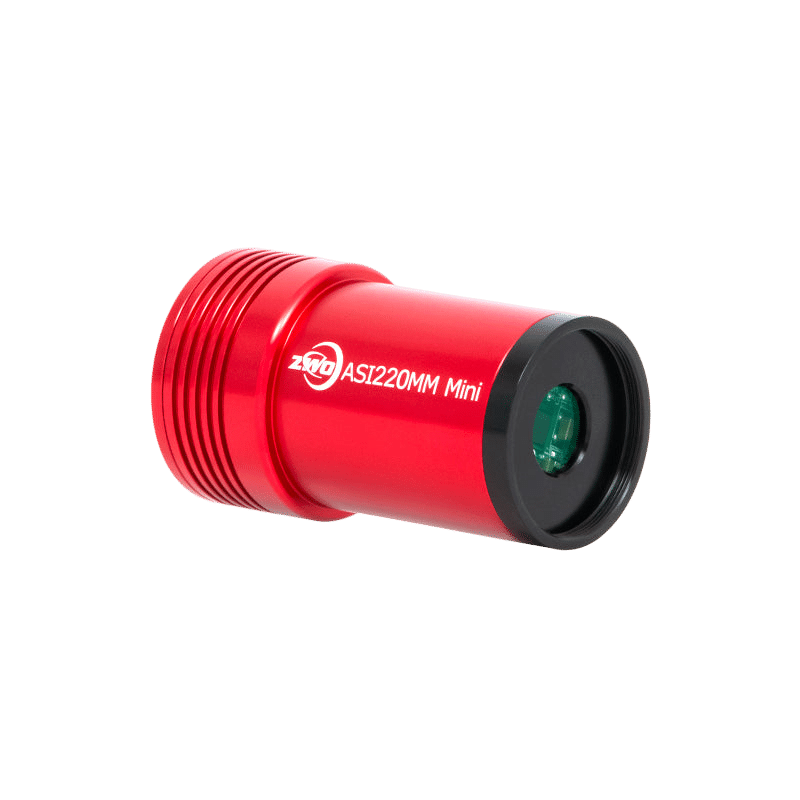
The ASI220MM Mini is primarily a monochrome autoguiding camera. Its 1920 × 1080-pixel SC2210 sensor measures 7.68 × 4.32 mm, with 4 µm photosites. The choice is therefore not based on producing large final images, but on the ability to find and measure a guide star within the field of view of the guiding system. Its 1.25-inch body and stated weight of 60 g make it suitable for installations where space and the load on the eyepiece holder are important considerations.
A wider field of view than that of the ASI290MM Mini
ZWO presents the ASI220MM Mini as an evolution of the ASI290MM Mini: the sensor area has increased from 5.6 × 3.2 mm to 7.68 × 4.32 mm, the pixels are larger, and sensitivity in the near-infrared has been improved. Using the same guide scope, this larger sensor area covers a wider portion of the sky and can make it easier to locate a star. However, it does not guarantee a usable star in all directions or with every optical splitter.
The manufacturer specifies a maximum quantum efficiency of 92 % and a readout noise of 0.6 to 3.2 electrons, depending on the settings. These characteristics are useful when the available signal is weak. As a general guideline, look for a star that can be measured without saturation: systematically increasing the gain or excessively shortening the exposure times can degrade the stability of the measurement rather than improve tracking.
Sighting scope or optical divider?
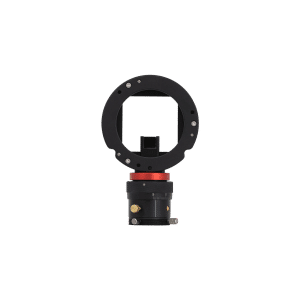
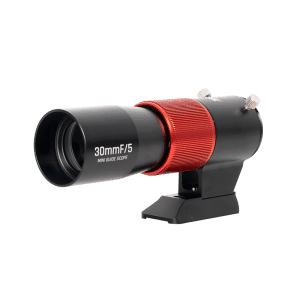
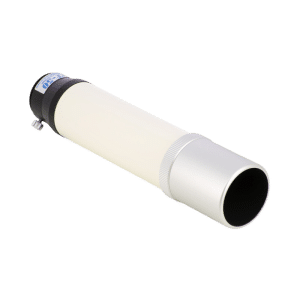
When using a separate guide scope, ensure that the mounts are secure and avoid letting the cables pull on the camera. Even if tracking appears to be correct, this does not necessarily reveal any flexing between the main instrument and the guide scope. With an optical splitter, on the other hand, the camera captures a portion of the beam from the same instrument; check the size of the prism, the actual illuminated field, and whether both cameras can be focused simultaneously.
The focus travel specifications provided by ZWO are 8.5 or 12.5 mm, depending on the mechanical configuration. Do not confuse these with the focus travel required by a photographic corrector; you must examine the entire assembly. The listed adapter combines the 1.25-inch format with an M28.5 × 0.6 thread. The diameter alone is not sufficient to confirm the focus travel or the compatibility of each accessory.
A connection designed for guidance
The USB Type-C connector operates here in USB 2.0 mode: its shape does not indicate USB 3.0. At full resolution, ZWO specifies 14 frames per second in RAW8 and 7 in RAW16. This distinction matters more than a single frame rate displayed without context. The converter remains 12-bit; RAW16 refers to the output format, not a 16-bit sensor. For high-frame-rate, wide-field planetary video, you’re better off comparing it to a camera specifically designed for high-speed capture.
Documentation: ZWO official data sheet.