CHF 467.10incl. Swiss VAT
Part Number ZWO-A140045
Will be ordered for you
Timeframe: 10 days to 3 weeks
Estimated shipping: Between November 22 and 27, 2026







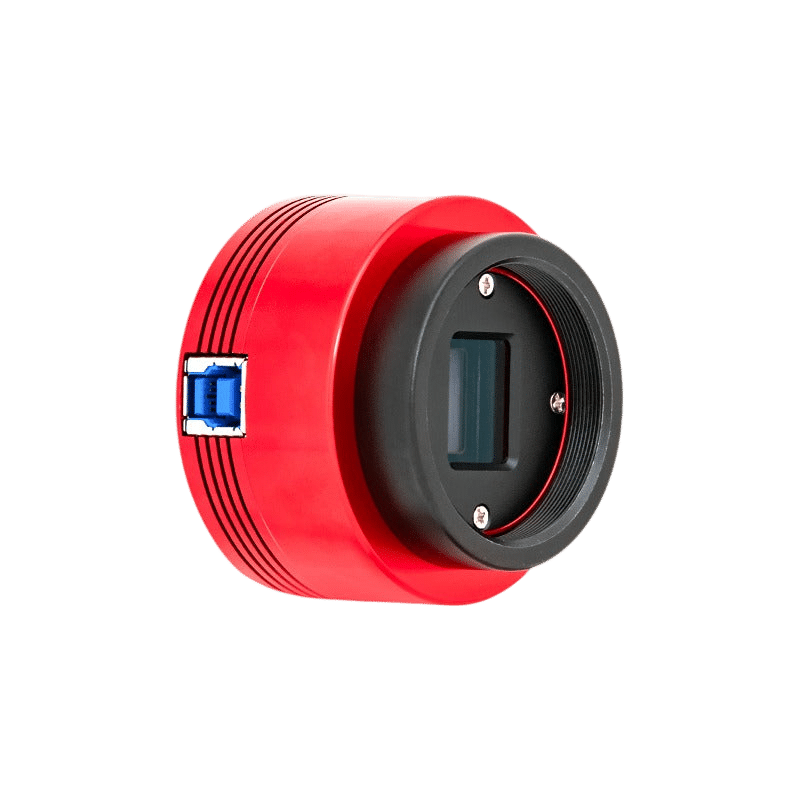
The ASI432MM prioritizes sensor area and speed over megapixel count. Its Sony IMX432 monochrome sensor combines 9 µm pixels with a 14.5 × 9.95 mm sensor area. This combination is particularly noteworthy for high-magnification solar and lunar imaging: it allows you to maintain a relatively wide field of view while using large photosites. However, its resolution of 1608 × 1104 pixels remains a key factor to consider if you plan on extensive cropping or large prints.
The global shutter exposes all pixels simultaneously, unlike line-by-line progressive scan. ZWO is therefore marketing this camera for imaging the Sun, the Moon, and fast-moving objects, including the ISS. The advertised frame rate reaches 120 frames per second at full resolution in 12-bit ADC mode. To achieve this, the exposure time must remain sufficiently short, and the entire USB 3.0 system—including the computer and storage—must keep up; this figure does not represent a guaranteed frame rate in every configuration.
The advertised charge capacity of 97,000 electrons provides a useful margin before saturation. However, this does not eliminate the need to monitor the histogram: bright regions of the solar disk may lose detail even if the prominences remain relatively dim. First, reduce the exposure or gain when the highlights are clipped, then adjust the processing to bring out the desired features.
At the same focal length, these large pixels provide less-detailed sampling than small pixels. Therefore, they do not, by themselves, promise higher resolution: the telescope’s diameter, atmospheric turbulence, and effective focal length remain the determining factors. An amplifying mount may be useful for capturing fine details, but it reduces the field of view and makes tracking more challenging. When observing the entire disk, check the framing using the final focal length rather than relying solely on the nominal 1.1-inch aperture.
The monochrome sensor is suitable for recording a selected spectral band without a color matrix. A solar image displayed in orange can be colorized during processing; the camera does not directly produce this color. Color planetary images, on the other hand, require acquisitions through appropriate filters followed by recombination.
The camera does not protect either the lens or the sensor from sunlight. Before aligning your telescope, install a complete, undamaged, and securely mounted solar filter system specifically designed for your instrument, in accordance with the manufacturer’s instructions. A solar H-alpha system requires all of its safety components; a deep-sky H-alpha filter or a simple UV/IR filter is not a substitute. Also secure the finder scope. If you have any doubts about the setup, do not point the telescope at the Sun.
Documentation: ZWO official data sheet.
The ZWO ASI432MM is primarily intended for imaging the Sun (with a filter or a suitable solar instrument, such as an Hα filter) and the Moon, followed by the planets. The entire disk of the Sun or Moon fits within the shorter side of the sensor up to a focal length of approximately 1050 mm; beyond that, mosaics are required.
The Sony IMX432 has the largest pixels in our lineup: 9 µm, with a well capacity of 97 ke⁻ and a global shutter capable of 120 frames per second. It can be used with long focal lengths without a Barlow lens, making it ideal for Hα solar imaging.
No: It is powered by its USB cable. No external power source is required.
The camera's back focus is 6.5 mm or 17.5 mm, depending on the adapter. Mounts: 2″ and M42 × 0.75.
The manufacturer's manual (in English) is available here: ZWO ASI432MM Manual (PDF).