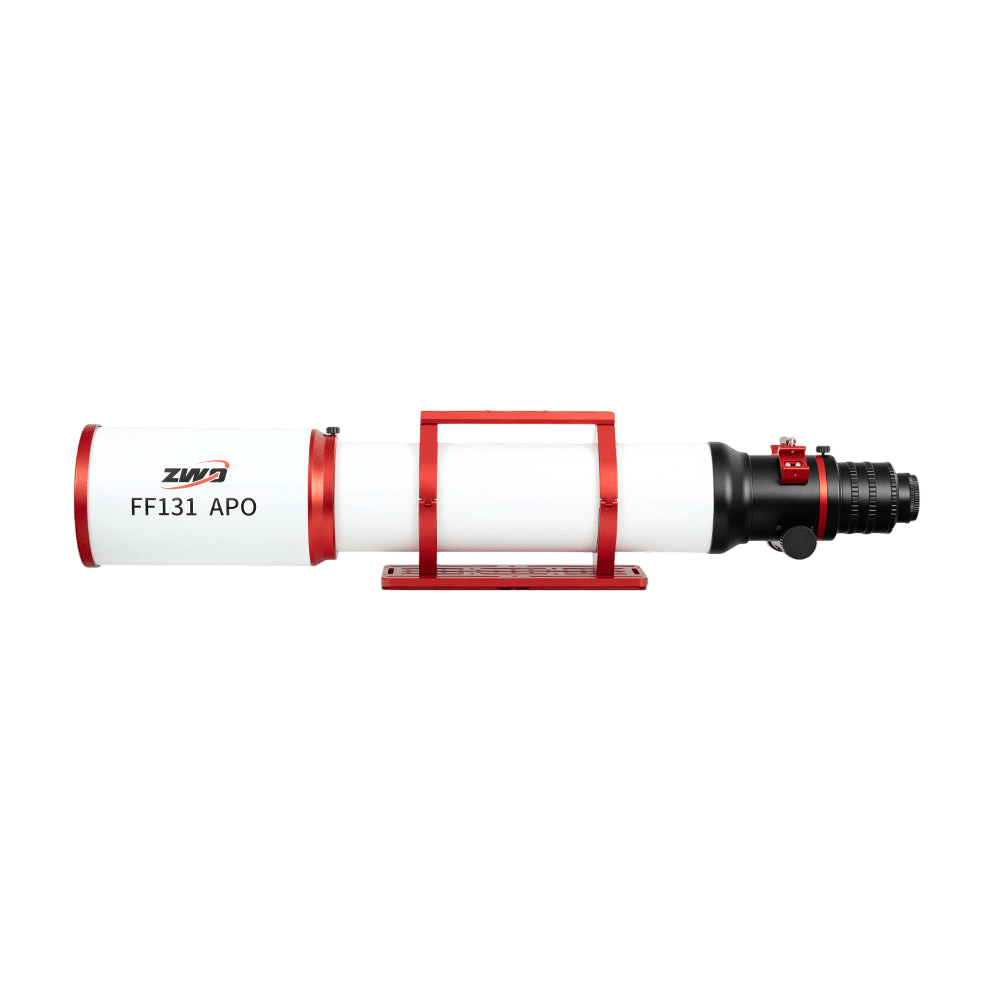
131-mm, four-element apochromatic telescope with a focal length of 983 mm and a native flattened field, designed for astrophotography.
CHF 1'529.10incl. Swiss VAT
Part Number ZWO-A195518
Will be ordered for you
Timeframe: 10 days to 3 weeks
Estimated shipping: Between November 22 and 27, 2026







131-mm, four-element apochromatic telescope with a focal length of 983 mm and a native flattened field, designed for astrophotography.
The corrector is part of the optical design: an additional flattener is not required in the native configuration provided by ZWO. The 44-mm image circle is specifically designed for full-frame sensors. The choice of camera depends on the focal length, pixel size, and intended targets. The retractable dew shield facilitates transport; the detachable clamps allow for mounting on a compatible dovetail. The eyepiece holder features a geared focus mechanism and rear rotation to adjust the framing. Adjust the focus using the actual imaging setup, including filters. Ensure the mechanical range of the mount is observed and check the cable routing throughout the mount’s full range of motion. This product corresponds to the FF131 APO optical tube; mount bundles are sold separately.
Documentation and Compatibility: ZWO official data sheet.
The ZWO FF131 APO is a flat-field ED quadruplet refractor with a 131 mm aperture and a focal length of 983 mm (f/7.5), designed primarily for deep-sky astrophotography. Its focal length is ideal for observing galaxies (M51, M101, the Leo Triplet), planetary nebulae such as M27, and globular clusters, with a good level of detail. At f/7.5, its classic focal ratio requires slightly longer exposures, but in exchange delivers very fine star points.
With an APS-C camera featuring 3.76 µm pixels (Sony IMX571 sensor), you get approximately 0.79″ per pixel for a field of view of 1.4° × 0.9°. This is a fine resolution: under moderate turbulence, 2×2 pixel binning or a reducer will produce rounder stars. With the 0.74× reducer, the resolution increases to 1.07″ per pixel and a field of view of 1.9° × 1.2°. The 44 mm image circle covers full-frame sensors (24 × 36 mm): a full-frame mirrorless camera also works.
No. Its optical design (flat-field ED quadruplet) inherently produces a flat field, with sharp stars all the way to the corners, without the need for an external field flattener. To increase the field of view and brightness, the dedicated reducer (Askar 131F 0.74× Reducer Corrector) the aperture to 727 mm at f/5.5.
42 to 73 mm. This depth is measured from the thread to the sensor, including the rings, filter wheel, and filter drawer: adhering to this measurement down to the millimeter ensures that the stars remain round in the corners.
The tube weighs about 7.9 kg; with the camera, filter wheel, and guide scope, expect a total weight of around 9.4 kg: aim for an EQ6-R Pro-class mount. A refractor requires no collimation: once balanced, it’s ready to use as soon as it reaches operating temperature.
Yes, as a bonus: with an angled mirror and an eyepiece, it provides high-contrast images without false colors of the Moon, the planets, and double stars.