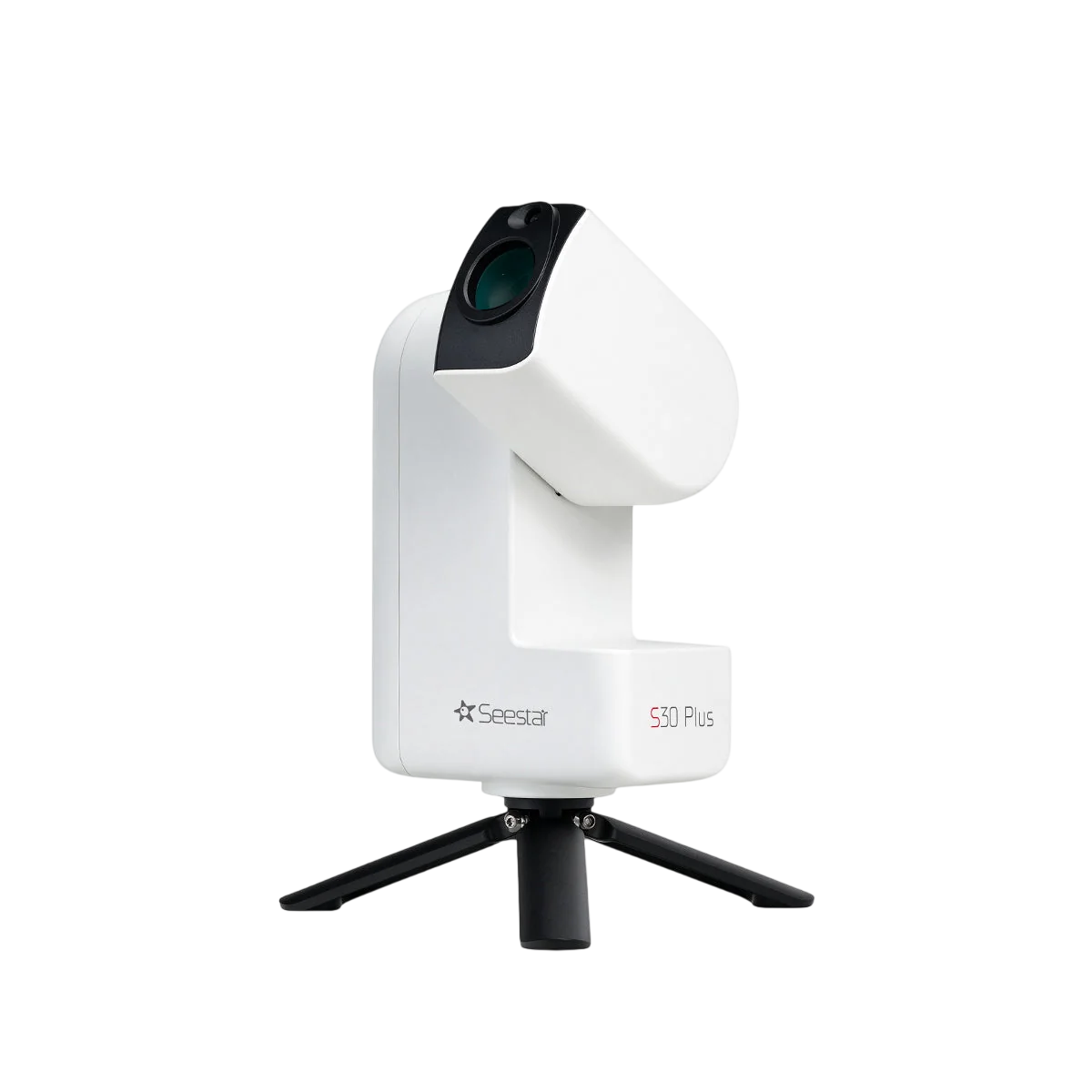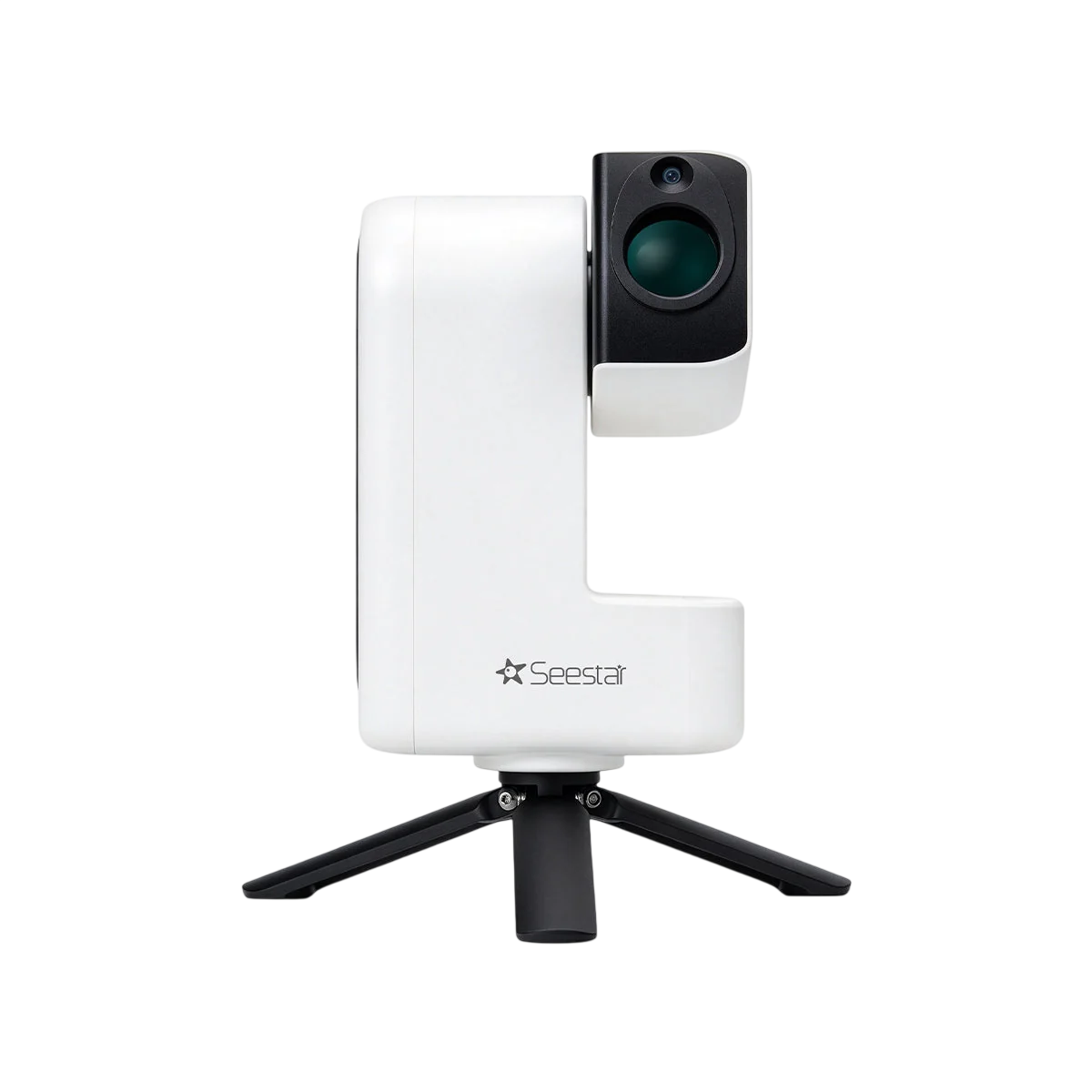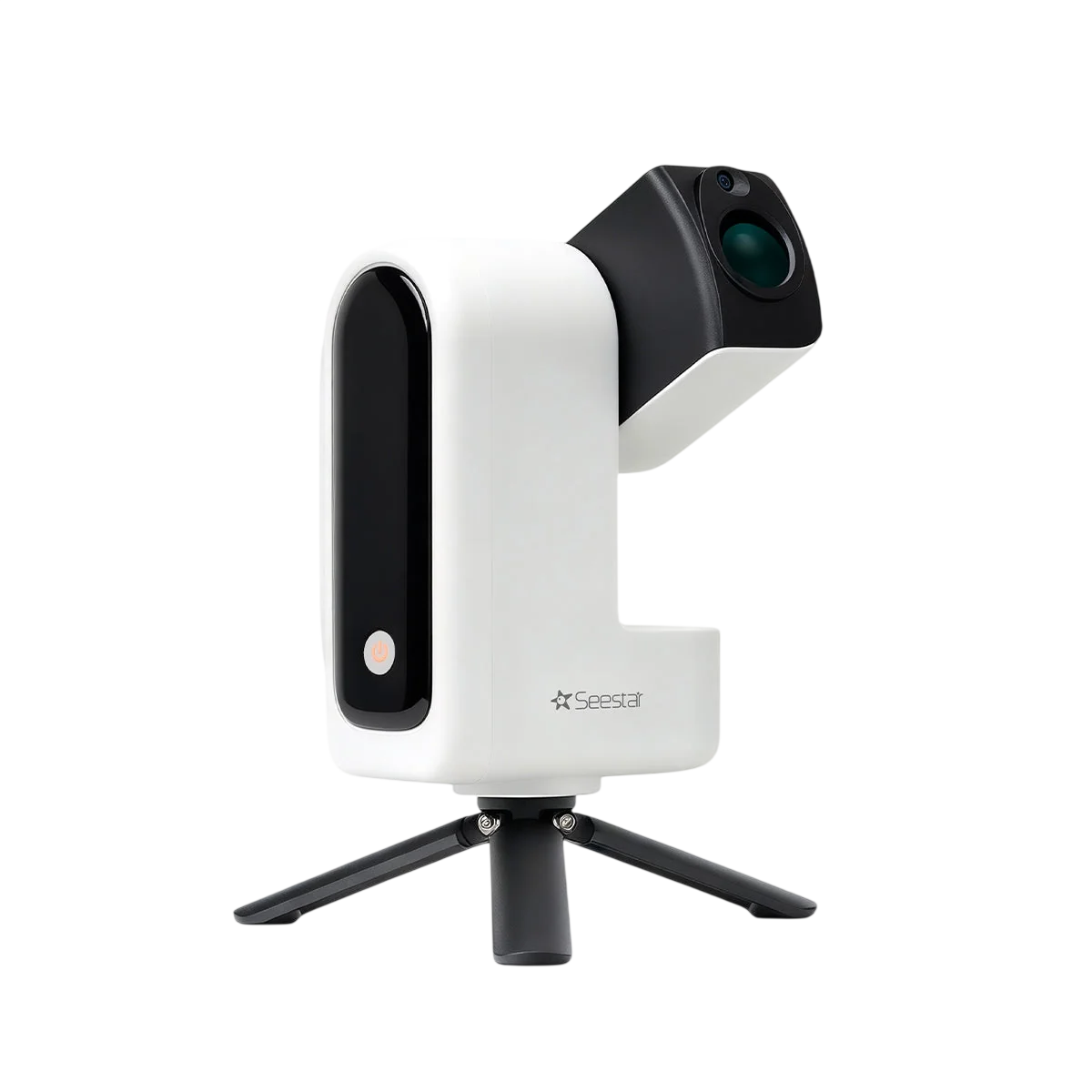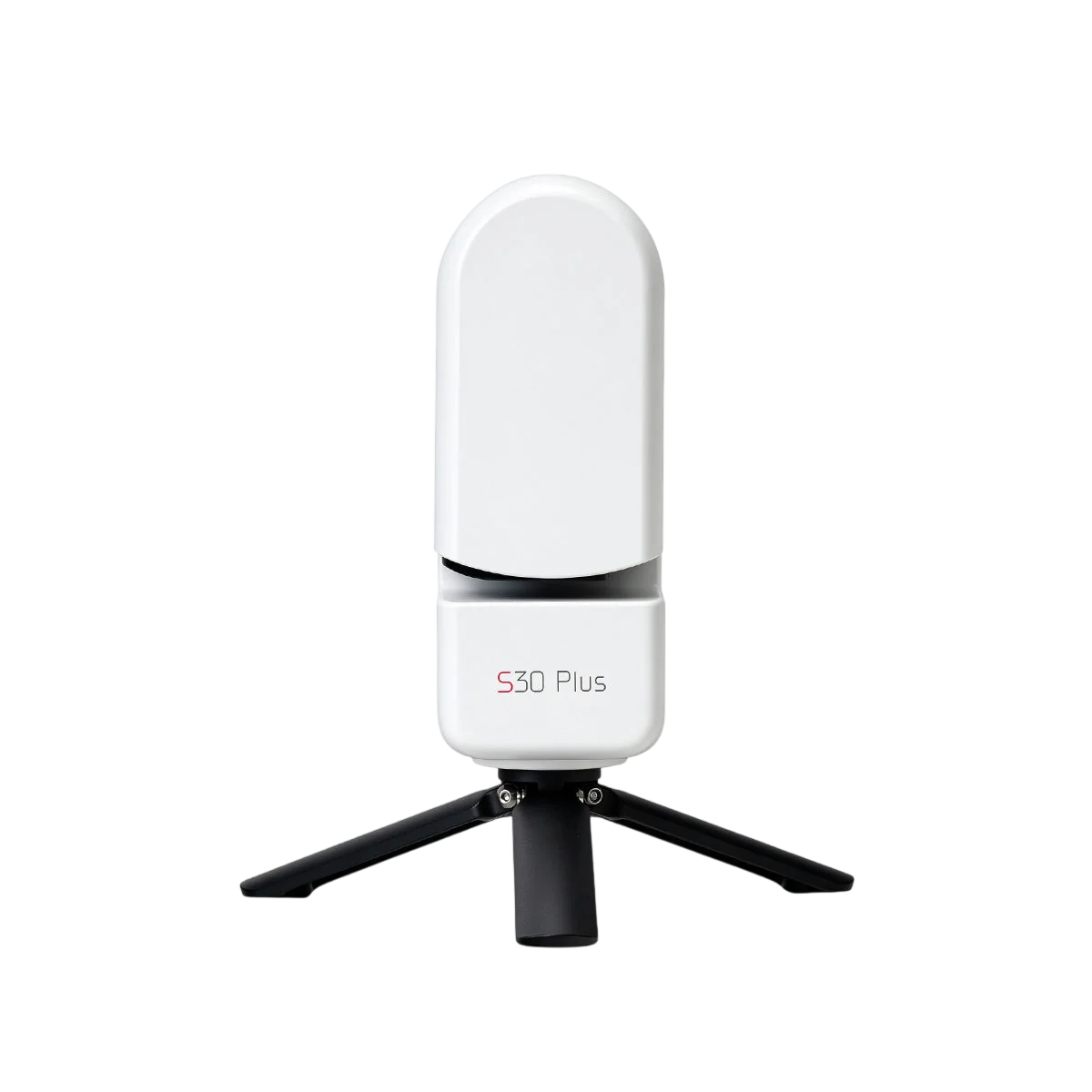
The Seestar S30 Plus is an all-in-one smart telescope with two 2K cameras: a 30 mm telephoto camera for deep-sky imaging and a 43.5° wide-angle camera for the Milky Way and star trails, all controlled via the Seestar app.
CHF 428.00incl. Swiss VAT
Reference A201902






The Seestar S30 Plus is an all-in-one smart telescope designed for photographing the sky without having to assemble a separate mount, camera, and tube. The optics, two sensors, motorized mount, filters, and battery all fit into a 1.65 kg unit, not including the tripod. You place it on the included tripod, turn it on, and then control the session using the Seestar app on a smartphone or tablet. Observation takes place on the screen, not through the eyepiece.
The telephoto camera, featuring a 30-mm, f/5.3, four-element apochromatic lens, is used for nebulae, clusters, galaxies, the Moon, and the Sun. The wide-angle camera, with a 43.5° field of view, is used for the Milky Way, star trails, and nightscapes. In both cases, images are captured at 1440 × 2560 pixels (2K) in portrait orientation.
The telephoto lens features a four-element apochromatic optical system, a 30-mm aperture, and a focal length of 160 mm, resulting in an aperture ratio of f/5.3. The lens is folded inside the body, which allows for this focal length. The sensor is a 1/1.8-inch SC485SL CMOS sensor with a resolution of 1440 × 2560 pixels in portrait orientation, for a total of approximately 3.68 million pixels. The field of view is 3°, corresponding to a full-frame equivalent focal length of 815 mm. The focus range extends from 6 m to infinity.
It is used for nebulae, star clusters, and galaxies, as well as for the Moon and the Sun, with the included solar filter. The app can automatically stitch together overlapping images taken with the telephoto lens to widen the field of view. However, according to the manufacturer, the S30 Plus does not support stitching wide-angle mosaics, panoramas, or Milky Way arcs.
The second camera has a focal length of 6 mm, an aperture of 3.4 mm, and an f/1.75 aperture ratio. It uses a 1/2-inch IMX586 CMOS sensor. The image is cropped to 1440 × 2560 pixels in portrait orientation, providing a 43.5° field of view, which is equivalent to a 55 mm full-frame focal length. The focus range extends from 0.1 m to infinity, which also allows for close-up shots in landscape mode.
This camera is designed for the Milky Way, star trails, and time-lapse videos. The two cameras cannot be used at the same time: you must choose one or the other. The Milky Way can be photographed in a sufficiently dark sky. In areas with heavy light pollution, the signal may be limited, as the manufacturer notes.
Three filters are built-in and can be activated from the app. A UV/IR-Cut filter is available on both cameras. The telephoto lens also features a Duo-Band filter, with 30 nm passbands for OIII and 20 nm for Hα, as well as a Dark filter for calibration shots. The Duo-Band filter isolates the emission lines of nebulae and attenuates some of the artificial light, which helps when photographing emission nebulae from an urban environment or a balcony.
For white-light solar imaging, a magnetic-mount solar filter is included. It must be installed according to the manufacturer’s instructions before pointing the camera at the Sun. Pointing the camera at the Sun without this filter may cause permanent damage to the device.
The azimuth mount aligns itself when powered on, then automatically returns to its initial position. You select a target from the app—choosing from more than 80,000 objects—and the telescope points at it, tracks it, and stacks the exposures. Tracking speeds range from 1× to 1,440×. An active anti-fog heater limits condensation on the optics when the temperature drops.
There are four modes available: «Stargazing» for deep-sky objects, «Milky Way» for the Milky Way and star trails, «Solar System» for the Sun, Moon, and planets, and «Scenery» for landscapes and terrestrial subjects. A scheduling mode sequences multiple targets throughout the night. The app also allows you to control a device installed at a remote location. According to the manufacturer, this remote control feature is available as a limited free trial during a beta phase.
For nighttime landscapes, the app can detect the foreground and process it separately from the sky. You can then adjust how long the foreground remains frozen. This way, the stars stay sharp during tracking, while the foreground landscape remains sharp and natural. Constellation recognition displays the constellation lines and names. You can then initiate automatic tracking from this map. Star trails can be automatically converted into a video.
An equatorial mode is also available. To use this mode, you must point the camera toward the celestial pole using a compatible tilting ball head, sold separately—for example, the TH10 head, either on its own or with the TC20 tripod. According to the manufacturer, 60-second single exposures are limited to equatorial mode, once the alignment is sufficiently precise. They are not available in azimuth mode.
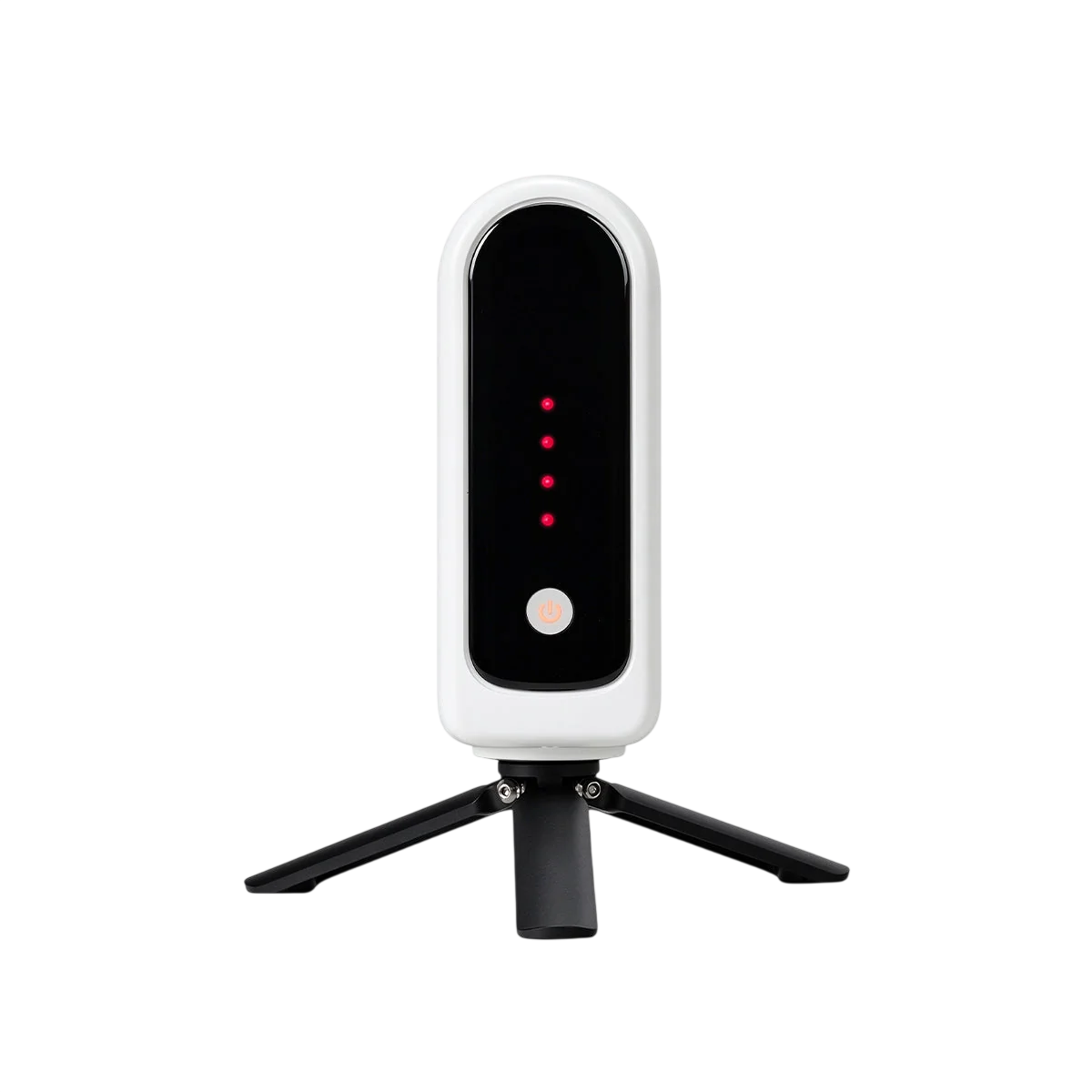
The device connects to a phone or tablet via 2.4 or 5 GHz Wi-Fi—up to 10 meters under the manufacturer’s test conditions—or via Bluetooth, up to 5 meters. On a compatible phone, an NFC connection is established by bringing the device close to the phone. A USB-C port is used for data transfer and charging (5 V, 3 A). A button allows you to reset the Wi-Fi.
The built-in 6,000 mAh battery provides up to 6 hours of battery life according to the manufacturer’s lab tests, at room temperature, in viewing mode. Actual battery life varies depending on temperature, active features, and usage conditions. Internal storage is 64 GB, of which approximately 45 GB is available for images and videos, with the remainder occupied by the system. Updates may affect this available space. Photos are saved in JPEG and FITS formats, and videos in MP4 or AVI. The app also allows you to enhance images with a single tap or manually adjust noise reduction, star size, brightness, contrast, saturation, cropping, and flipping.
The device measures 210 × 140 × 80 mm when closed and weighs 1.65 kg without the tripod. The base has a 3/8″-16 thread, compatible with the included tripod or any other photographic or astronomical tripod with the same thread pitch. The specified operating range is −10 °C to 40 °C, with a relative humidity of 20 to 80 %. Charging must be performed between 0 °C and 40 °C.
Compared to the Seestar S30, the S30 Plus features a four-element apochromatic lens, a 160 mm telephoto focal length (compared to 150 mm), larger sensors, and 2K resolution. It also adds wide-angle photography of the Milky Way, star trails, and meteors, as well as NFC connectivity.
The Seestar S30 Pro Goes even further: an 8.3-megapixel 1/1.2-inch telephoto sensor, a 63° wide-angle field of view, 4K output, wide-angle mosaic, Milky Way arc capture, and simultaneous shooting with both cameras. Both models share the same four-element optical design. The S30 Plus is the entry-level model of this generation. It already allows users to photograph deep-sky objects and wide-field scenes in a simpler, more accessible camera. The Seestar S50 Pro has a 50 mm opening.
| Features | Value |
|---|---|
| Model | Seestar S30 Plus |
| Type | All-in-One Smart Telescope with Dual Cameras |
| Telephoto Sensor | CMOS SC485SL, 1/1.8-inch, 1440 × 2560, portrait orientation |
| Wide-angle sensor | CMOS IMX586, 1/2 inch, 1440 × 2560 after cropping, portrait orientation |
| Field of view | 3° telephoto, 43.5° wide-angle (after sensor cropping) |
| Aperture | 30 mm telephoto lens, 3.4 mm wide-angle lens |
| Focal length | 160 mm telephoto lens, f/5.3; 6 mm wide-angle lens, f/1.75 |
| Full-frame equivalent focal length | 815 mm telephoto lens, 55 mm wide-angle lens |
| Telephoto lens | Four-element apochromatic lens |
| Focusing | Telephoto: 6 m to infinity; wide-angle: 0.1 m to infinity |
| Integrated filters | UV/IR-Cut (both cameras). Duo-Band OIII 30 nm / Hα 20 nm and Dark (telephoto only) |
| External filter | Magnetic sun filter (included) |
| Photo/Video Formats | JPEG, FITS / MP4, AVI |
| Mount | Azimuth, with equatorial mode available |
| Travel speeds | 1× to 1,440× |
| Automatic return to the starting position | Yes |
| Basic Threading | 3/8″-16 |
| Storage | 64 GB (approximately 45 GB usable) |
| Battery | 6,000 mAh, up to 6 hours (manufacturer's lab tests) |
| Power supply | USB-C, 5 V at 3 A |
| Connections | 2.4/5 GHz Wi-Fi, Bluetooth, NFC, USB-C |
| Wi-Fi / Bluetooth Range | Up to 10 m / up to 5 m (manufacturer's test conditions) |
| Operating temperature | −10 °C to 40 °C |
| Charging temperature | 0 °C to 40 °C |
| Operating Humidity | 20 to 80 % |
| Dimensions (closed) | 210 × 140 × 80 mm |
| Weight | 1.65 kg (without the tripod) |
Specifications and contents as provided by the manufacturer, Seestar (ZWO).
Both models share the same four-element optical design, a 30 mm aperture, and a 160 mm focal length. The S30 Plus records at 1440 × 2560 pixels (2K), with a 1/1.8-inch SC485SL telephoto sensor and a 43.5° wide-angle camera. The S30 Pro steps up to 8.3 MP and 4K, with a 1/1.2-inch telephoto sensor, a 63° wide-angle field of view, wide-angle mosaic, Milky Way arch capture, and simultaneous shooting with both cameras. The S30 Plus is the entry-level model of this generation. The S30 Pro offers higher resolution and a wider field of view.
Yes, with the 43.5° wide-angle camera. The manufacturer notes that a sufficiently dark sky is required: under heavy light pollution, the Milky Way’s signal may be limited. The S30 Plus does not support wide-angle mosaic stitching, panoramas, or Milky Way arcs.
Yes. A magnetic solar filter is included and must be installed according to the manufacturer’s instructions before pointing the device at the Sun. Without this filter, the device may be permanently damaged.
Equatorial mode is available, but you’ll need a compatible tilting ball head—sold separately—to point the camera toward the celestial pole; for example, the TH10 head, either on its own or with the TC20 tripod. According to the manufacturer, 60-second single exposures are limited to this mode, provided the alignment is sufficiently precise. They are not available in azimuth mode.
No. According to the manufacturer, the S30 Plus does not allow you to use both cameras at the same time. You choose either the telephoto or the wide-angle lens, depending on the subject.
The 6,000 mAh battery provides up to 6 hours of battery life, according to the manufacturer's lab tests. Actual battery life depends on temperature, active features, and usage conditions. The internal storage capacity is 64 GB, of which approximately 45 GB is available for user files, with the remainder reserved for the system. Updates may affect this available space.
The Seestar S30 Plus telescope, a magnetic solar filter, an aluminum alloy tripod, a protective case with a shoulder strap, a USB-C cable, the quick start guide, safety instructions, and a sheet of astronomy-themed stickers.