More products from the brand :Player One

Neptune 664C - Planetary camera

CHF 272.64incl. Swiss VAT

Reference CAM-0050

In stock
Estimated shipping time: 24 to 48 hours

Free shipping in Switzerland on orders of 200 CHF or more
14 days to request a return
Credit Card · TWINT · PayPal · Invoice · Klarna
Free pickup in Nyon · credit card or cash
Product description

Product description

Neptune 664C: Third-Generation Planetary Color Camera, the successor to the excellent IMX 464

Visit Neptune 664Cdeveloped by Player One Astronomyis a third-generation color camera specially designed for planetary, lunar and solar imaging. Equipped with the Sony IMX664 CMOS sensor, it combines advanced technologies such as STARVIS 2 and a Super AR Plus window, offering outstanding performance in the ultraviolet and near-infrared.

Main technical specifications

  • Sony IMX664 CMOS sensor : 1/1.8" format (7.9 mm x 4.5 mm) with 4.2 megapixel resolution (2704 x 1540 pixels) and 6.46 mm diagonal. Pixel size of 2.9 µm for excellent sensitivity and precise detail reproduction.
  • Full Well depth : Maximum capacity of 38.5 ke, allowing high-dynamic images to be captured without saturation.
  • High cadence : Up to 93 FPS in RAW10 mode at full resolution and up to 136 FPS in RAW8 mode, ideal for freezing atmospheric turbulence during planetary captures.
  • STARVIS 2 technology : Backlit architecture maximizes light sensitivity while reducing noise, improving performance in low-light conditions.

Imaging performance

  • Super AR Plus window: This multi-layer anti-reflective window offers very high light transmission (310 nm to 1100 nm), improving performance in the ultraviolet and near infrared (NIR).
  • Non-Amp-Glow: Free of amp-glow, ensuring a clean background even during extended exposures.
  • HCG (High Conversion Gain) mode : Automatically activated for ≥180% gain, reducing playback noise while maintaining high dynamic range.

Technological advances

  • Ultra-low playback noise : From just 6.1 e- to 0.67 e-, depending on the gain used.
  • Quantum Efficiency (QE): A quantum efficiency peak of around 91 %, ensuring optimum capture of incident light.
  • Integrated DDR3 cache (256 MB) : Stabilizes data transmission and reduces image loss, even with a USB 2.0 port.
  • DPS (Dead Pixel Suppression) technology : Automatically corrects defective pixels to ensure sharp, clean images.

Ergonomic design

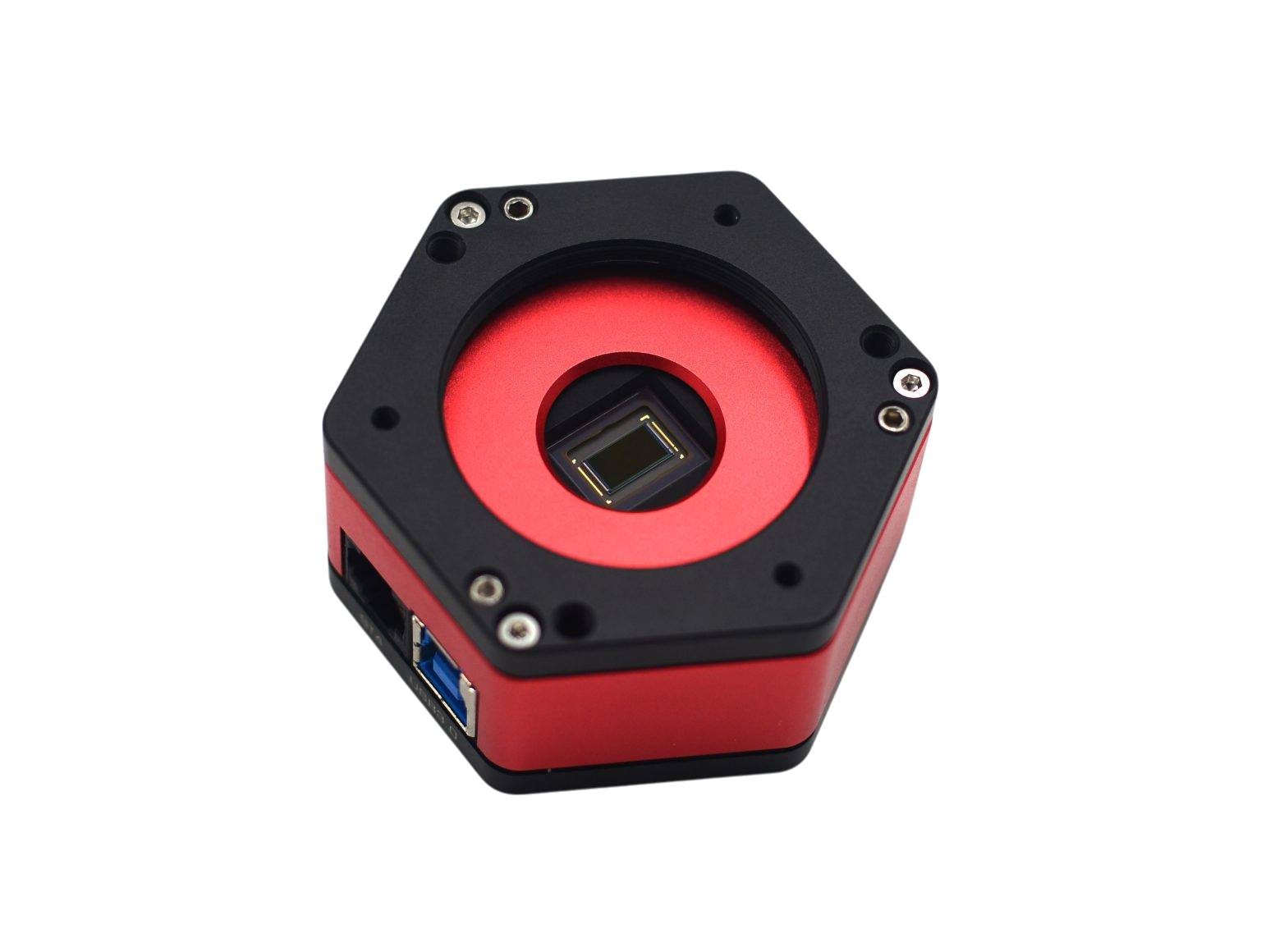
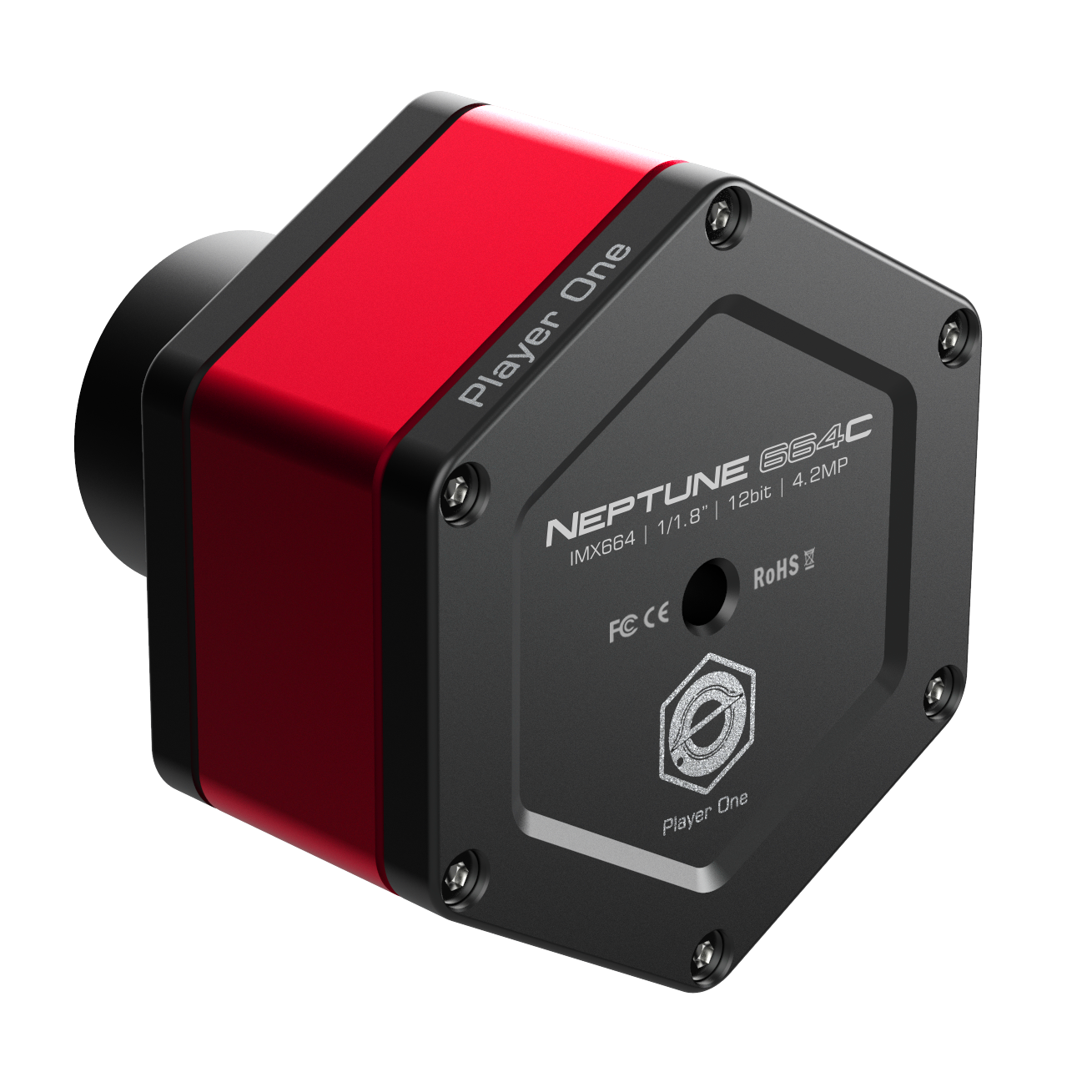
Player One's iconic hexagonal design combines aesthetics and functionality. The bright red and black finish reflects its planetary orientation while offering excellent heat dissipation. Compact and lightweight (180 g), it integrates easily into any configuration thanks to its standard T2 thread.

Applications

Visit Neptune 664C is ideal for :

  • High-resolution planetary imaging (Jupiter, Saturn, Mars)
  • Solar observation using H-alpha filters or white light
  • Lunar imaging thanks to its high frame rate for capturing precise details

Additional highlights

  • Software compatibility : Compatible with software such as SharpCap Pro for precise control of parameters (gain, exposure).
  • Accessories Included : Supplied with all necessary accessories: USB3.0 cables, T2/1.25" adapters, protective cap.
  • Passive cooling system : Maintains stable performance even during prolonged observation.

Conclusion

With its advanced technical features and design optimized for fast, precise imaging, the Neptune 664C has established itself as an essential tool for astrophotographers wishing to explore the fascinating details of our solar system.

Back to the sections
Frequently asked questions

Frequently asked questions

What is the Player One Neptune 664C designed for?

The Player One Neptune 664C is designed for planetary, lunar, and solar imaging (the Sun only with a suitable filter) using «lucky imaging»: you record for a few minutes at up to 136 frames per second, then stack the best frames. With 2.9 µm pixels, aim for an F/D ratio of approximately f/9 to f/15 when imaging planets, using a Barlow lens if necessary.

What makes the Player One Neptune 664C's sensor stand out?

The Sony IMX664 (STARVIS 2) has extremely low readout noise: 0.67 e⁻. With 136 frames per second at 2704 × 1540 resolution, good sensitivity in the near-infrared, and no amp glow, it captures fine details even with very short exposure times.

Does the Player One Neptune 664C require a power supply?

No: It is powered by its USB cable. No external power source is required.

What backfocus should be used with the Player One Neptune 664C?

The camera's back focus is 12.5 mm. Mount: 1.25"; M42 × 0.75.

Do you need a filter to photograph planets with the Player One Neptune 664C?

Yes: its window is only anti-glare. Add a ZWO 1.25" UV/IR-cut filter for sharp images and accurate colors. For planets low on the horizon, a ZWO ADC Atmospheric Dispersion Corrector significantly improves sharpness.

Where can I find more information about the Player One Neptune 664C?

The manufacturer's data sheet (in English) is available here: Player One Neptune 664C Specifications.

Technical specifications

Technical specifications

Technical specifications

Sensor
Sony IMX664
Color / black-and-white
Color
Sensor Size
1/1.8″
Sensor Dimensions
7.8 × 4.5 mm
Sensor diagonal
9 mm
Resolution
4.2 megapixels
Resolution in pixels
2704 × 1540
Pixel size
2.90 µm
Shutter
Roll-up
ADC Converter
12 bits
Playback noise
0.67 e⁻
Well Capacity
38.5 ke⁻
Maximum quantum efficiency
91 %
Cooling
No
Buffer memory
256 MB DDR3
Interface
USB 3.0 / USB 2.0
ST4 Port (autoguiding)
Yes
Speed
136 frames per second
Backfocus
12.5 mm
Threads / Connections
1.25"; M42 × 0.75
Protective window
Anti-reflective (AR Plus), Ø 21 × 1.1 mm
Case diameter
66 mm
Camera weight
180 g
Power supply
Powered by the USB cable
Camera Uses
Planetary, Solar, Lunar
Documentation

Products in the same category

[category_menu_mobile]