Two bands for nebulae
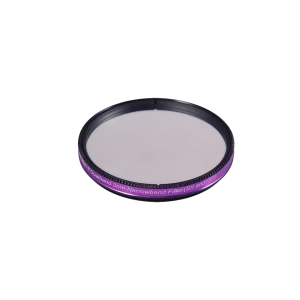
The Antlia ALP-T 5 nm H-alpha/OIII filter simultaneously selects the red H-alpha emission from hydrogen and the blue-green OIII emission from oxygen. It is primarily intended for color cameras used to photograph emission nebulae, whether they are SLR cameras or astronomical cameras with CMOS or CCD sensors. Both useful bands are recorded during the same exposure.
Version and Terms of Use
The standard version features a band centered at 656.3 nm for H-alpha and another at 500.7 nm for OIII. Each has a half-width at half-maximum of 5 nm. It differs from the Highspeed version, whose bands are shifted for fast-moving objects. Antlia recommends the standard model for focal ratios higher than f/3.6. The choice of version should therefore take into account the instrument being used, in addition to the filter’s mechanical format.
Reduction of Unwanted Light
The multilayer coating reduces the transmission of unwanted wavelengths associated with light pollution, moonlight, and sky glow. The stated blocking performance is at least OD4.5 over the 300–1100 nm range. The spectral profile, with a flat peak and steep edges, is designed to preserve the useful signal and limit internal reflections. The substrate is polished on both sides and then coated with optical layers using ion beam deposition.
Two mechanical options
The 2″ size comes in an M48 × 0.75 threaded mount. The second option is the 36 mm filter (unmounted) accompanied by a B-4836 adapter. The manufacturer’s size and price chart specifies that a B-4836 adapter is included with this 36 mm offering, for both the standard and Highspeed versions. This adapter allows the unmounted disc to be fitted into a 2″ filter slot. The glass has a thickness of 2 mm ± 0.05 mm in both sizes.
Images Only
Although this series is primarily designed for color cameras, Antlia also mentions its use with monochrome cameras to record both bands simultaneously. The filter is intended for photographing nebulae and is not a substitute for solar safety equipment. The manufacturer advises against nighttime visual observation and solar imaging. Never look at the Sun through this filter: the selection of certain spectral bands does not protect the eyes from solar radiation.
Technical specifications
| Strips |
H-alpha and OIII |
| FWHM |
5 nm per band |
| Central Wavelengths |
656.3 and 500.7 nm |
| Blocking |
≥ OD 4.5, 300 to 1,100 nm |
| Thickness |
2 mm ± 0.05 mm |
| Formats |
2″ mounted; 36 mm unmounted with B-4836 bracket |