Sky-Watcher Explorer 250PDS – The ultra-bright 10″ Newtonian telescope for deep-sky enthusiasts
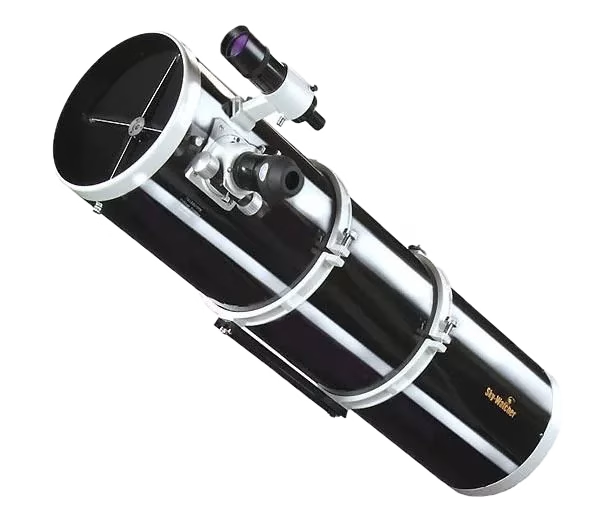
The Sky-Watcher Explorer 250PDS is a 254-mm-diameter Newtonian telescope designed for discerning amateur astronomers who want to explore the faintest deep-sky objects in detail while enjoying excellent performance when observing the Moon and the planets. With a focal length of 1,200 mm and a focal ratio of f/4.7, it offers a perfect balance between light-gathering power, field of view, and sharpness.
A 254 mm mirror: an opening that changes everything
With an aperture of 25.4 cm, this telescope captures more than 1270 times more light than the human eye, revealing faint galaxies, subtle nebulae and distant clusters with astonishing clarity. The diffraction-limited parabolic mirror maintains remarkable sharpness even at high magnification, while offering optimal contrast on the lunar surface or Jupiter's cloud bands.
Precise focusing with Crayford DualSpeed
The 2″ Crayford-style focuser, mounted on ball bearings, ensures smooth focusing even with heavy accessories such as cameras or wide-field eyepieces. The 1:10 gear ratio allows for micrometric adjustment, ideal for high-resolution photography and achieving perfect focus on diffuse objects.
A fast, open Newton for photography
With its f/4.7 ratio, the Explorer 250PDS is a fast instrumentideal for reducing exposure times in astrophotography. Mounted on an EQ6-R, AZ-EQ6 or equivalent, it becomes a formidable machine for capturing planetary nebulae, spiral galaxies or large Hα complexes.
Supplied with :
- Sky-Watcher Explorer 250PDS telescope (254/1200)
- LET 28 mm (2″) Eyepiece
- 9×50 Optical Finder
- Dovetail clamps
What you need to get started
This tube is supplied without frame. For visual use, a EQ5 or HEQ5 is a minimum. For photography, we recommend a EQ6-R or AZ-EQ6. You can also add high-magnification eyepieces, a 2x Barlow lens or a lunar filter for greater comfort during lunar observation.
Conclusion
The Sky-Watcher 250PDS is an excellent gateway to advanced astronomy. Bright, fast, versatile and precise, it's a wise choice for passionate visual astronomers as well as for those who want to get serious about deep-sky astrophotography.