The Sky-Watcher Heliostar 100 Ha is a dedicated 100-mm solar telescope that delivers the performance of two telescopes for the price of one. 0.5 angstrom bandwidth, prominences, filaments, granulation, and active regions—everything the chromosphere has to offer, all in a single tube. Thierry Legault, the internationally renowned French astrophotographer, tested it and called it a «little marvel.» At CHF 4,729, it’s a revolution in solar observation.
All the info at a glance
Opening: 100 mm
Focal length: 800 mm, f/8
Bandwidth: 0.5 Å or better (dual-standard performance using a single standard)
Technology: Internal Solis reference (without a costly double stack)
Wavelength: 656.28 nm (H-alpha)
Included eyepiece: 22 mm, 70° wide-field (36x)
90° solar elbow included
Integrated solar researcher
Tuning: Triffid system for adjusting the wavelength (Doppler shift)
Safety: Individually tested on the Sun; compliant with ISO 12312-2
Weight: 6 kg
Price: CHF 4,729 (including all taxes, Swiss VAT included)
Availability: Available by special order in our store
Recommended mount: Wave 100i or higher (6 kg)
0.5 Å with a single standard: Sky-Watcher's feat
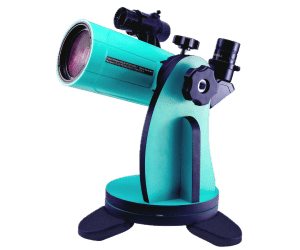
Sky-Watcher Heliostar 100 Ha, a dedicated H-alpha solar telescope. Credit: Sky-Watcher.
The key to the Heliostar 100 is its Solis etalon. A Fabry-Pérot etalon is an interferential filter that allows only a narrow band of wavelengths around the H-alpha line (656.28 nm) to pass through. The narrower the band, the higher the contrast, and the more detail you can see on the Sun’s surface.
A single etalon typically provides 0.7 to 0.8 Å. To achieve 0.5 Å or less, a double etalon (double stack) is usually required, which doubles the price. Sky-Watcher has managed to achieve 0.5 Å with a single etalon, thanks to Solis technology. The result: double-etalon performance for the price of a single one. It is this feat that has caught the attention of the entire solar community.
At 0.5 Å, we can see the protuberances on the limb, the dark filaments on the disk, the granulation, the active regions around the sunspots, and even solar flares in real time as they occur. At 0.7 Å, the prominences are visible but the surface contrast is lower: the granulation is no longer visible, and the filaments are less detailed. The difference between 0.5 and 0.7 Å is visible through the eyepiece.
Thierry Legault: «This little gem»
Thierry Legault, a world-renowned French astrophotographer (a specialist in transits of the International Space Station across the Sun, eclipses, and high-resolution solar imaging), tested the Heliostar 100 in a video review posted on YouTube in 2026. His verdict is unequivocal:
«This little gem was released in France in early 2026, and I ordered one right away, knowing its potential,» he explains. «It costs between €4,500 and €5,000—a substantial amount—but its design and performance are very similar» to much more expensive instruments.
Legault highlights the quality of the Triffid tuning system, which allows for fine-tuning of the wavelength to compensate for the Doppler shift and extract as much detail as possible depending on the conditions. At a focal length of 24 mm (33x), he observes the entire solar disk. At 8 mm (100x), he zooms in on interesting regions of the chromosphere.
His conclusion: a benchmark instrument for H-alpha solar observation and imaging, offering the performance of a dual-etalon at the price of a single etalon.
What can you see with a 100 mm H-alpha filter?
Sky-Watcher Heliostar 100 Ha, three-quarter view. Credit: Sky-Watcher.
With a 100 mm aperture at f/8 (800 mm focal length), the Heliostar 100 collects 1.5 to 2 times more light than a 70–80 mm H-alpha instrument. This extra light translates directly into useful magnification: you can exceed 100x and still maintain an image bright enough to see the fine structure of the chromosphere. A smaller telescope exhausts the brightness before reaching resolution.
Here's what we've observed:
Protuberances : plasma arcs that extend from the Sun's limb. Sometimes mistakenly called eruptions, these are stable structures that can last for days.
Filaments : streaks of dark plasma on the disk. These are the same prominences viewed from above, projected onto the luminous disk.
Granulation : the cellular texture of the Sun's surface, visible at 0.5 Å.
Active regions : bright regions around the spots, associated with the magnetic field.
Solar flares : sudden increases in brightness in real time, when activity permits.
The Triffid System: Precise and Stable Tuning
Tuning the etalon is crucial for H-alpha. The H-alpha line shifts slightly depending on the relative velocity between the Sun and the observer (Doppler shift). To stay centered on the line, the standard’s bandwidth must be adjusted. Sky-Watcher uses the Triffid system: a knob on the tube allows for fine-tuning of the wavelength, with greater stability than traditional pressure-based (tuning) systems.
The Triffid system also offers greater temperature stability: the line shifts with the temperature of the standard, and the Triffid compensates more effectively than pressure-based systems. In practice, you calibrate it once at the start of a session, and the image remains stable for hours.
Comparison of H-alpha eyepieces from the store
Our store offers several H-alpha sunglasses at various price points. Here's how to compare them:
Heliostar 100 (CHF 4,729): 100 mm, 0.5 Å, dual-standard for the price of a single one. The industry standard.
Heliostar 76 (CHF 2,399): 76 mm, more compact and lightweight. For those who want a portable H-alpha telescope but don't have the budget for the 100 mm model.
DayStar Solar Scout SS60DS (CHF 971): 60 mm, entry-level H-alpha. A great way to get started with solar observation at an affordable price.
Lunt LS50THa (CHF 1,689–2,349): 50 mm, optional dual scale. Lunt is the historic benchmark in solar observation.
Lunt LS60MT (CHF 1,769 to 3,199): 60 mm, modular day/night (converts to an ED night scope).
Lunt LS80MT (CHF 3,679 to 4,399): 80 mm, optional dual standard.
Lunt LS100MT (CHF 3,879 to 5,449): 100 mm, dual-element, modular day/night. A direct competitor to the Heliostar 100.
DayStar Quark (CHF 1,299): H-alpha filter in eyepiece format, designed to be mounted on an existing refractor (f/4 to f/8).
The choice depends on your budget and intended use: for those new to H-alpha, the DayStar SS60DS at CHF 971 is perfect. For maximum resolution at 100 mm, the Heliostar 100, priced at CHF 4,729, offers the best value for the money. For a modular day/night instrument, the Lunt LS60MT and LS100MT are good alternatives.
Why shop at Deep Space Astronomy?
We're not just a retailer. We test, advise, and provide support.
Personalized Advice : Solar observation requires special precautions. We can advise you on choosing the right instrument, safety measures, and accessories. Contact us by phone, WhatsApp, or schedule an appointment in Nyon.
After-Sales Support : A question about Triffid tuning, safety, or solar imaging? We're here to help.
14-Day Return Policy : Not satisfied? Return the product within 14 days.
Secure payment : Twint, credit card, invoice, Apple Pay, Bitcoin. Pay in 3 or 4 installments with no fees.
Free shipping in Switzerland Starting at CHF 200. Free pickup in Nyon.
Prices are valid as of October 28, 2026, and are subject to change. Current prices are listed on the product pages in our store.
Sources
This article is based on Thierry Legault’s review (YouTube, 2026), reviews by High Point Scientific and First Light Optics (October 2026), Astronomy Magazine’s 2026 Star Products selection, and Sky-Watcher’s official specifications.
To provide the best experiences, we use technologies such as cookies to store and/or access device information. Consenting to these technologies will allow us to process data such as browsing behavior or unique IDs on this site. Failure to consent or withdrawal of consent may adversely affect certain features and functions.
Functional
Always active
Storage or technical access is strictly necessary for the legitimate purpose of enabling the use of a specific service explicitly requested by the subscriber or user, or for the sole purpose of transmitting a communication over an electronic communications network.
Preferences
Storage or technical access is necessary for the legitimate purpose of storing preferences not requested by the subscriber or user.
Statistics
Storage or technical access used exclusively for statistical purposes.Storage or technical access which is used exclusively for anonymous statistical purposes. In the absence of a subpoena, voluntary compliance by your Internet service provider or additional third-party records, information stored or retrieved for this sole purpose generally cannot be used to identify you.
Marketing
Storage or technical access is necessary to create user profiles in order to send advertisements, or to track the user on a website or on several websites with similar marketing purposes.