CHF 109.00incl. Swiss VAT







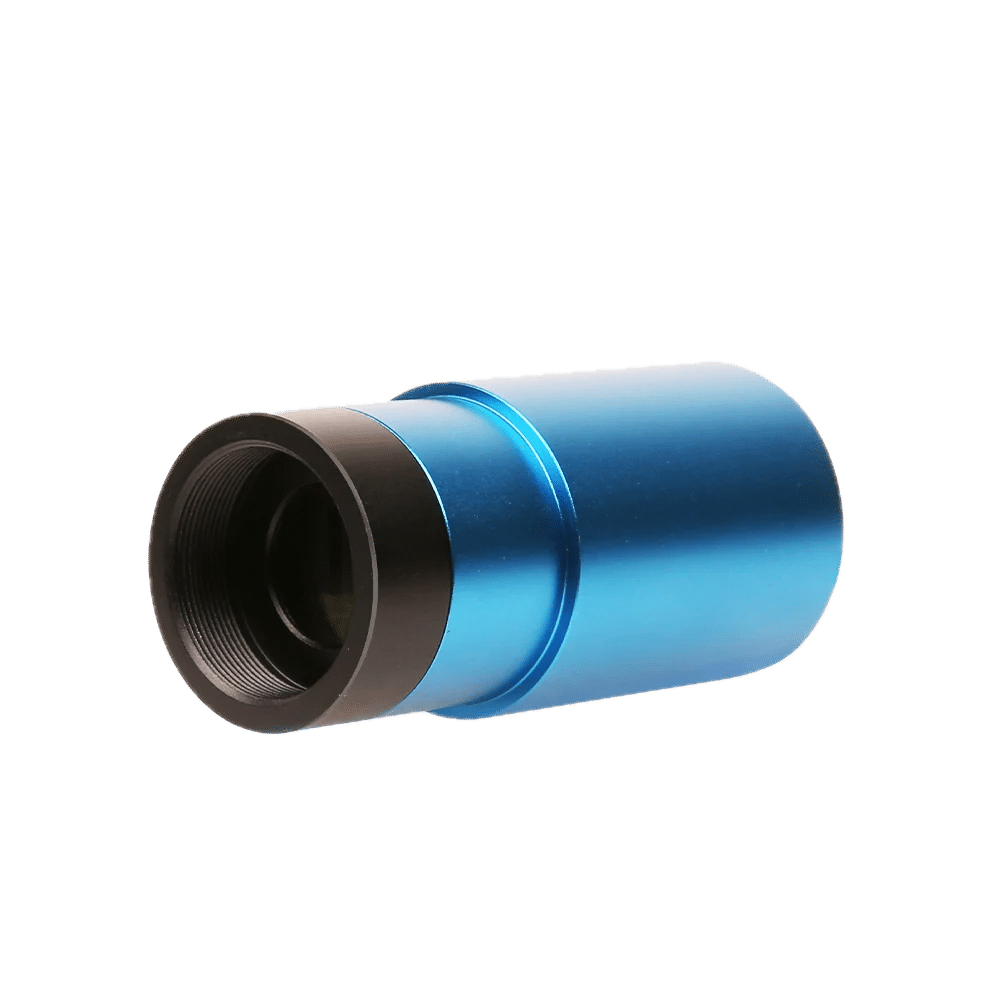
Visit ToupTek GPCMOS02000KPA is a color camera in 1.25″ originally designed for the’self-steering, but versatile enough to also be used in planetary/lunar imaging and for capturing brilliant deep-sky objects (open clusters, luminous nebulae, short exposures).
Its strong point is balance: a highly sensitive sensor, ultra-compact size, broad compatibility (Windows / macOS / Linux), and above all the presence of a ST-4 port integrated to directly guide a mount. In practice, this is typically the camera that is slid like an eyepiece into a guide telescope, a guide finder, or a guide mount. OAG (Off-Axis Guider) when you want a reliable, lightweight solution that's easy to implement.
The GPCMOS02000KPA is based on a Sony IMX290 CMOS sensor (optical format 1/2.8″) whose reputation is well established in the guiding and planetary arenas. They include :
As a result, you gain in acquisition comfort (faster star detection), and guidance becomes smoother, especially on compact setups where you don't want to multiply constraints.
The camera features a USB 2.0 for the acquisition of a ST-4 port for “direct mount” guidance. This allows two approaches:
The announced rate (up to 18 fps at full resolution) is also interesting: in planetary/lunar mode, you can edit a usable video stream; in guiding mode, you can adjust the frame rate to optimize responsiveness to turbulence.
The GPCMOS02000KPA is designed to be easy to integrate in an optical train. It offers:
In concrete terms, it's a camera that takes the hassle out of mounting, focusing and guiding. Its small size and featherweight also limit stress on the eyepiece holder and clamping rings, especially on small guide glasses.
In addition to guidance, the GPCMOS02000KPA can also be used for imaging:
The camera incorporates an input window described as UV/IR cut filter, This helps to avoid some of the focusing problems and “bloat” on stars with certain optics.
The announced compatibility with Windows, macOS and Linux is an important point: whether you're in a nomadic setup (Windows PC), a Mac environment, or an observatory with a Linux mini-PC (INDI/Ekos), the camera integrates easily into a modern astro ecosystem.
In a typical flow, you can :
If you have any doubts about mechanical compatibility (OAG, draw, rings, etc.), don't hesitate to ask us: we can check the assembly together and optimize the optical train to avoid unpleasant surprises.
La ToupTek GPCMOS02000KPA est destinée à l'autoguidage : montée sur une petite lunette guide ou un diviseur optique, elle suit une étoile et envoie les corrections à la monture pendant les poses longues. Avec ses pixels de 2,9 µm, elle échantillonne à environ 4,7″ par pixel sur une lunette guide Askar 32 mm (128 mm de focale) et 2,9″ sur l'Askar 52 mm (208 mm). La lunette guide convient aux focales d'imagerie courtes à moyennes ; pour les longues focales, le diviseur optique est plus précis car il guide à travers l'instrument principal.
Le Sony IMX290 (STARVIS) est un capteur 1/2,8″ de 2,1 Mpx à pixels de 2,9 µm, apprécié pour son faible bruit de lecture (0,53 e⁻) et sa bonne sensibilité dans le proche infrarouge : il trouve facilement des étoiles guides et convient aux planètes avec des filtres infrarouges. C'est le prédécesseur direct de l'IMX462.
Non : elle est alimentée par son câble USB. Aucune alimentation externe n'est nécessaire.
Elle se glisse dans le porte-oculaire 1,25″ d'une lunette guide, par exemple l'Askar 32 mm ou l'Askar 52 mm, ou se monte sur un diviseur optique. Le port ST4 permet d'envoyer les corrections directement à la monture ; avec un ordinateur ou un ASIAIR, le guidage passe le plus souvent par USB.
La version couleur est la plus simple : une seule pose donne l'image en couleurs. La version monochrome, la ToupTek GPCMOS02000KMA, demande une roue à filtres et plus de temps de pose. En échange, elle est plus sensible et donne de meilleurs résultats en bande étroite.
La fiche du fabricant (en anglais) est disponible ici : fiche ToupTek GPCMOS02000KPA.