CHF 189.00incl. Swiss VAT







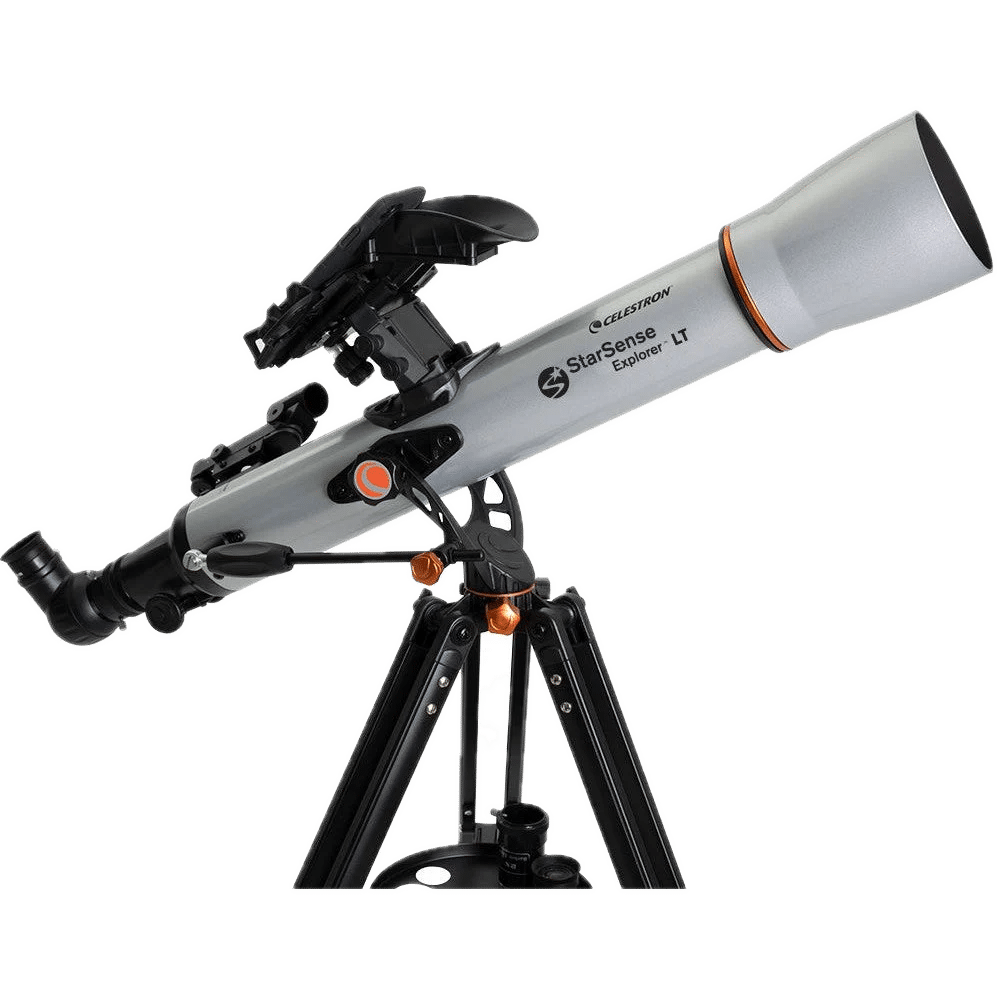
The StarSense Explorer 70mm is the ideal telescope for a head start in astronomy. No need to know the constellations: your smartphone guides you step by step to the most beautiful wonders of the sky.
Thanks to patented StarSense, the telescope uses the camera on your
phone to recognize the stars above you and automatically determine its position in real time.
The application StarSense Explorer, powered by SkySafari™, then offers you a list of
of objects visible at the moment: planets, bright nebulae, star clusters, easy galaxies and double stars.
From the city, you can already see many bright objects. By taking your telescope under darker skies, you can explore fainter deep-sky objects and go even further in your discovery of the Universe.
The telescope is mounted on a manual azimuth mount, It's very intuitive: you simply move from left to right and top to bottom.
A fine vertical movement with adjusting spindle for precise tracking
the arrows displayed on your smartphone screen. When the crosshairs turn green, the object is centered: all that's left to do is look through the eyepiece!
The optical tube is a 70 mm bezel equipped with fully coated glass lenses,
to deliver bright, detailed images of the Moon, planets and the brightest deep-sky objects.
Supplied accessories :
In short, this telescope is designed for beginners who want to treat yourself quickly, without getting lost in the technicalities. It guides you through the sky, helps you find objects easily and offers you a first observing experience that's both fun and fascinating.
La Celestron StarSense Explorer LT 70AZ est une lunette achromatique de 70 mm pour 700 mm de focale (f/10), un instrument d'observation visuelle idéal pour débuter. Elle montre les cratères et les mers de la Lune, les anneaux de Saturne, les bandes de Jupiter et ses quatre satellites, les phases de Vénus, et parmi les plus gros objets du ciel profond les Pléiades, l'amas double de Persée ou la nébuleuse d'Orion. Son long rapport focal limite le chromatisme et la rend particulièrement agréable sur la Lune et les planètes.
Yes. Like any telescope, it is factory-aligned and requires no optical adjustments: simply set it up, leave the tube out in the open air for a few minutes, and start observing. The enclosed tube stays clean, and maintenance is minimal. The StarSense Explorer app uses your smartphone to tell you where to point: the mount is moved by hand, without a motor or power source.
À diamètre comparable, une lunette achromatique est généralement moins chère qu'un Maksutov, se met plus vite à température et n'a pas d'obstruction centrale, ce qui préserve le contraste. Le Maksutov est plus compact pour une focale plus longue ; la lunette, avec ses 700 mm, reste plus polyvalente entre planètes et grands objets du ciel profond.
Oculaires fournis : 25 mm (28×) et 10 mm (70×). Le grossissement se calcule en divisant la focale de la lunette (700 mm) par celle de l'oculaire. Pour aller plus loin sur la Lune et les planètes, un oculaire d'environ 7 mm (100×) complète bien le kit ; le grossissement utile maximal tourne autour de 140×. La Barlow 2× fournie double chaque grossissement.
Ce n'est pas sa vocation. L'objectif achromatique laisse un halo violet autour des étoiles et des objets brillants : en astrophotographie, ce défaut ressort nettement. Pour la photo du ciel profond, une lunette apochromatique est l'outil adapté. La Celestron StarSense Explorer LT 70AZ reste avant tout un excellent instrument d'observation.
70/700 Tube, 25 mm and 10 mm Eyepieces, 2× Barlow Lens, 90° Erecting Prism, StarPointer Red-Dot Finder, StarSense Explorer Smartphone Mount, Altazimuth Mount and Tripod (pre-assembled), Accessory tray.
Oui, c'est un ensemble léger : le tube pèse environ 1,6 kg et il mesure environ 81,3 cm.