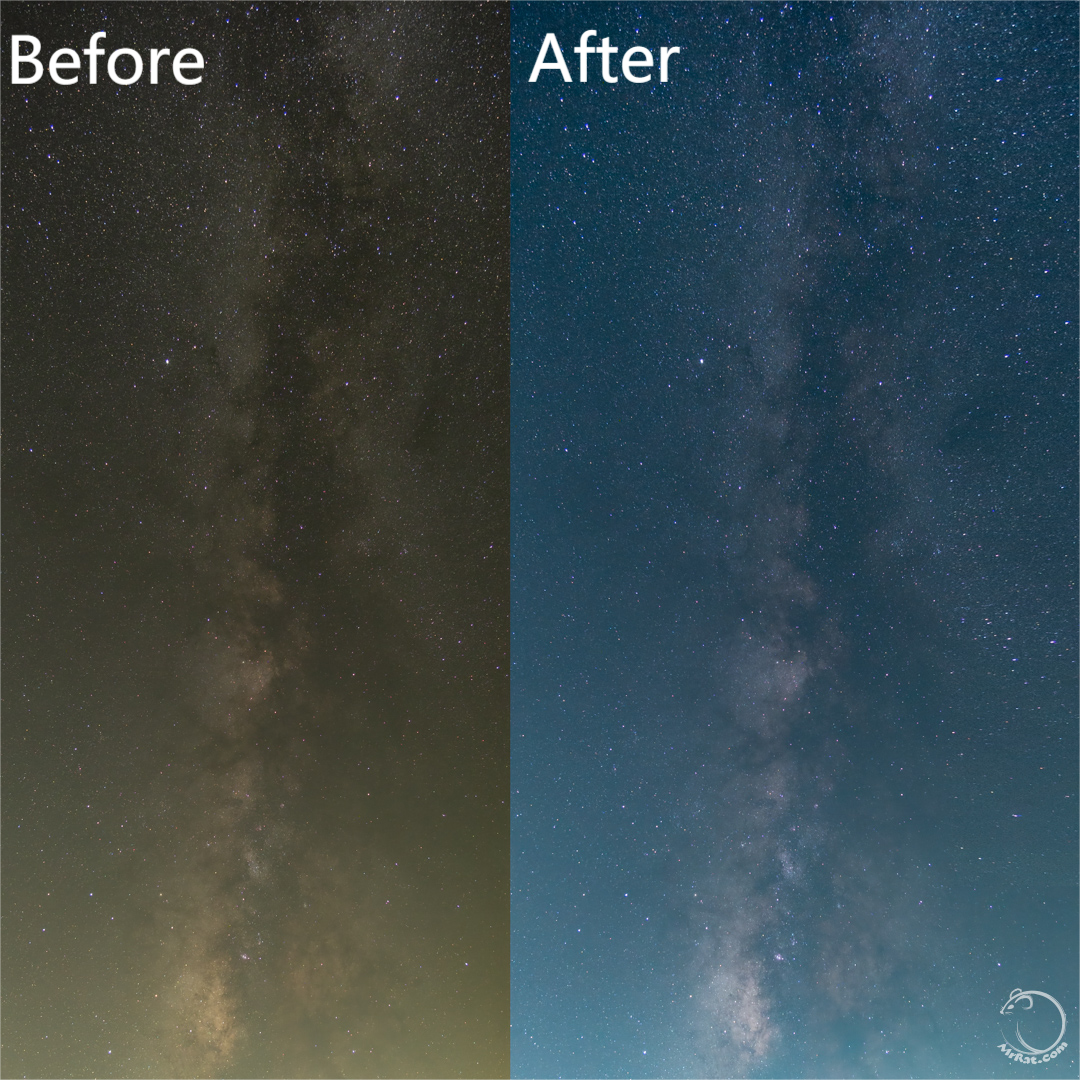
This light pollution filter is designed to improve the quality of night-time and astrophotographic images by effectively reducing the effects of artificial lighting. Thanks to the use of a multi-layer didyme glass, With its high resolution, it restores natural colors and enhances the contrast between the night sky and the landscape.
Dimensions and features
Filter type : light pollution filter
Diameter : 82 mm
Glass thickness only : 2 mm
Thickness with ring : 5.5 mm
Material : didyme glass
Weight : 23 g
How do I choose the right adapter?
The main filter is in 82 mm. For use with smaller-diameter lenses, simply add an adapter ring to match your lens thread. The version on offer includes all the adapters needed to cover the majority of photo lenses.
How does the MSM light pollution filter work?
This filter is made from a special didyme glass combined with several optical layers. It acts by significantly reducing the light transmission of sodium and mercury vapor lamps, emissions are mainly between 575 nm and 600 nm.
These light sources, widely used for public and industrial lighting, project a yellow-orange light towards the sky, which severely impairs night-time observation and photography. Wavelengths between 575 and 600 nm are one of the main causes of light pollution.
The MSM filter effectively blocks this spectral range, while allowing other useful wavelengths to pass through. The camera can then capture faithful colors of the night sky and landscapes, with significantly improved contrast.
This precise filtering also makes it possible to significantly reduce post-processing time and effort, by limiting the predominance of yellow right from the start.
Color rendering and contrast
The filter does not add no dominant blue or other artificial hues to the image. It simply blocks the wavelengths responsible for light pollution. The contrast between sky and ground is enhanced, and the natural, detailed colors of the landscape are preserved.
Frequently asked questions (FAQ)
Q: What does «all adapters» mean for this light pollution filter?
A: The «82 mm filter + all adapters».» includes an 82 mm filter with 8 adapter rings: 49 mm, 52 mm, 55 mm, 58 mm, 62 mm, 67 mm, 72 mm and 77 mm.
Q: Light pollution filters often require an increase in exposure of about one f-stop. What about this filter?
A: This filter effectively removes the yellow cast caused by light pollution, but the resulting image is not significantly darker. Increasing the exposure time is therefore much smaller than a diaphragm.
To provide the best experiences, we use technologies such as cookies to store and/or access device information. Consenting to these technologies will allow us to process data such as browsing behavior or unique IDs on this site. Failure to consent or withdrawal of consent may adversely affect certain features and functions.
Functional
Always active
Storage or technical access is strictly necessary for the legitimate purpose of enabling the use of a specific service explicitly requested by the subscriber or user, or for the sole purpose of transmitting a communication over an electronic communications network.
Preferences
Storage or technical access is necessary for the legitimate purpose of storing preferences not requested by the subscriber or user.
Statistics
Storage or technical access used exclusively for statistical purposes.Storage or technical access which is used exclusively for anonymous statistical purposes. In the absence of a subpoena, voluntary compliance by your Internet service provider or additional third-party records, information stored or retrieved for this sole purpose generally cannot be used to identify you.
Marketing
Storage or technical access is necessary to create user profiles in order to send advertisements, or to track the user on a website or on several websites with similar marketing purposes.