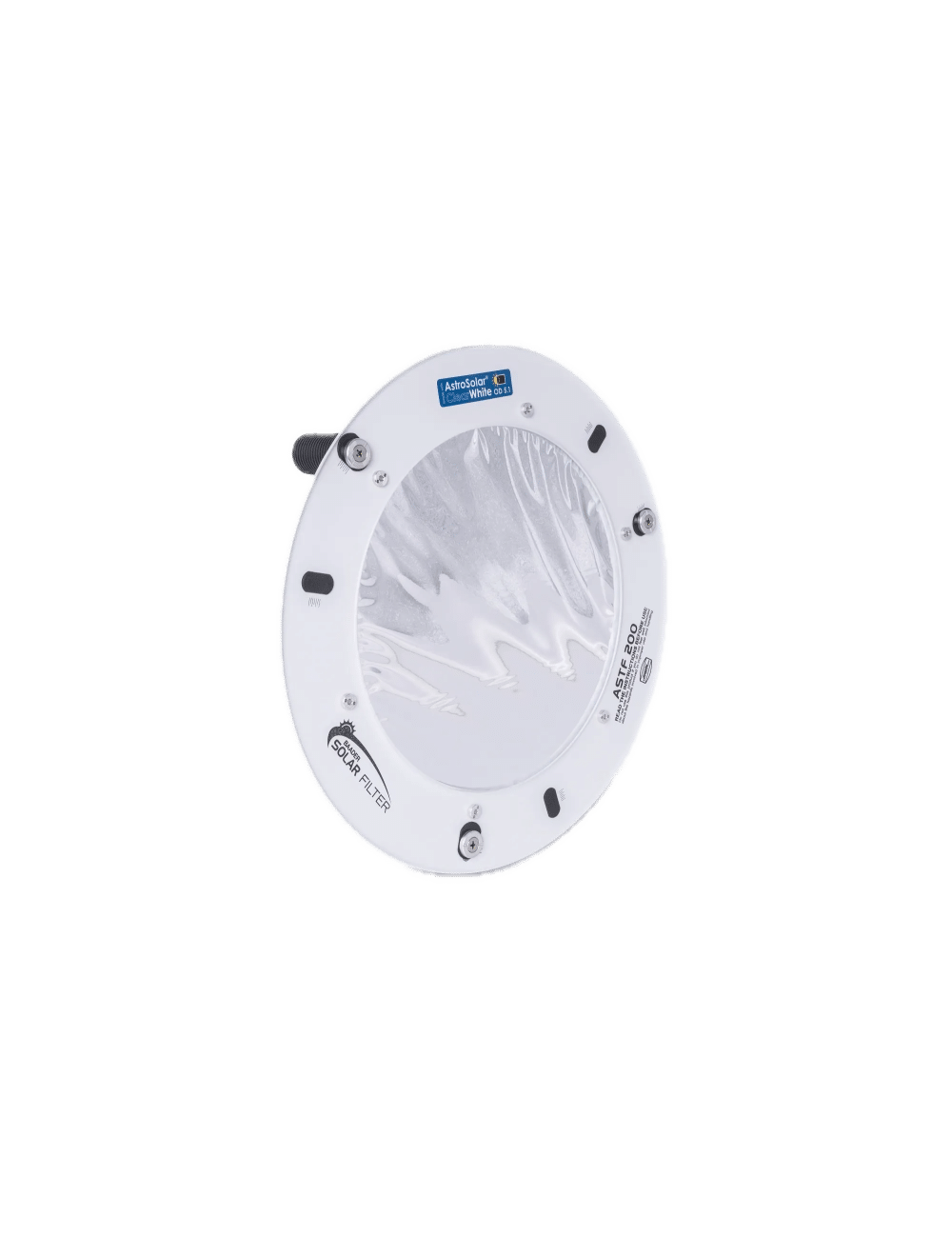
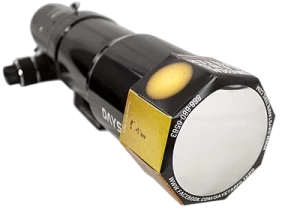
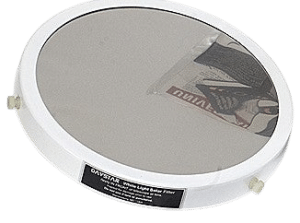
Baader ASTF 80 AstroSolar® OD 5.1 ClearWhite Solar Filter
Visit Baader ASTF 80 AstroSolar® OD 5.1 ClearWhite is a forehead sunscreen
high-quality telescope designed for visual observation and photography of the Sun in white light.
It is placed directly in front of the telescope, astronomical telescope, or telephoto lens, before
sunlight is not concentrated by the instrument.
It allows us to observe the Sun's photosphere, sunspots, and the shadow and penumbra regions, as well as,
Under the right conditions, certain fine details of the Sun's surface.
Important: This product sheet applies to the ASTF 80 mm model.
The figure 80 mm refers to the’open solar filter,
that is, the diameter of the area of the AstroSolar® film through which light passes.
It does not directly correspond to the outer diameter of the tube or the moisture barrier on which
The filter will be installed.
All other diameters in the range are available upon request:
100, 120, 140, 160, 180, 200, 240, and 280 mm.
AstroSolar® ClearWhite Safety OD 5.1 Window Film
The filter uses the original film
Baader AstroSolar® ClearWhite Safety OD 5.1, designed for direct observation
and a photograph of the Sun in white light.
Its optical density OD 5.1 significantly reduces the intensity of sunlight,
about 99,9992 %, which corresponds to an attenuation factor of approximately 125,000.
The ClearWhite rendering produces a white, bright, and neutral image. It prevents orange casts.
or very pronounced bluish tints that can be seen with certain other sunscreens.
Detailed Solar Observation
The Baader ASTF 80 is suitable for observing the Sun at various magnifications. The level of detail
The visibility of these features will depend on the diameter and quality of the instrument, the magnification used, and the
atmospheric turbulence.
It is particularly well-suited for:
- observing sunspots; ;
- the study of shadows and penumbra; ;
- a photograph of the entire solar disk; ;
- solar imaging at higher magnification; ;
- observing the partial phases of a solar eclipse; ;
- Use with a compatible monocular, telescope, or telephoto lens.
Tension-free film installation
AstroSolar® film is installed without excessive mechanical stress. It must not be stretched like
a rigid membrane or like a drumhead.
Slight visible ripples are normal. They help the film maintain its performance.
optics. A film that is stretched too tightly could cause distortions and reduce image quality,
especially at high magnification.
Thermally Compensated Mount
The ASTF series uses a mounting system designed to accommodate temperature fluctuations without imposing
undesirable stresses in the solar film.
The frame that holds the film can move slightly independently of the main ring. This design
reduces the risk of optical distortion or astigmatism when the temperature changes rapidly.
The system is designed to operate over a wide temperature range, approximately ranging from
between -30 °C to +50 °C.
How does the filter attach to the telescope?
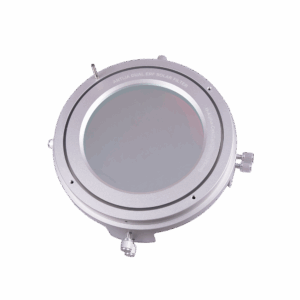
The Baader ASTF filter has a large front ring equipped with
three adjustable centering pins, arranged around the filter.
These three rods act as support legs. They rest against the tube
or against the telescope's anti-fog screen in order to:
- center the filter in front of the lens; ;
- keep the filter in the correct position; ;
- adapt the same model to multiple outer tube diameters; ;
- Make sure the filter does not rest directly on the solar film.
The rods slide into the ring's holders. Their position can be adjusted without tools,
and then locked in place once the filter is properly centered.
Outdoor installation: the most common scenario
In most installations, the three rods wrap around the mist guard or the front of the tube.
They press against its outer surface.
Simplified front view:

 Rod
 ↓

 ┌─────────────┐
 │   ┌─────┐   │
 Rod → │   │tube │   │ ← Rod
 │   └─────┘   │
 └─────────────┘

 Filter ring
The filter then acts like a large, adjustable cap placed in front of the telescope.
To choose the right size, you need to measure the
outer diameter of the mist guard or tube at the exact spot where the poles will rest.
Example of an outdoor installation
A pair of binoculars may have an 80-mm objective lens, but a dew shield with an outer diameter of 110, 120, or even 130 mm.
It is this outer diameter that must be taken into account when checking the fastening.
For example:
- An 80-mm eyepiece has a dew shield with an outer diameter of 115 mm; ;
- The ASTF 80 filter has a clear opening of 80 mm; ;
- the rods are adjusted to fit around the 115-mm anti-fog screen; ;
- The filter is then centered in front of the lens and secured with the straps provided.
The number 80 mm does not, therefore, mean that the tube itself must have an outside diameter of 80 mm.
Two sets of rods are included
The ASTF 80 filter comes with two sets of centering rods:
- 3 rods, 10 mm in diameter; ;
- 3 rods, each 20 mm in diameter; ;
- Stem length: 38 mm.
The 10-mm and 20-mm rods serve the same purpose, but their different thicknesses allow
to adapt the filter to different tube diameters.
The 20-mm rods take up more space between the filter ring and the tube. They allow
So it's generally best to attach the filter to a smaller tube.
10-mm rods are thinner and are generally suitable for tubes with a larger outer diameter.
Examples using 10-mm and 20-mm rods
For the ASTF 80 model:
- an outer tube measuring approximately 105 mm will normally use 20-mm rods; ;
- an outer tube measuring approximately 115 mm can often use 10- or 20-mm rods,
depending on the shape of the anti-fog screen and the most stable position; ;
- an outer tube measuring approximately 130 mm can use 10-mm rods; ;
- an outer tube measuring approximately 138 mm will normally use 10-mm rods; ;
- A 145-mm outer tube is too wide for standard outdoor installation of the ASTF 80.
Outdoor Installation Ranges for the ASTF 80 Model
When the rods surround the tube or the anti-fog screen from the outside, the compatibility ranges are:
- with 10-mm rods: outer diameter between
110 and 140 mm ;
- with 20-mm rods: outer diameter between
100 and 130 mm.
By combining the two sets of rods, the ASTF 80 model can generally be mounted on a tube
or an anti-fog screen with an outer diameter of between approximately 100 and 140 mm.
Table of Compatibility Examples
| Measured outer diameter |
Compatibility with the ASTF 80 |
Recommended rods |
| 95 mm |
No, the diameter is usually too small |
Choose a different model or check another installation method |
| 102 mm |
Yes |
20-mm rods |
| 110 mm |
Yes |
10- or 20-mm rods, depending on the fit |
| 120 mm |
Yes |
10- or 20-mm rods |
| 130 mm |
Yes |
10- or 20-mm rods, depending on the fit |
| 138 mm |
Yes |
10-mm rods |
| 145 mm |
No, for standard outdoor installation |
Choose a larger ASTF model |
Indoor Installation: A More Specific Setup
In certain configurations, the rods can rest against the inside of a ledge or a fog guard
or an opening that is wide enough.
This isn't the most common type of assembly. It's mainly useful when the shape of the tube doesn't allow for
the stems are unable to properly encircle the outside.
Simplified front view:

 ┌───────────────┐
        │   anti-fog screen   │
 │  → ┌─────┐ ← │
 │    │     │   │
 │    └─────┘   │
        └───────────────┘

The rods rest
against an inner surface.
For the ASTF 80 model, the recommended indoor installation ranges are:
- with 10-mm rods: inner diameter between
130 and 160 mm ;
- with 20-mm rods: inner diameter between
140 and 170 mm.
This type of installation depends heavily on the exact shape of the anti-fog screen. It must be checked on a case-by-case basis.
What measurement should we send you?
In most cases, a single measurement is sufficient:
the outer diameter of the tube or steam barrier, measured at the exact location where the filter will be installed.
For example, you shouldn't just write:
- «80-mm lens»; ;
- «100-mm telescope»; ;
- «400 mm camera lens.».
This information describes the aperture or focal length of the instrument, but not necessarily its actual outer diameter.
Measure the anti-fog strip using a ruler, caliper, or flexible tape measure, and provide us with a measurement such as:
- outer diameter of the anti-fog screen: 118 mm; ;
- outer diameter of the camera lens: 108 mm; ;
- Outer diameter of the tube: 136 mm.
Based on this measurement, we can determine whether the ASTF 80 model is suitable or if a larger diameter should be chosen.
Tip: If you're unsure, please send us the exact model of your instrument along with
the measured outer diameter of the tube or the mist guard.
We can tell you the appropriate ASTF diameter and the set of rods to use.
Adjustable centering system
The rods are mounted on sliding aluminum blocks. These blocks can be moved around the ring
in order to precisely adjust the position of the three support points.
Index marks make it easy to find the same setting the next time you use the tool.
Once the filter is in place:
- Place the ring in front of the tube; ;
- Adjust the three rods until they rest evenly; ;
- Make sure the filter is centered in front of the lens; ;
- Tighten the adjustments without applying excessive force; ;
- Install the safety straps; ;
- Make sure the filter cannot slip or come loose.
The rods must not crush the tube
The rods are used to center and hold the filter in place. They should not be tightened with excessive force.
Their ribbed rubber casings improve traction and reduce the risk of slipping or leaving marks
of the mist shield.
The unit's stability depends on both the three centering points and the safety straps provided.
Safety straps are required
Three safety straps with hook-and-loop fasteners and self-adhesive pads are included.
They provide additional security in case the filter is moved due to accidental handling,
a vibration or a gust of wind.
The straps must be secured before each observation. The filter must never be allowed to fall or
come loose when the telescope is pointed at the Sun.
Protection against stray light
A black sliding plate covers the frame's adjustment openings to block out sunlight
to enter the instrument from the side.
Plugs are also provided to close off unused openings.
Use with a camera or video camera
The ASTF 80 filter can be used for solar photography with a camera or an astronomical camera.
The setup is as follows:
Sun → ASTF filter mounted in front of the telescope → telescope optics → camera
The solar filter must always be installed before pointing the instrument at the Sun.
You should never point the telescope at the Sun and then try to attach the filter.
Use with a researcher
The telescope researcher must also be kept safe.
It must be:
- equipped with its own specially designed front solar filter; ;
- or completely closed with its cap; ;
- or removed from the instrument.
An unprotected researcher can concentrate sunlight and cause a burn or damage their internal organs.
Technical Specifications of the Model Shown
- Product: Baader ASTF 80 AstroSolar® ClearWhite
- Clear opening: 80 mm
- Outer diameter of the barrel: approximately 170 mm
- Solar Film: AstroSolar® ClearWhite Safety
- Optical density: OD 5.1
- Observation: white light / full light
- Film metallized on both sides
- White, neutral solar image
- Editing the film without constraints
- Thermally Compensated Mount
- Three adjustable centering points
- Tool-free adjustment
- Two sets of rods included
- Outer diameter with 10 mm rods: 110 to 140 mm
- Outer diameter with 20 mm rods: 100 to 130 mm
- Inner diameter with 10 mm rods: 130 to 160 mm
- Inner diameter with 20 mm rods: 140 to 170 mm
- Approximate weight: 139 g
Scope of delivery
- Baader ASTF 80 Solar Filter, Mounted
- AstroSolar® ClearWhite Safety OD 5.1 Film Installed
- 3 10-mm centering pins
- 3 20-mm centering pins
- 3 safety straps
- Self-adhesive pads for straps
- Plugs for unused openings
- Complete User Manual
Other diameters are available upon request
This data sheet pertains to the model ASTF 80 mm.
All other diameters in the range can be ordered upon request.
| Open filter |
Outer diameter of the barrel |
| 80 mm |
170 mm |
| 100 mm |
190 mm |
| 120 mm |
210 mm |
| 140 mm |
230 mm |
| 160 mm |
250 mm |
| 180 mm |
270 mm |
| 200 mm |
290 mm |
| 240 mm |
330 mm |
| 280 mm |
370 mm |
The choice of model should not be based solely on the telescope's optical diameter.
The following should also be taken into account:
- the actual outer diameter of the mist guard; ;
- the adjustment range of the rods; ;
- of the desired free opening; ;
- the exact shape of the front of the instrument.
Complete Example of Choices
You have an 80-mm telescope.
The optical diameter is therefore 80 mm, but the anti-fog screen has an outer diameter of 118 mm.
The ASTF 80 model may be suitable because:
- its clear opening is 80 mm; ;
- The 118-mm anti-fog screen fits within the external mounting range; ;
- 10- or 20-mm rods can be used, depending on the fit achieved; ;
- The three rods allow you to center the filter in front of the lens; ;
- The straps ensure that the assembly is secure.
Conversely, another 80-mm telescope may have a dew shield with an outer diameter of 145 mm.
In this case, the ASTF 80 model is not suitable for outdoor installation, even though the scope has
It also has an 80-mm aperture.
In that case, you'll need to choose a larger ASTF version.
Compliance and Security
The AstroSolar® ClearWhite Safety OD 5.1 film meets the applicable transmission requirements of the standard
EN ISO 12312-2:2015 for filters intended for direct observation of the Sun.
Solar observation, however, remains an activity that requires absolute vigilance.
Improper installation or a damaged filter can cause serious and irreversible eye damage.
Essential Safety Guidelines
- Always install the filter at the front of the instrument.
- Never place the filter near the eyepiece, the diagonal mirror, or the focal point.
- Check the condition of the film before each use.
- Never use a filter that has a hole, tear, or damaged area.
- Make sure the filter completely covers the opening of the instrument.
- Adjust the three rods so that they are evenly spaced.
- Always use the safety straps provided.
- Block or filter the search engine separately.
- Never leave a solar instrument unattended.
- Children must be supervised directly by an adult.
- If you have any doubts about the filter's attachment or condition, do not look at the Sun.
Observing a Solar Eclipse
The filter must be worn during all partial phases of a solar eclipse, as well as during
an annular eclipse.
During a total eclipse, it can only be removed during the brief phase of totality, when the photosphere
The Sun is completely obscured by the Moon.
As soon as part of the sun's disk reappears, the filter must be replaced immediately.
Eclipse glasses should never be used on their own to look through a telescope,
binoculars, a spotting scope, or a telephoto lens.
Why Choose the Baader ASTF 80 ClearWhite?
The Baader ASTF 80 combines a solar filter renowned for its optical quality with a rigid, adjustable mount
and thermally compensated.
Its three-rod system allows the filter to be precisely adjusted to the outer diameter of the tube or the anti-fog screen,
while keeping the film properly centered in front of the lens.
The model shown on this page has a 80 mm clear opening and is generally considered,
for outdoor installation, on pipes or steam barriers measuring approximately 100 to 140 mm in outer diameter.
For any other dimensions, all diameters in the ASTF range are available upon request.
If you're unsure, please provide us with your instrument's model and the exact outer diameter.
the anti-fog screen so that we can recommend the right version for you.