CHF 1'629.00 Original price was: CHF 1'629.00.CHF 1'499.00Current price is: CHF 1'499.00.incl. Swiss VATCHF 1'629.00
Will be ordered for you
Timeframe: 10 days to 3 weeks
Estimated shipping: Between November 20 and 25, 2026







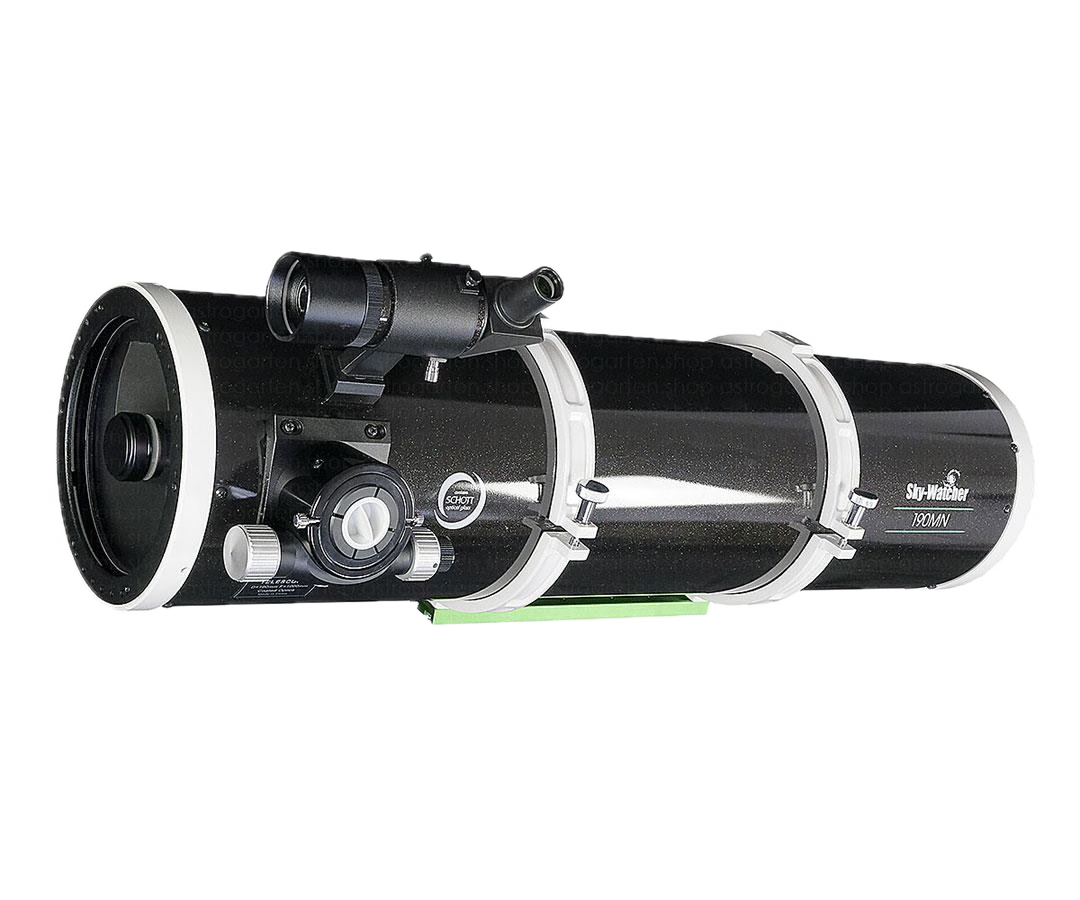
The Sky-Watcher MN 190/1000 is a telescope in a class of its own. Thanks to its hybrid Maksutov-Newton design, it combines the brightness of mirror telescopes with integrated field correction of rare efficiency. Designed to meet the needs of the most demanding astrophotographers, it also offers astonishing visual performance, worthy of a top-of-the-range instrument.
This telescope excels in deep sky photoThis is particularly true of full-frame cameras and digital SLRs. Nebulae, galaxies and star clusters are displayed with remarkable sharpness and field regularity. In visual terms, it will also delight observers of planets and the Moon, thanks to its sharpness and high contrast.
With a reasonable weight of 12.5 kgThis optical tube can be used on transportable frames such as the HEQ5 Pro or theAVX. However, to fully exploit its potential in astrophotography, a EQ6-R or higher is highly recommended.
The Sky-Watcher MN 190/1000 is for those who want to capture images of the sky with finesse and fidelity, without compromising on optical quality. It uniquely combines the best of both worlds: the power of a fast Newton and the optical precision of a closed design with built-in correction.
Whether you're an ambitious amateur photographer or a demanding observer, this 190 mm Maksutov-Newton telescope will offer you exceptional performance for a contained budget. It's one of the best choices for those who want to combine the pleasure of observing with scientific rigor in their shots.
Sky-Watcher designed it primarily for astrophotographers. Its meniscus lens corrects the field of view right out of the box: no need to add a coma corrector, and stars remain pinpoint sharp all the way to the edge of the image—ideal for large sensors (APS-C, full-frame, SLR). With a 190 mm diameter and a 1000 mm focal length (f/5.3), it quickly gathers light from nebulae and galaxies, and its large 64 mm secondary mirror provides ample illumination across the field of view. It’s also a rare design on the market: it delivers a very sharp, high-contrast image—similar to that of an apochromatic refractor—with the aperture and price of a reflecting telescope. For visual observation, this contrast also works wonders on the Moon and the planets.
This is a Newtonian telescope whose entrance is sealed by a Schott glass meniscus lens. This thick, curved lens corrects the aberrations of the primary mirror, particularly coma, which causes stars at the edge of the field to appear elongated in a conventional Newtonian telescope. The secondary mirror is mounted directly on the lens: there is no spider, so there are no streaks around bright stars. The central obstruction is 34 % in diameter, or 11 % of the mirror’s surface area. The enclosed tube limits dust ingress and internal turbulence; according to Sky-Watcher, the image is sharper and has higher contrast than that of a Schmidt-Newton of the same size. On the other hand, the enclosed tube and thick lens require a longer warm-up time than an open Newtonian. Take it outside in advance; its front vents and Pyrex mirror help. The lens, exposed to the night air, can also fog up: an anti-fog strip placed around the front of the tube protects it from this.
The Moon in great detail and the planets: Jupiter’s bands and moons, Saturn’s rings. With a diameter of 190 mm, it captures a great deal of light: under a very dark sky, bright galaxies and nebulae become visible. Its maximum useful magnification is approximately 380× (2 × the diameter in mm); in practice, atmospheric turbulence often limits observation to lower magnifications.
No eyepiece is included with this model. The magnification is calculated by dividing the telescope's focal length (1000 mm) by that of the eyepiece: for example, a 25 mm eyepiece provides 40× magnification.
It can still be transported by car: the tube weighs about 12.5 kg.
Yes, from time to time: just like on a Newtonian, the primary mirror is adjusted using screws at the back of the tube, but the Maksutov blade holds the secondary mirror very securely in place. After transporting the telescope, a star test is all that’s needed: point the telescope at a bright star, defocus it slightly, and the rings should be perfectly concentric.
This tube is sold separately: its photographic capabilities depend on the mount you choose. When mounted on a motorized equatorial mount, it is suitable for observing the Moon, the planets, and—especially at f/5.3—deep-sky objects (nebulae, galaxies, clusters), which is its primary purpose. The tube weighs approximately 12.5 kg: be sure to take this into account when considering the mount’s load capacity.
190 mm Maksutov-Newton optical tube, 2″ dual-speed eyepiece holder, 9×50 angled finder scope.