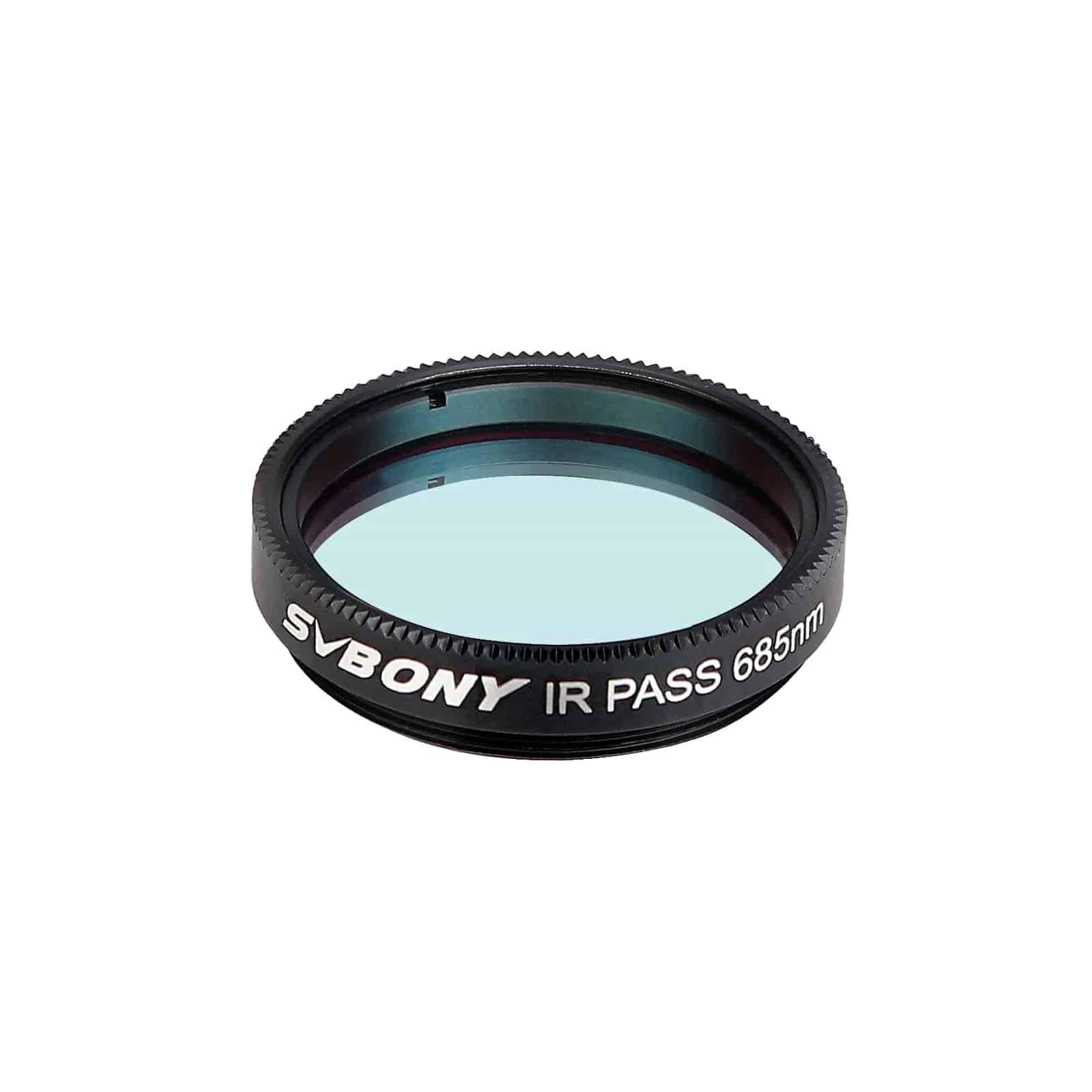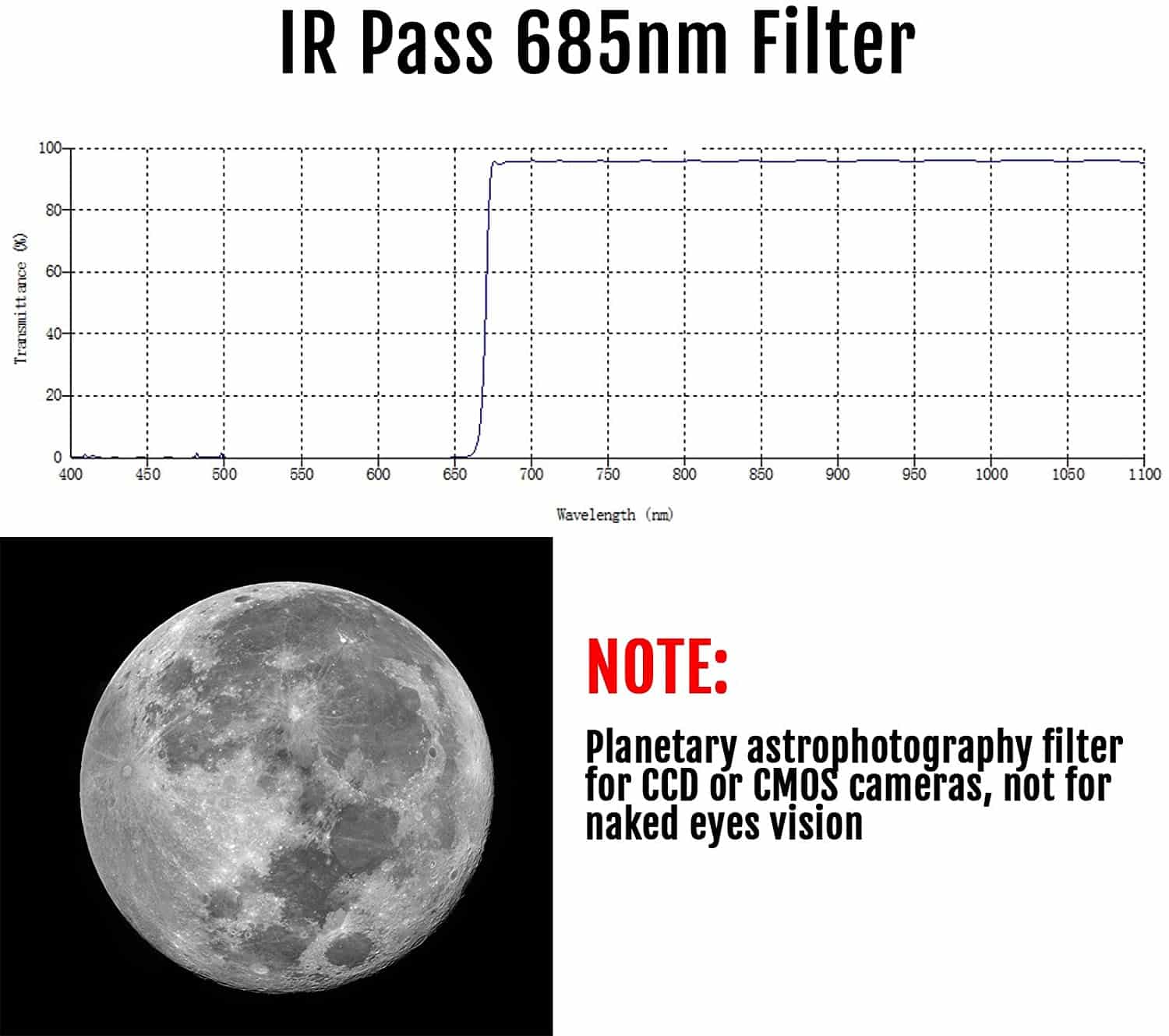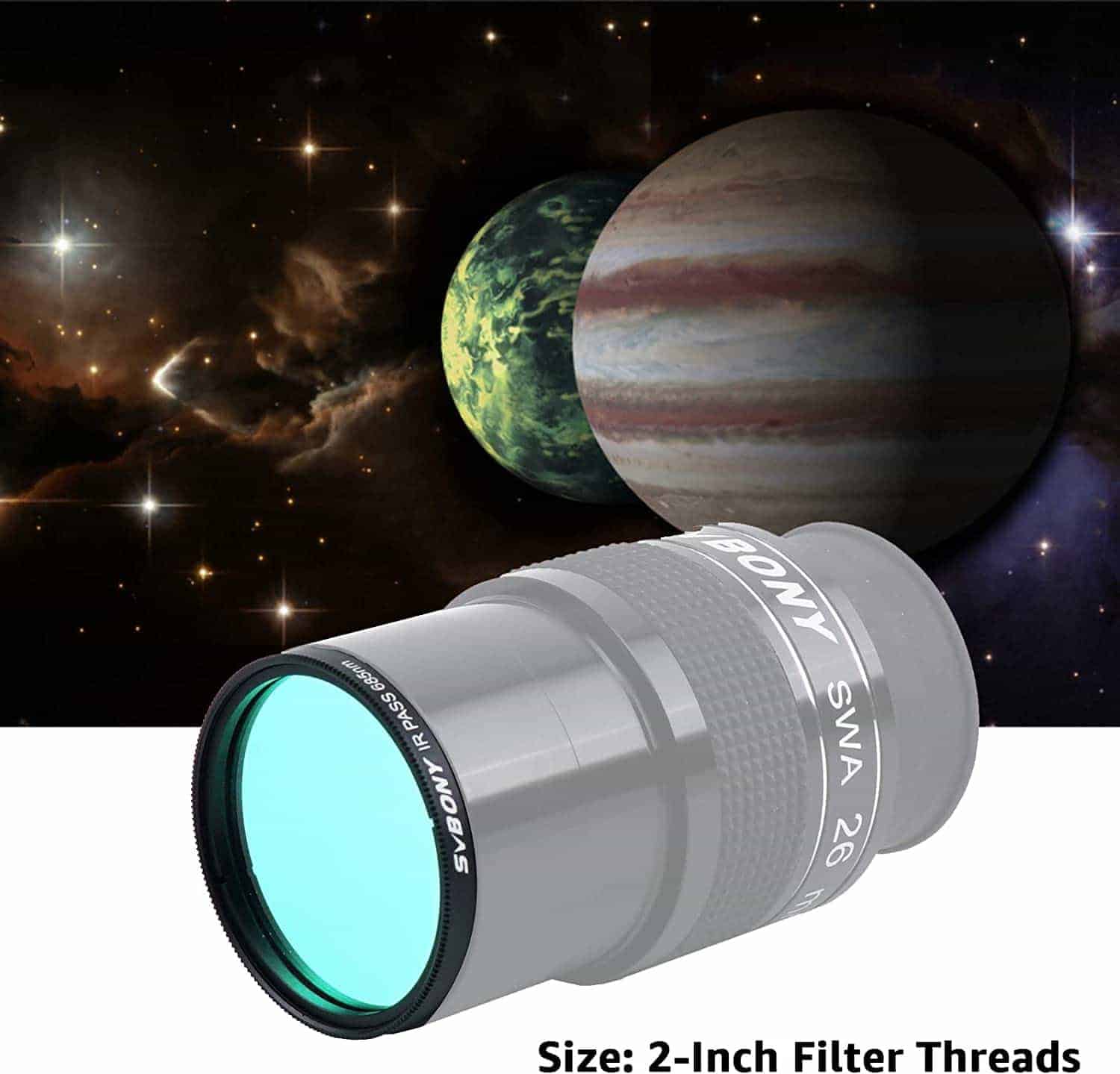
The SVBONY SV183 IR Pass 685 nm is a 2-inch filter designed for imaging the Moon and planets in the near-infrared. It blocks visible light between 400 and 660 nm (OD2) and transmits more than 95% of light from 673 to 1100 nm, which reduces the effect of atmospheric turbulence and enhances contrast.
CHF 40.65incl. Swiss VAT
Part Number W9142B






The SVBONY SV183, part number W9142B, is a 685 nm IR-pass filter in a 2-inch format. It is designed for planetary and lunar imaging: by allowing only deep red and near-infrared light to pass through, it reduces the effects of atmospheric turbulence and brings out surface details.
The cutoff wavelength (T = 50%) is 670 nm. Transmission then exceeds 95% from 673 to 1100 nm. Blocking is indicated at OD2 between 400 and 660 nm. This filter, marketed as the IR Pass 685 nm, is suitable for IR-LRGB imaging of the Moon, Mars, Jupiter, or Saturn, and helps darken the sky background at dawn or dusk.
The filter can also be used for nature photography in the near-infrared spectrum, provided you use a camera capable of detecting light beyond 670 nm, such as a planetary camera or a modified camera.
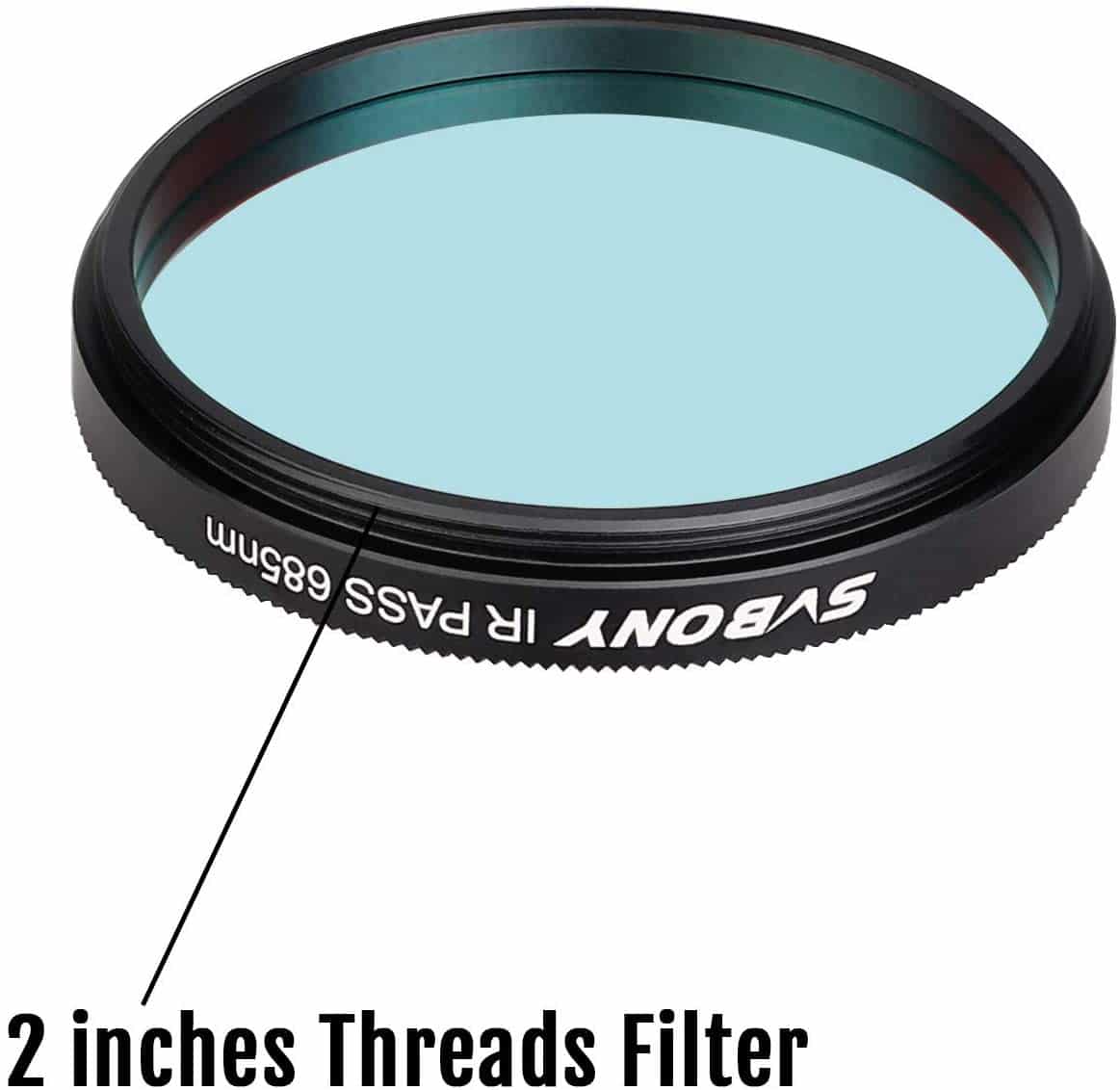
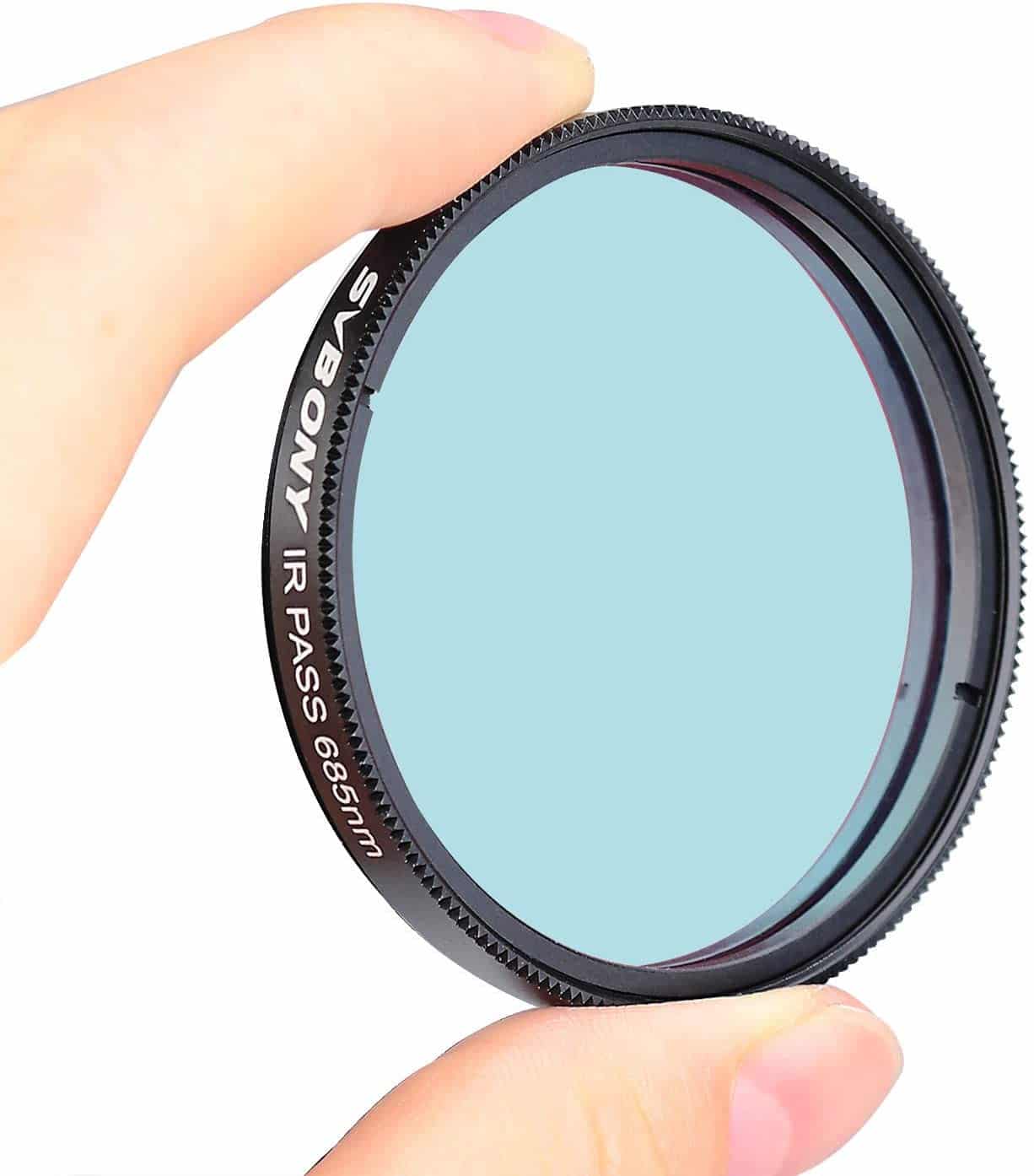
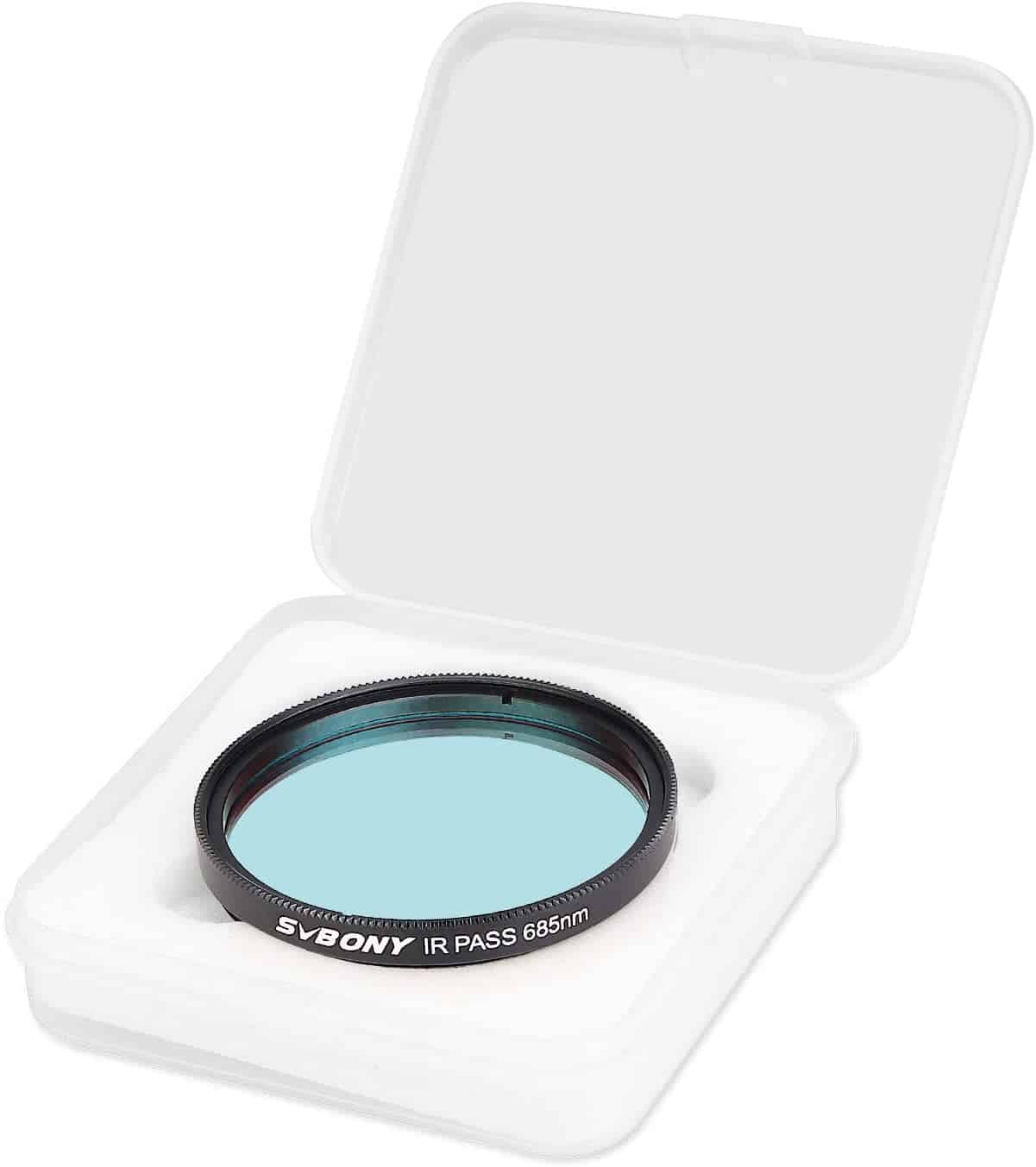
The substrate is 1.1 mm thick SCHOTT B260 glass with a multilayer coating deposited using ion beam assistance. The surface quality is 60/40, the surface parallelism is 1/4 λ, and the parallelism is 30 arcseconds. The cell, made of CNC-machined 6061T6 aircraft-grade aluminum, black anodized and laser-engraved, provides a 44 mm effective aperture. The thread is a standard 2-inch M48 × 0.75. The filter weighs 15 g and comes in a protective case.
This SVBONY filter is not designed for visual observation or for observing the Sun. It is intended exclusively for imaging with a near-infrared camera. A camera that already has a built-in UV/IR cut filter will only allow a portion of the useful signal to pass through.
| Make and model | SVBONY SV183 |
|---|---|
| Reference | W9142B |
| Type | IR Pass Filter for Planetary and Lunar Imaging |
| Format | 2 inches, mounted |
| Thread | M48 × 0.75 |
| Useful opening | 44 mm |
| Glass | SCHOTT B260 |
| Substrate thickness | 1.1 mm |
| Cell | 6061T6 aviation-grade aluminum, black anodized, laser-engraved |
| Surface quality | 60/40 |
| Surface Parallelism | 1/4 λ |
| Parallelism | 30 arc seconds |
| Wavelength range | 350 to 1,100 nm |
| Cut-off threshold (T = 50%) | 670 nm |
| Transmission | More than 95% from 673 to 1100 nm |
| Blocking | OD2 from 400 to 660 nm |
| Net weight | 15 g |
| Use | Imaging only; no visual or solar observations |
No. SVBONY intends it solely for imaging. It is not designed for viewing with the naked eye or for observing the Sun.
A camera sensitive to near-infrared light beyond 670 nm: a planetary camera, a modified CMOS/CCD sensor, or a modified camera. If the camera already has a UV/IR cut filter in front of the sensor, much of the useful signal will be blocked.
The manufacturer specifies a cutoff wavelength (T = 50%) at 670 nm and a transmission greater than 95% from 673 to 1100 nm. The trade name "IR Pass 685 nm" refers to this transmission range in the deep red and near-infrared spectrum.
The thread size is M48 × 0.75, with a 2-inch standard. The effective opening is 44 mm.
Yes, in the near-infrared, provided the camera is sensitive to wavelengths beyond 670 nm. The filter can then highlight differences in vegetation, the sky, and clouds.