More products from the brand :ZWO

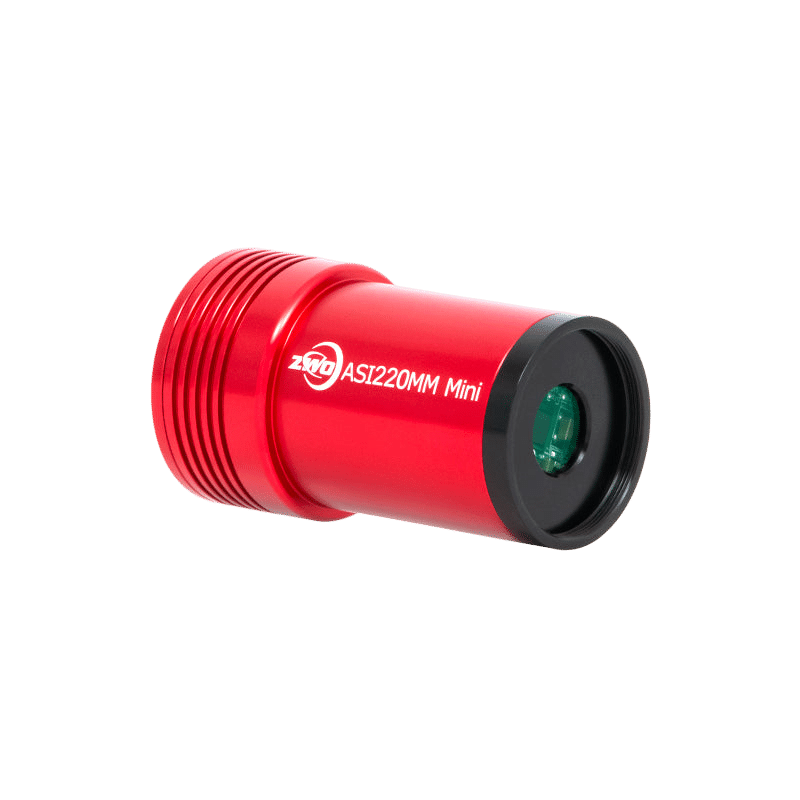
ZWO ASI220MM Mini

SC2210 monochrome autoguiding camera with 4 µm pixels; its 7.68 × 4.32 mm sensor provides a wider field of view than the ASI290MM Mini, which has the same optics. Its 1.25-inch format, 60 g weight, and USB 2.0 Type-C connection make it possible to set up a compact mount on a compatible guide scope or optical splitter.

CHF 242.10incl. Swiss VAT

Part Number ZWO-A142386

Will be ordered for you
Timeframe: 10 days to 3 weeks
Estimated shipping: Between November 19 and 24, 2026

Free shipping in Switzerland on orders of 200 CHF or more
14 days to request a return
Credit Card · TWINT · PayPal · Invoice · Klarna
Free pickup in Nyon · credit card or cash
5 Recommended Products for This Model
Product description

Product description

ZWO ASI220MM Mini: Find a guide star, then track it

The ASI220MM Mini is primarily a monochrome autoguiding camera. Its 1920 × 1080-pixel SC2210 sensor measures 7.68 × 4.32 mm, with 4 µm photosites. The choice is therefore not based on producing large final images, but on the ability to find and measure a guide star within the field of view of the guiding system. Its 1.25-inch body and stated weight of 60 g make it suitable for installations where space and the load on the eyepiece holder are important considerations.

A wider field of view than that of the ASI290MM Mini

ZWO presents the ASI220MM Mini as an evolution of the ASI290MM Mini: the sensor area has increased from 5.6 × 3.2 mm to 7.68 × 4.32 mm, the pixels are larger, and sensitivity in the near-infrared has been improved. Using the same guide scope, this larger sensor area covers a wider portion of the sky and can make it easier to locate a star. However, it does not guarantee a usable star in all directions or with every optical splitter.

The manufacturer specifies a maximum quantum efficiency of 92 % and a readout noise of 0.6 to 3.2 electrons, depending on the settings. These characteristics are useful when the available signal is weak. As a general guideline, look for a star that can be measured without saturation: systematically increasing the gain or excessively shortening the exposure times can degrade the stability of the measurement rather than improve tracking.

Sighting scope or optical divider?

When using a separate guide scope, ensure that the mounts are secure and avoid letting the cables pull on the camera. Even if tracking appears to be correct, this does not necessarily reveal any flexing between the main instrument and the guide scope. With an optical splitter, on the other hand, the camera captures a portion of the beam from the same instrument; check the size of the prism, the actual illuminated field, and whether both cameras can be focused simultaneously.

The focus travel specifications provided by ZWO are 8.5 or 12.5 mm, depending on the mechanical configuration. Do not confuse these with the focus travel required by a photographic corrector; you must examine the entire assembly. The listed adapter combines the 1.25-inch format with an M28.5 × 0.6 thread. The diameter alone is not sufficient to confirm the focus travel or the compatibility of each accessory.

A connection designed for guidance

The USB Type-C connector operates here in USB 2.0 mode: its shape does not indicate USB 3.0. At full resolution, ZWO specifies 14 frames per second in RAW8 and 7 in RAW16. This distinction matters more than a single frame rate displayed without context. The converter remains 12-bit; RAW16 refers to the output format, not a 16-bit sensor. For high-frame-rate, wide-field planetary video, you’re better off comparing it to a camera specifically designed for high-speed capture.

Documentation: ZWO official data sheet.
Back to the sections
Frequently asked questions

Frequently asked questions

What is the ZWO ASI220MM Mini designed for?

The ZWO ASI220MM Mini is designed for autoguiding: mounted on a small guide scope or an optical splitter, it tracks a star and sends corrections to the mount during long exposures. With its 4 µm pixels, it samples at approximately 6.4″ per pixel on an Askar 32 mm guide scope (128 mm focal length) and 4″ on the Askar 52 mm (208 mm). The guide scope is suitable for short- to medium-focal-length imaging; for long focal lengths, the optical splitter is more accurate because it guides through the main instrument.

What makes the ZWO ASI220MM Mini sensor stand out?

The SmartSens SC2210 combines 4.0 µm pixels, a quantum efficiency of 92 %, and a readout noise of 0.6 e⁻: it detects faint guide stars with short exposures. Its modest well capacity (8.78 ke⁻) does not interfere with guiding.

Does the ZWO ASI220MM Mini require a power supply?

No: It is powered by its USB cable. No external power source is required.

What backfocus setting should be used with the ZWO ASI220MM Mini?

The camera's back focus is 8.5 mm. Mounts: 1.25″ and M28.5 × 0.6.

How do I set up the ZWO ASI220MM Mini for guiding?

It slides into the 1.25″ eyepiece holder of a guide scope, such as the'Askar 32 mm or the'Askar 52 mm, or can be mounted on an optical splitter. The ST4 port allows corrections to be sent directly to the mount; when using a computer or an ASIAIR, guiding is most often done via USB.

Where can I find the ZWO ASI220MM Mini manual?

The manufacturer's manual (in English) is available here: ZWO ASI220MM Mini Manual (PDF).

Technical specifications

Technical specifications

Technical specifications

Sensor
SmartSens SC2210
Color / black-and-white
Monochrome
Sensor Size
1/1.8″
Sensor Dimensions
7.68 × 4.32 mm
Sensor diagonal
8.81 mm
Resolution
2.1 megapixels
Resolution in pixels
1920 × 1080
Pixel size
4.00 µm
Shutter
Roll-up
ADC Converter
12 bits
Playback noise
0.6 e⁻
Well Capacity
8.78 ke⁻
Maximum quantum efficiency
92 %
Cooling
No
Interface
USB 2.0 (Type-C)
ST4 Port (autoguiding)
Yes
Speed
14 frames per second
Backfocus
8.5 mm
Threads / Connections
1.25″ and M28.5 × 0.6
Protective window
Anti-reflective (AR)
Case diameter
36 mm
Camera weight
60 g
Power supply
Powered by the USB cable
Camera Uses
Guidance
Recommended Products (5)

Recommended Products (5)

How to Care for Your Instrument

Here are a few accessories we've selected for this model, depending on your needs.

ZWO OAG - Classic

ZWO splitter for guiding through the telescope with this Mini camera, as an alternative to a guide scope. Check the connections, the focus, and the position of the prism.

CHF 107.10

ZWO OAG-L

Large-prism splitter for guiding light through the instrument with this Mini camera, as an alternative to the traditional OAG or a guide scope. Check the prism’s mounting, focus, and position.

CHF 152.10

Takahashi TGT05000 - GT-50 Guide Scope

Separate guide camera and eyepiece. 31.7 mm push-fit mounting: allow at least 14.5 mm of skirt in front of the sensor; check the back focus, focus, and tightness. Direct mounting on M42 does not allow for focusing. Check the finder mount. A guide scope is an alternative to an optical splitter.

CHF 234.23
Documentation

Products in the same category

[category_menu_mobile]