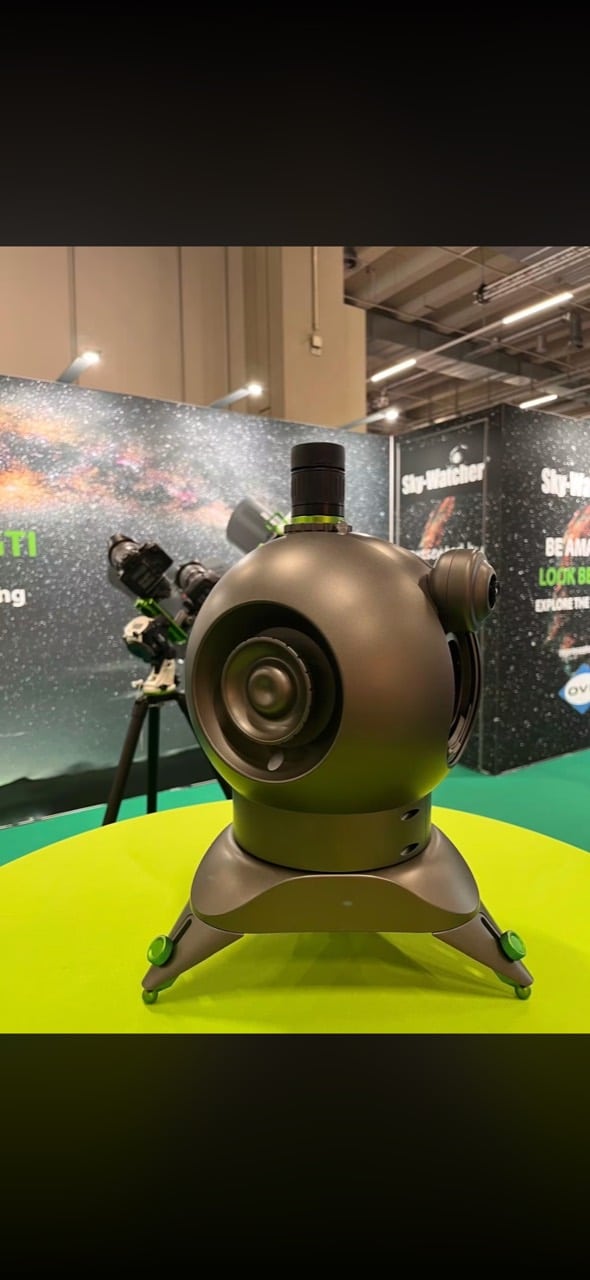
At the’Imaging World 2026 in Nuremberg, Sky-Watcher unveiled the ORBIS 60EDX, billed as its first “smart telescope.” Amid all the smartphone-controlled instruments, it has one feature that immediately stands out at the booth: a real eyepiece. You can let the device locate and photograph an object, then return to the pleasure of observing it directly.
Sky-Watcher ORBIS 60EDX, front view at the booth. Photos courtesy of Carlos Burkhalter.
Two Ways of Looking at It
On most smart telescopes, observing is done through the screen: the device points at the sky, takes a series of exposures, and gradually builds an image. The ORBIS 60EDX uses this same principle, featuring a motorized mount, autofocus, and an app that locates objects, captures images, stacks the exposures, and processes them.
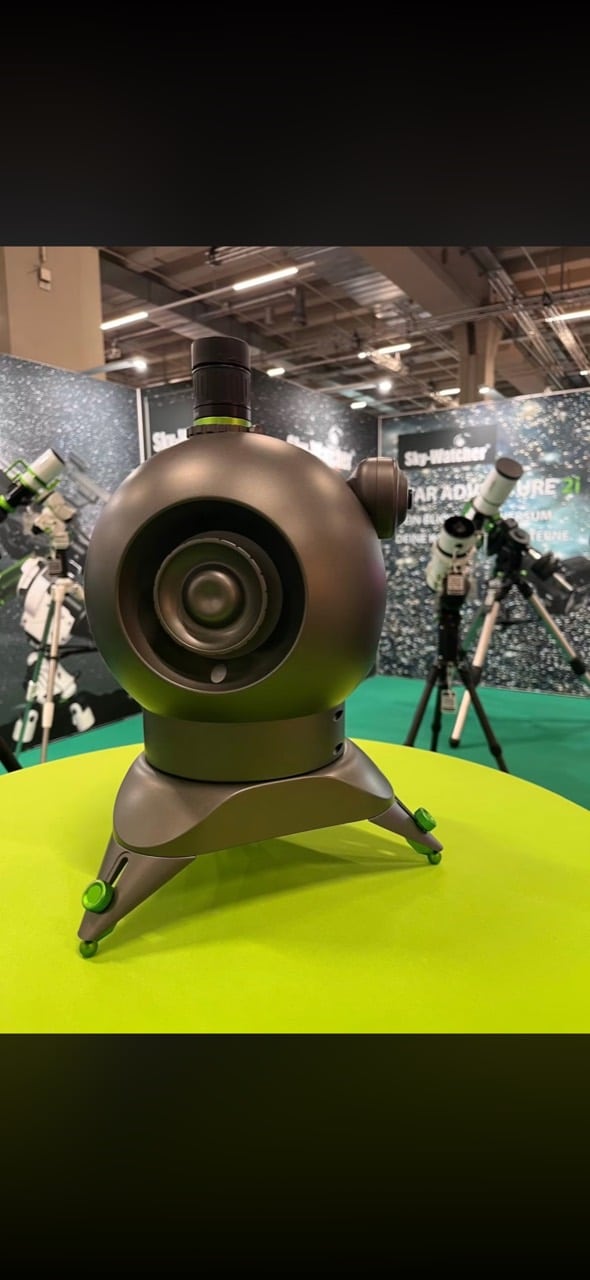
But the eyepiece changes your relationship with the instrument. To show someone the Moon, track a planet, or simply take the time to look, all you have to do is put your eye to the telescope. The lunar craters will be an obvious subject for observation; for Saturn and its rings, the view will depend largely on the magnification selected and how steady the sky is. You’ll need to try out the telescope at night to see what it actually shows.
Sky-Watcher ORBIS 60EDX, three-quarter view with the eyepiece. Photos courtesy of Carlos Burkhalter.
A 60-mm lens and two Sony sensors
According to the specifications presented at the trade show, the ORBIS has a 60-mm aperture, a 300-mm focal length, and a focal ratio of f/5. By way of comparison, a 60-mm diameter represents a theoretical collecting area 44 % greater than that of a 50-mm instrument. This is a real gain in light on paper, even though the final result also depends on the optics, the sensor, and image processing.
The main imaging channel would use a Sony IMX585, an 8.3-megapixel STARVIS 2 sensor with a resolution of 3840 × 2160. A second camera, equipped with an IMX662, would be used for tracking and wide-angle views of the sky. Sony is introducing these two sensors such as high-sensitivity models. However, we’ll have to wait for raw images taken with the ORBIS to assess its performance in astrophotography.
Integrate everything to observe faster
The project follows the philosophy behind smart telescopes: minimizing adjustments that delay the first observation. The mount must locate the target and track it, while the autofocus and the app handle the imaging. Sky-Watcher also announces built-in filters, 128 GB of storage, and a 10,000 mAh battery. The type of filters, actual battery life, and file export options will need to be clarified in the final specifications.
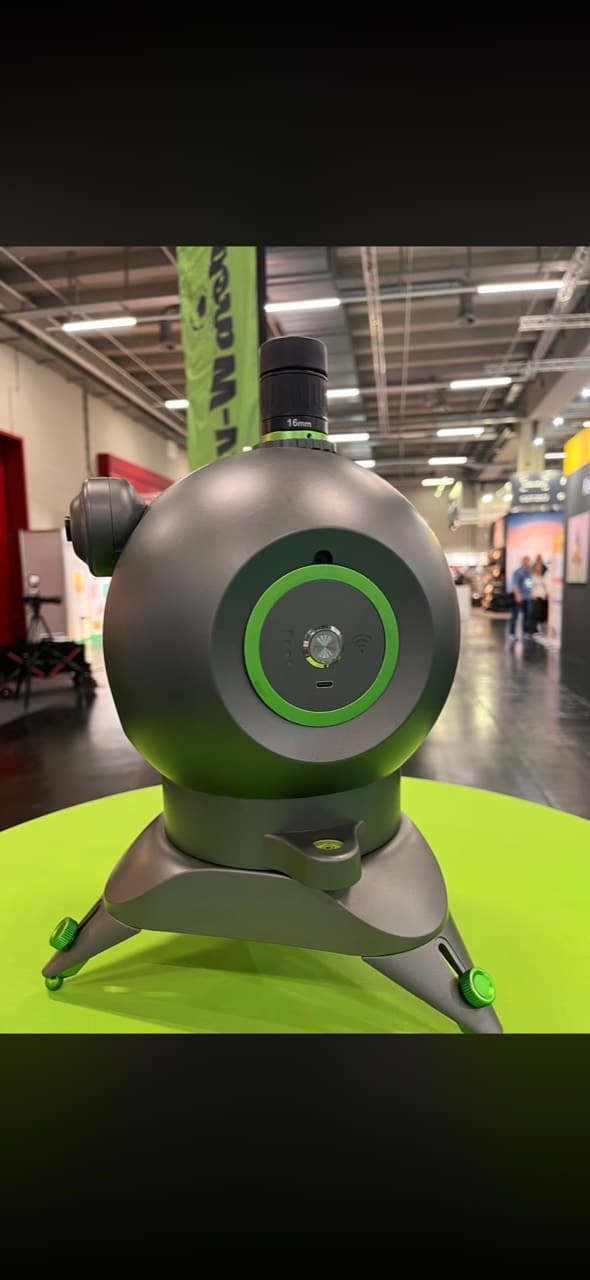
On the back, the photo shows a central control panel, a USB-C port, and the wireless connection label. The unit rests on a small three-legged base. This compact design seems intended for quick setup, but its stability and ergonomics will need to be evaluated during a session under the stars.
Sky-Watcher ORBIS 60EDX, rear view showing the central control unit and the USB-C port. Photos courtesy of Carlos Burkhalter.
The Promise to Be Tested Under the Stars
The concept behind the ORBIS 60EDX is appealing: it combines the simplicity of automated astrophotography with eyepiece observation in a single device. This second use prevents an entire evening of stargazing from being reduced to a single photo on a phone, without sacrificing the convenience of automatic search and tracking.
The model on display in Nuremberg already gives a clear idea of this ambition. To fully evaluate the experience, we still need a test flight, a complete product spec sheet, a price, and a release date. The specifications above are based on information provided at the trade show; they are subject to change in the final retail version.
Photos: ORBIS 60EDX at the Sky-Watcher booth at Imaging World 2026. Photos courtesy of Carlos Burkhalter. Additional sources: organizer of Imaging World and Sony Semiconductor.
To provide the best experiences, we use technologies such as cookies to store and/or access device information. Consenting to these technologies will allow us to process data such as browsing behavior or unique IDs on this site. Failure to consent or withdrawal of consent may adversely affect certain features and functions.
Functional
Always active
Storage or technical access is strictly necessary for the legitimate purpose of enabling the use of a specific service explicitly requested by the subscriber or user, or for the sole purpose of transmitting a communication over an electronic communications network.
Preferences
Storage or technical access is necessary for the legitimate purpose of storing preferences not requested by the subscriber or user.
Statistics
Storage or technical access used exclusively for statistical purposes.Storage or technical access which is used exclusively for anonymous statistical purposes. In the absence of a subpoena, voluntary compliance by your Internet service provider or additional third-party records, information stored or retrieved for this sole purpose generally cannot be used to identify you.
Marketing
Storage or technical access is necessary to create user profiles in order to send advertisements, or to track the user on a website or on several websites with similar marketing purposes.