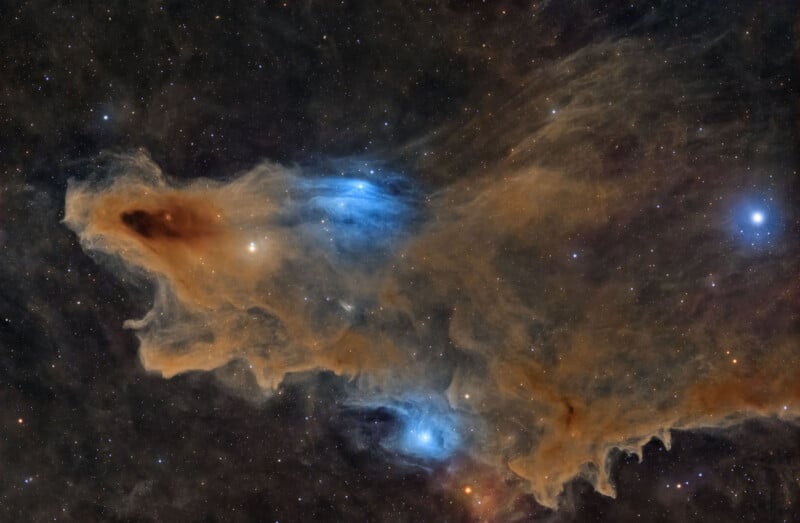
On September 17, 2026, the Royal Observatory Greenwich announced the winners of the 18th annual ZWO Astronomy Photographer of the Year competition. Nearly 4,000 images, 769 photographers, 66 countries. The overall winner, Ali Alobaidly of Kuwait, received 10,000 pounds for his image of the Shark Nebula (LDN 1235). He is the first overall winner in the contest’s history to come from Kuwait.
The overall winner: The Quiet Predator
The winning image, titled «The Quiet Predator,» shows the Shark Nebula, LDN 1235, a dark nebula composed of dense dust that blocks the light from the stars behind it. Photographed from the Jahra Governorate in Kuwait, the image reveals remarkably delicate dust structures, with bluish reflection nebulae and distant galaxies visible through the dust filaments.
Steve Marsh, a judge for the contest and art editor of BBC Sky at Night Magazine, said: «Sometimes a photograph comes to life through its impeccable presentation, razor-sharp details, and dynamic contrast of light and shadow. This image is one of those. The Shark Nebula is already a striking object, but when it’s resolved to the point where you can see highly detailed galaxies within it, you know you’re looking at something truly special.»
Ali Alobaidly described the award as an «immense honor» and said he hopes to use his photographs to make astronomy more accessible, engaging, and meaningful through science communication and education.
The eight categories
The contest features eight main categories, plus two special awards and an open category.
Stars and Nebulae
This is the overall winner's category. Ali Alobaidly (Kuwait) took the title with *The Quiet Predator*.
- Winner: Ali Alobaidly, Kuwait – The Quiet Predator (Nébuleuse du Requin, LDN 1235). Overall winner.
- Second: Kfir Simon, Israel – Beyond the Wormhole.
- Note: Humbert Cédric, France – Abell 85.
Auroras (Aurorae)
- Winner: Radoslav Sviretsov, Bulgaria – The Crown (Northern Lights, Iceland).
- Second: Phil Halper, United Kingdom – Aurora Between Two Continents.
- Note: MaryBeth Kiczenski, United States – *On the Edge of Glory*.
Our Moon
- Winner: Petr Horalek, Czech Republic – Venusian Pearl on the Moon (Venus in front of the Moon).
- Second: Raul Cantemir, Germany – Plato and Vallis Alpes.
- Note: Tom Williams, United Kingdom – Pythagoras Crater.
Our Sun
- Winner: Miguel Claro, Portugal – Active Region 4122 (solar active region, detail of the chromosphere).
- Second: Peter Ward, Australia – Anatomy of the Chromosphere.
- Note: James McBeath, United Kingdom – Moody Partial Solar Eclipse.
Planets, Comets, and Asteroids (Planets, Comets, and Asteroids)
- Winner: Tom Williams, United Kingdom – Saturnian Equinox (Saturn with rings, viewed edge-on).
- Second: Tom Williams, United Kingdom – The Uranian System (Uranus and its moons).
- Note: Julien DeWinter, Belgium, and Landon Boehm, United States – Comet C/2025 A6 (Lemmon).
People and Space
- Winner: Max Inwood, New Zealand – A Message From the Ancients (composition featuring people and a starry sky, California).
- Second: Dan Zafra, Spain – Capture the Night.
- Note: AJ Smadi, United States – Golden Moonrise Over Seattle.
Earthly Skies (Skyscapes)
- Winner: Stefano Pellegrini, Italy – Botswana Star Trail (starlight trails in Botswana).
- Second: Tom Rae, New Zealand – Cosmic Canyon.
- Note: João Yordanov Serralheiro, Portugal – I Hear the Stars.
Galaxies
- Winner: Zhipeng Yan and Xinran Li, China – NGC 4753: A Symphony of Dust Lanes in Virgo (NGC 4753, Virgo Cluster).
- Second: Patrick Winkler, Austria – M104: Pure Elegance (Sombrero Galaxy).
- Note: Shaoyu Zhang, China – Wildflowers Across a Neighboring Galaxy: The Large Magellanic Cloud.
Special Offers
Sir Patrick Moore Award for Best Newcomer
- Winner: Haocheng Zhu, China – M1: Echoes of an Ancient Explosion (Crab Nebula, M1).
This award honors a photographer who only recently began practicing astrophotography. Haocheng Zhu photographed the Crab Nebula, the remnants of a supernova observed by Chinese astronomers in 1054.
ZWO Young Astronomy Photographer of the Year
Category for photographers aged 15 and under. Each category winner receives 1,500 pounds sterling.
- Winner: Nikolaos Strimpoulis, age 15, Greece – Mineral Moon (enhanced colors of the lunar seas).
- Second: Kaiyan Ma, age 15, China – M20, the Trifid Nebula.
- Credits: Yu Chen Lin, age 14, China – *Celestial Enchantress*; Shamiqh Gajdhar, age 14, India – *A Sphere of Opposites*; Benjamin and Joshua Lawler – *The Heart Nebula*.
Annie Maunder Open Category
This category is open to images that have been freely edited and composed, with no restrictions on editing.
- Winner: Pawel Wawrzyniak, Poland – Reverse Astronomy: Mother.
The Contest by the Numbers
- 18th edition (since 2009).
- Nearly 4,000 images submitted.
- 769 photographers participants.
- 66 countries represented.
- 10,000 pounds sterling (~12,700 CHF) for the overall winner.
- 1,500 pounds sterling (~1,900 CHF) for each category winner.
- 750 pounds sterling (~950 CHF) for each special offer.
The Exhibition
The winning photographs have been on display at the National Maritime Museum in Greenwich, London, since September 18, 2026. Admission is free. The exhibition features all the winning and finalist photographs, along with the equipment and techniques used by the photographers.
For more information: Royal Observatory Greenwich – Astronomy Photographer of the Year.
What This Contest Says About Astrophotography in 2026
The technical quality of the winning images reflects several trends in amateur astrophotography in 2026:
The fineness of the resolution. The winning image shows distant galaxies through a dark nebula. The resolution is such that objects of magnitude 15–18 are visible in the background. This requires a dark sky, a precise mount, and long exposures.
The diversity of topics. The categories range from planetary objects (Saturn, Uranus) to deep-sky objects (galaxies, nebulae), including the Sun, the Moon, the auroras, and compositions featuring people. Astrophotography isn’t limited to deep-sky objects: the Sun, the Moon, and the auroras are disciplines in their own right.
Accessibility for young people. The ZWO Young category shows that 14- and 15-year-olds are producing professional-quality images. Nikolaos Strimpoulis, 15, photographed a lunar landscape with color processing of remarkable precision. Equipment is more accessible than ever, but talent and patience remain essential.
The French-speaking community. Humbert Cédric, from France, received an honorable mention in the Stars and Nebulae category for Abell 85. This marks a French-speaking presence in a competition dominated by the United States, the United Kingdom, and China.
Sources : BBC Sky at Night Magazine – Astronomy Photographer of the Year 2026 ; Royal Observatory Greenwich – APoTY 2026 ; BBC News – Nebula Image Wins Royal Observatory Competition ; PetaPixel – The 31 Out-of-This-World Winners
See also on Deep Space Astronomy: PixInsight LRGB Tutorial: Processing a Galaxy from Stacking to Color (2026)
Signature: CBurkhalter