Sky-Watcher Skyliner 150, 200, and 250: A Guide to Choosing Your First Dobsonian Telescope and Preparing for Your Observation Session (Checklist Included) (October 2026)
Are you looking for a telescope to get started in astronomy without breaking the bank? Sky-Watcher Skyliner Dobson telescopes are probably the best value for the money. Three aperture sizes, three price points, one design principle: a large parabolic mirror mounted on a simple, stable mount. But setting up a Dobsonian takes some preparation. Here’s the complete guide to choosing yours, setting it up, and preparing for your first observing session. And at the bottom, you’ll find a checklist to print out before heading out.
All the info at a glance
Skyliner 150P : 153 mm, f/8, focal length 1200 mm, in-store
Skyliner 250P : 254 mm, f/5, focal length 1200 mm, in-store
Mirrors : parabolic, RAQ treatment (94 % reflectivity), secondary mirror mounted on thin 0.5 mm arms
Eyepieces included : 12.5 mm and 20 mm, 70-degree wide angle (all three models)
Researcher : 6×30 on the 150P, 9×50 on the 200P and 250P
Mount : Wooden Dobsonian, alt-azimuth, non-motorized
Accessories included : universal smartphone adapter, DSLR camera adapter
Attention : These telescopes often sell out quickly, especially the 200P and the 250P
Why a Dobsonian?
A Dobsonian is a Newtonian telescope mounted on a wooden alt-azimuth mount. No motors, no electronics, no equatorial mount to adjust. You point the tube by hand, track objects by hand, and that’s it. Simplicity itself.
The advantage? The entire budget goes toward the optics. While a motorized mount and a 150-mm tube cost more, a 200-mm Dobsonian with a larger mirror costs less. The diameter-to-price ratio of Skyliner Dobson telescopes is unbeatable in the Sky-Watcher catalog.
The downside? No automatic tracking. You have to manually move the tube to track objects. It’s a skill you can learn in five minutes. And as for photography, forget about it: a Dobsonian isn’t designed for long-exposure imaging. It’s an instrument for visual observation.
Skyliner 150P: The First Telescope ()
The Skyliner 150P is the smallest in the line. It has a diameter of 153 mm, a focal length of 1,200 mm, and an aperture of f/8. It has an f/8 aperture, which means the mirror is less open: images are sharp, the collimation is forgiving, and the Moon, planets, and star clusters appear with excellent contrast.
It gathers 73 % more light than a 114 mm telescope. That’s enough to observe Saturn’s rings, Jupiter’s bands, lunar craters, globular clusters (M13, M3), and the most beautiful nebulae (M42, M27) under a dark sky.
Magnifications supplied : 60x (with the 20 mm) and 96x (with the 12.5 mm). Theoretical maximum magnification: 306x. In practice, magnifications between 50x and 200x are used, depending on atmospheric turbulence.
For whom? Beginners looking for their first serious telescope without spending too much. The 150P is the least expensive model in the line, but don't underestimate it: under a truly dark sky, it can already reveal galaxies (M51, M81, M82).
Skyliner 200P: the best-seller ()
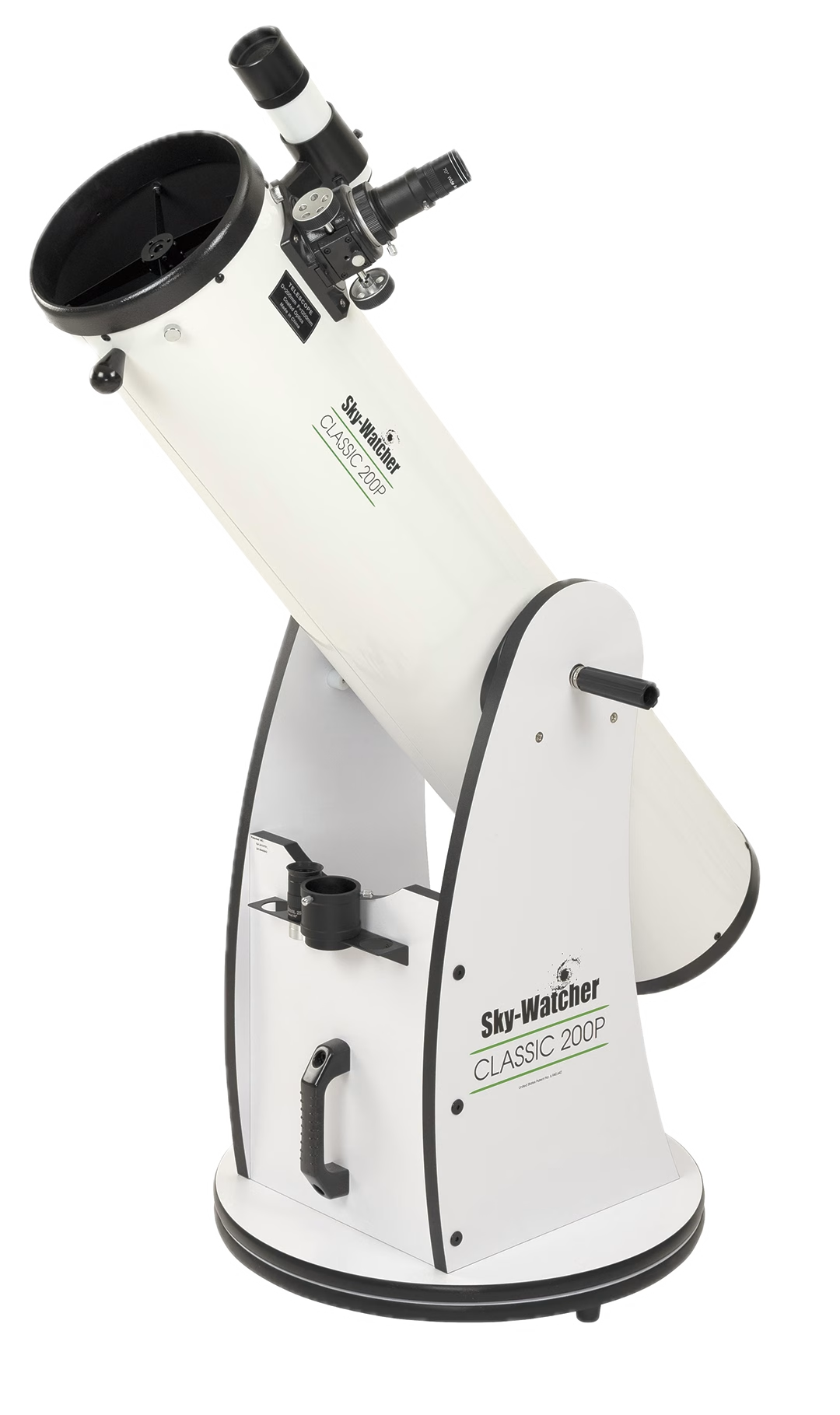
Sky-Watcher Skyliner 200P Classic, a 203 mm f/5.9 Dobsonian telescope. Credit: Sky-Watcher.
The Skyliner 200P It is the best-selling Dobsonian in Europe, and for good reason. 203 mm in diameter, 1,200 mm focal length, f/5.9. It gathers 77 % more light than the 150P. This difference is immediately apparent with faint objects: galaxies are brighter, nebulae appear more expansive, and the spiral arms of M51 begin to emerge.
BBC Sky at Night Magazine tested it and wrote: «Saturn was breathtaking: five visible moons, a clearly defined Cassini Division, and even a color difference between the A and B rings.»
Magnifications supplied : 48x (with the 20 mm) and 120x (with the 12.5 mm). Theoretical maximum magnification: 406x. The finder scope is a 9×50, which is significantly more comfortable than the 6×30 on the 150P.
For whom? The beginner who wants to see more, and the hobbyist who wants a versatile instrument. The 200P is the ideal compromise: enough aperture for deep-sky observing, enough focal length for planetary observing, and a price that remains affordable.
Attention : The 200P is currently available for order, with an estimated shipping time of 10 days to 3 weeks. These Dobsonians are often out of stock, especially in the fall when everyone wants to observe Saturn and Jupiter.
Skyliner 250P: the big brother ()
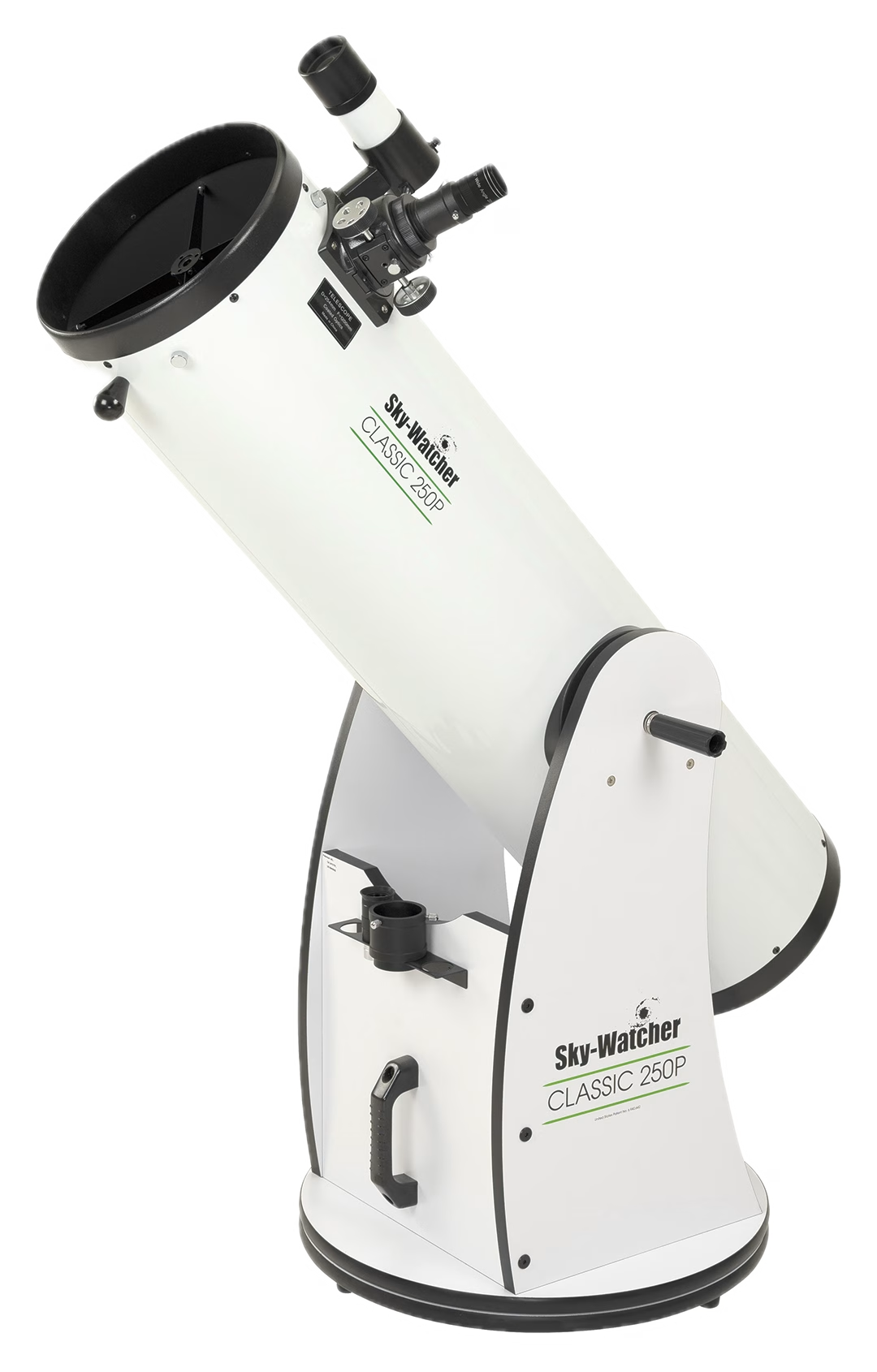
Sky-Watcher Skyliner 250P Classic, a 254 mm f/5 Dobsonian telescope. Credit: Sky-Watcher.
The Skyliner 250P increases the diameter to 254 mm, still at a focal length of 1,200 mm but at f/5. It collects 56 % more light than the 200P. With faint objects, the difference is striking: M57 (the Ring Nebula) reveals fine details, M13 (the Hercules Cluster) resolves its individual stars at 250x, and the galaxies M81 and M82 show their structures.
Sir Patrick Moore, the legendary British astronomer, said of Sky-Watcher: «In my opinion, the Sky-Watcher line is excellent, suitable for all amateur astronomers, and the prices remain very affordable. It offers exceptional value for the money.»
Magnifications supplied : 60x (with the 20 mm) and 96x (with the 12.5 mm). Theoretical maximum magnification: 508x. The finder scope is a 9×50, just like on the 200P.
For whom? For the enthusiast who wants to take it to the next level. The 250P is bulkier and heavier than the 200P, but the difference in light output makes it worth it. It’s in stock at our store, but here too: it often sells out.
Recommended Accessories
A Dobsonian telescope is ready to use right out of the box: the 12.5 mm and 20 mm eyepieces are included. But to get the most out of the telescope, a few accessories can make a real difference.
Collimation laser
A Dobsonian telescope has a primary mirror and a secondary mirror that must be aligned (collimated). A collimation laser makes this process simple and precise. Insert the laser into the eyepiece holder, observe where the dot lands on the primary mirror, and adjust the screws until the dot returns to the center.
A Barlow lens multiplies the magnification of an eyepiece by its magnification factor (2x or 3x). With the included 12.5 mm eyepiece at 96x, a 2x Barlow lens provides 192x magnification, and a 3x Barlow lens provides 288x magnification. This is convenient for planetary observation without having to buy an additional eyepiece.
For planetary observation (Jupiter, Saturn, Mars), you need high magnification. With a 1,200 mm focal length, a 5 mm eyepiece provides 240x magnification, and a 6 mm eyepiece provides 200x magnification. The included eyepieces aren't sufficient for this.
Two options:
A short planetary eyepiece (5–6 mm), such as the Tele Vue Nagler Type 7 5.5 mm at: 218x with an apparent field of view of 82 degrees, offering exceptional visual comfort
The SVBONY zoom (coming soon to the store): a single eyepiece that covers multiple focal lengths—handy for beginners and for finding the right magnification
Lunar filter
The Moon looks stunning through a 200 mm lens. A lunar filter reduces the light for greater comfort and reveals the details of the Moon's surface. The Celestron 1.25" Moon Filter is a simple and effective option.
For high-end enthusiasts: Tele Vue
For those who want to get the most out of their setup, Tele Vue offers legendary eyepieces. The Nagler Type 6 13 mm It offers an 82-degree field of view at 92x magnification with impeccable image quality. Combined with a Barlow Tele Vue 2x, the 13 mm Nagler provides 184x magnification: perfect for Jupiter, with the comfort of a wide field of view.
The DeLite 11 mm It's a compact alternative to 109x, with a 62-degree field of view and a 20-mm eye relief. With a 3x Barlow lens, it goes up to 327x for Saturn. That's quite the setup.
Preparing for Your Outing
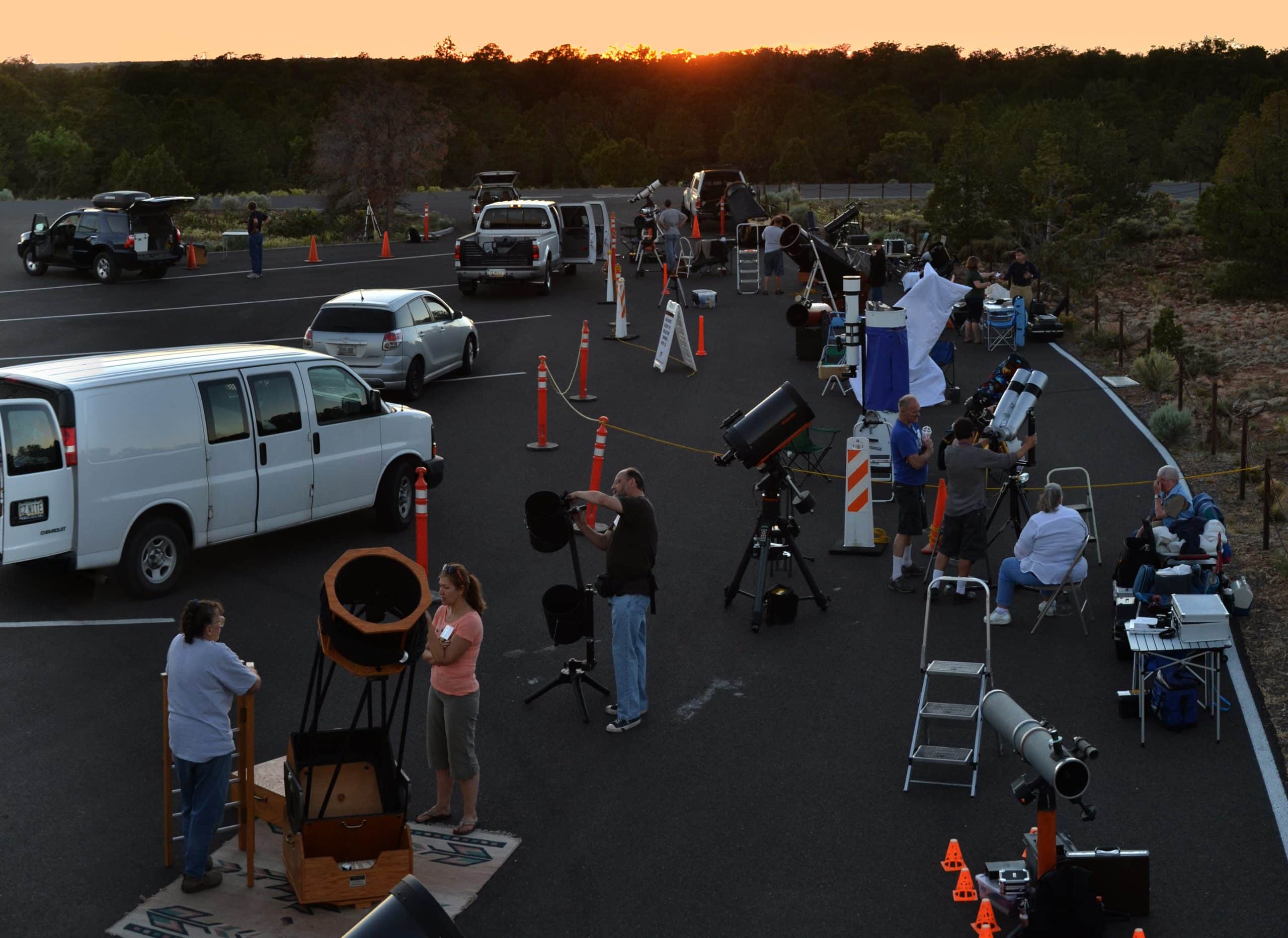
Star party at Grand Canyon National Park: amateur astronomers gathered under the stars with their telescopes. Credit: National Park Service (NPS), public domain, via Wikimedia Commons.
A successful stargazing trip requires some preparation before you head out. Here are the steps:
Check the weather : In Switzerland, MeteoSwiss does an excellent job. For astronomy, you want a clear, cloudless sky with good transparency. Specialized websites such as Clear Outside or MeteoBlue provide detailed astronomical forecasts.
Learn About the Current Sky : What’s visible this month? Saturn at opposition, Jupiter rising in the second half of the night, and the fall Messier objects (M31, M45, M27). Planning your targets in advance improves your chances of finding them. A star chart (Stellarium, SkySafari) is essential.
Setting Up the Telescope : Collimate before going outside (or at dusk), set up the finder scope, and check that the eyepieces are clean and within reach. If the finder scope uses batteries, check that they are working.
Warm clothes : You'll be standing still for hours at a time at night. The wind chill makes it feel 5 to 10 degrees colder than the daytime temperature. Be sure to wear several layers, a hat, gloves, and warm socks.
Checklist Before Going Out
A little teaser in the title: Here's the complete checklist to print out or take a picture of before every outing.
☐ Telescope (tube + mount)
☐ Collimation laser (check alignment before leaving)
☐ Eyepieces ready (the 20 mm for locating, the 12.5 mm for magnification, and a short one for planetary observation)
☐ Searchlight battery (if motorized or illuminated)
☐ Current sky conditions and prepared targets (sky map, Stellarium, list of objects)
☐ Warm clothes (multiple layers, hat, gloves)
☐ Check the weather (MeteoSwiss for Switzerland)
☐ Small camping table for setting things down
☐ Chairs (one per person, plus one for putting things on)
☐ Red light (for glare-free viewing; red light preserves the eyes' ability to adjust)
☐ Coffee and water (it's a long night)
☐ Something to eat (chocolate, fruit, cookies)
☐ Try astro-sketching: even if you’re terrible at drawing, trying to reproduce what you see makes you observe much more closely. You’ll notice details you would have missed just by looking. A sketchbook, a pencil, a red lamp—and you’re all set.
In a nutshell
The Skyliner 150P, 200P, and 250P Dobsonians are the telescopes with the best diameter-to-price ratio on the market. For beginners: the 150P at. To see more: the 200P at. To go the extra mile: the 250P at. All are in-store, but be warned: they often sell out quickly. If you're on the fence, order before they're gone.
To provide the best experiences, we use technologies such as cookies to store and/or access device information. Consenting to these technologies will allow us to process data such as browsing behavior or unique IDs on this site. Failure to consent or withdrawal of consent may adversely affect certain features and functions.
Functional
Always active
Storage or technical access is strictly necessary for the legitimate purpose of enabling the use of a specific service explicitly requested by the subscriber or user, or for the sole purpose of transmitting a communication over an electronic communications network.
Preferences
Storage or technical access is necessary for the legitimate purpose of storing preferences not requested by the subscriber or user.
Statistics
Storage or technical access used exclusively for statistical purposes.Storage or technical access which is used exclusively for anonymous statistical purposes. In the absence of a subpoena, voluntary compliance by your Internet service provider or additional third-party records, information stored or retrieved for this sole purpose generally cannot be used to identify you.
Marketing
Storage or technical access is necessary to create user profiles in order to send advertisements, or to track the user on a website or on several websites with similar marketing purposes.