On the evening of October 27, 2026, the gibbous Moon will pass through the Pleiades star cluster (M45) in Taurus. Visible throughout Switzerland and France, this event is fascinating to observe with both binoculars and a telescope: the stars in the cluster disappear and then reappear one by one behind the lunar disk. Here’s how to observe and photograph it, with concrete examples from French astrophotographers.
All the info at a glance
Date: the night of October 27–28, 2026
Start: Around 11:07 p.m. (CET) on October 27, the Moon reaches M45
Closest approach: around 2:27 a.m. (CET) on October 28, 0° 56′
End: around 4:29 a.m. (CET) on October 28
Coverage: All of Switzerland and all of France, starting this evening
Moon: waning gibbous, ~94 % illuminated (just after the full moon on the 26th)
Constellation: Taurus, rising in the east in the evening and reaching its highest point in the night sky
Recommended equipment: 10×50 binoculars or a 70–100 mm telescope
With the naked eye: difficult—the Moon is too bright for M45
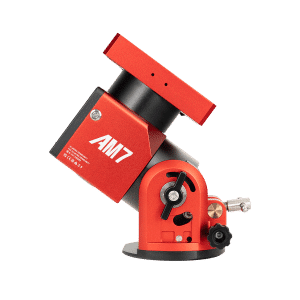
For astrophotography: a 200–300 mm telephoto lens or an 80–105 mm refractor on the following mount
What is an occultation?
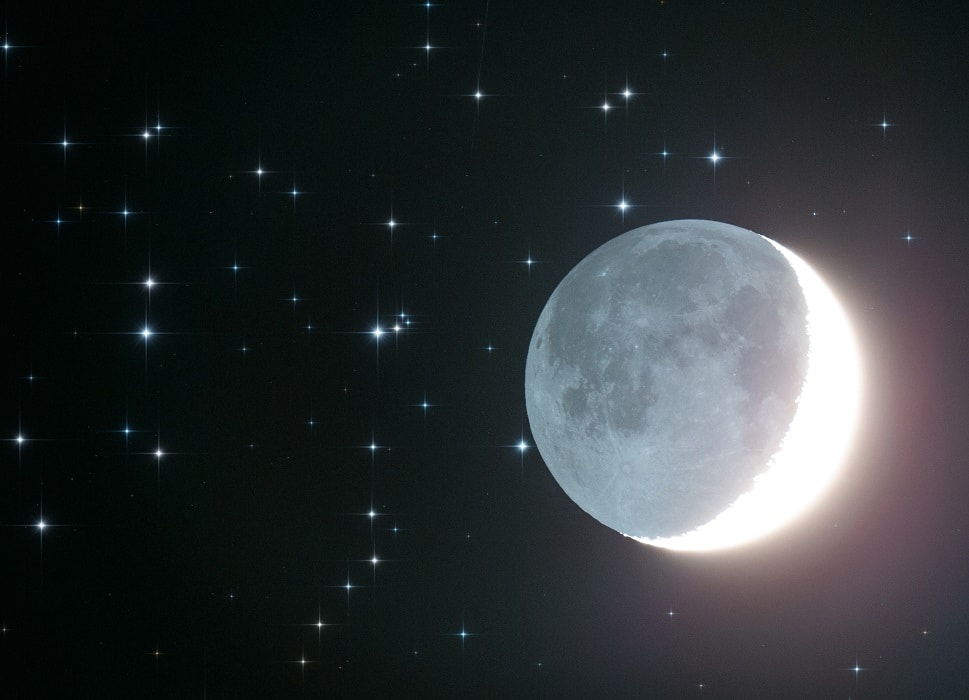
Lunar occultation of the Pleiades, April 1, 2025. Astro-Physics EDT 105 mm f/6 telescope, 3-second exposure. Credit: Emmanuel Beaudoin / Ciel & Espace.
An occultation occurs when the Moon passes in front of a celestial object and obscures it. In the case of the Pleiades, the cluster lies just 4 degrees from the ecliptic: the Moon therefore regularly passes nearby and occulted it about once a month. However, a total occultation—in which the Moon passes completely across the cluster—occurs only at certain times, when the Moon is high enough in the sky at the moment of the passage.
On October 27, 2026, the Moon is waning gibbous (94 % illuminated, just after the Full Moon on the 26th). It is very bright: M45, with a magnitude of 1.6, is difficult to see with the naked eye due to the Moon’s glare. But through binoculars or a small telescope, the contrast between the lunar disk and the blue stars of the Pleiades is striking. The stars disappear one by one behind the Moon’s illuminated limb, then reappear on the other side, on the darkened limb.
How to Observe It from Switzerland and France
The event can be seen in its entirety from both Switzerland and France. The Pleiades rise in the east in the early evening and reach their highest point in the sky during the night. Taurus is an autumn constellation that is well-positioned for European observers.
Through binoculars: With 10×50 binoculars, the occultation is spectacular. The wide field of view lets you see the Moon and the Pleiades together, as well as the stars disappearing behind the Moon’s disk. Mount the binoculars on a stand or a camera tripod for greater comfort and stability.
Through the telescope: A 70- to 100-mm telescope or a small reflector is sufficient. High magnification isn’t necessary: 30x to 50x provides a wide field of view where you can see both the Moon and the cluster together. Manual tracking is sufficient: the Moon moves slowly relative to the Pleiades, about one lunar diameter per hour.
How to Photograph It: Practical Examples
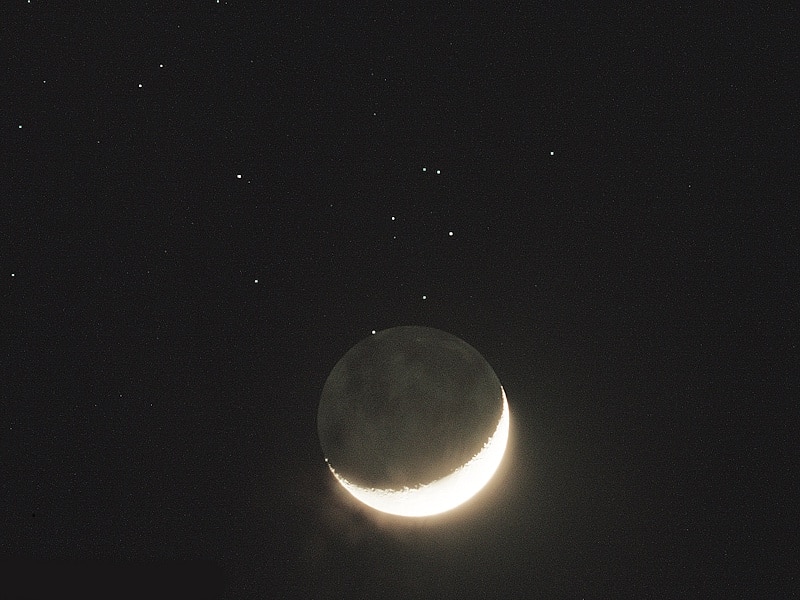
Lunar occultation of the Pleiades, April 1, 2025, Perrouse (Haute-Saône). TS APO 94 EDPH telescope at 412 mm, 1-second exposure. Credit: ShadowsPro.
The occultation of the Pleiades by the Moon has already been photographed by French and Swiss astrophotographers, notably on April 1, 2025, during a similar event. Here are two specific examples, along with the techniques used.
Example 1: Emmanuel Beaudoin, Chevreuse (France)
Emmanuel Beaudoin, an astrophotographer and contributor to Ciel & Espace, photographed the occultation on April 1, 2025, from the hills above Chevreuse, France. His setup:
Telescope: Astro-Physics EDT 105 mm at f/6 (focal length 630 mm)
Exposure: 3 seconds, single frame
Objective: to capture the Moon and its ashen glow as it visits the Pleiades
Technique: single application, no layering, light treatment for aesthetic purposes
The result: a perfectly balanced image of the Moon and its ashen glow among the blue stars of the cluster. A 3-second exposure is enough to capture the Moon in detail, but the Pleiades cluster remains visible thanks to the Moon’s ashen light, which gently illuminates the darkened edge.
Example 2: ShadowsPro, Perrouse, Haute-Saône (France)
Another French astrophotographer, ShadowsPro, photographed the same occultation from Perrouse (Haute-Saône). His setup:
Lens: TS APO 94 EDPH, 412 mm, f/4.4
Mount: EQ6-R Pro on a fixed column
Camera: ZWO ASI 2600MC Pro, cooled to -10°C
Exposure: 1 second, single frame
Acquisition: ASIair Plus
The result: a single one-second exposure is enough to capture the Moon and the Pleiades together. The ZWO ASI 2600MC Pro cooled camera offers excellent signal-to-noise ratio even with short exposures, and the 412-mm TS APO 94 EDPH telescope provides a wide enough field of view to frame both the Moon and the cluster together.
Which technique is best for which setup?
The two examples above use different techniques:
Short single exposure (1 to 3 seconds): The Moon is bright, so a short exposure is sufficient. The Pleiades cluster remains visible thanks to the ashen glow and appropriate exposure times. No need for stacking: a single well-exposed image yields a usable result. A cooled camera (ZWO ASI 2600MC Pro) or a DSLR/mirrorless camera mounted on a suitable mount will do the trick.
Telephoto lens on a tripod (without tracking): A 200- to 300-mm lens mounted on a camera tripod, with an exposure time of 1 to 2 seconds at ISO 1600–3200, captures the Moon-M45 conjunction in a single frame. It’s simpler and faster than a full telescope setup.
Next pair of eyeglasses: An 80- to 105-mm telescope mounted on one of the following equatorial mounts (EQ6-R Pro, AM5N, or similar) allows for 1- to 3-second exposures with excellent detail on the Moon and the stars. This is the setup used in the two examples above.
Wide-angle for landscapes: A wide-angle lens (24–50 mm) captures the landscape with Taurus, the Moon, and the Pleiades all together. The Moon is small, but the overall composition is beautiful. A few-second exposure on a tripod, ISO 1600–3200.
Recommended equipment (available in our store)
To observe and photograph the occultation, here is the appropriate equipment, available in our store:
80–100 mm eyepiece on the following mount: ideal for wide-field views of the Moon and the Pleiades
10×50 binoculars: for visual observation; mounted on a tripod for stability
200–300 mm telephoto lens on a camera tripod: for astrophotography without a telescope
Next equatorial mount: for 1- to 3-second exposures without panning
Why shop at Deep Space Astronomy?
We're not just a retailer. We test, advise, and provide support.
Personalized Advice : We'll help you choose the right equipment for your local sky, your budget, and your goals. By phone, WhatsApp, or by appointment in Nyon.
After-Sales Support : Do you have a question about installing, aligning, or editing your images? We're here to help.
14-Day Return Policy : Not satisfied? Return the product within 14 days.
Secure payment : Twint, credit card, invoice, Apple Pay, Bitcoin. Pay in 3 or 4 installments with no fees.
Free shipping in Switzerland Starting at CHF 200. Free pickup in Nyon.
Sources
This article draws on examples of astrophotography published by Emmanuel Beaudoin in *Ciel & Espace* (April 2, 2025) and by ShadowsPro (Perrouse, Haute-Saône, April 1, 2025). The times for the occultation on October 27–28, 2026, have been verified using NASA Skywatching Tips. Photo credits are attributed to their respective authors.
To provide the best experiences, we use technologies such as cookies to store and/or access device information. Consenting to these technologies will allow us to process data such as browsing behavior or unique IDs on this site. Failure to consent or withdrawal of consent may adversely affect certain features and functions.
Functional
Always active
Storage or technical access is strictly necessary for the legitimate purpose of enabling the use of a specific service explicitly requested by the subscriber or user, or for the sole purpose of transmitting a communication over an electronic communications network.
Preferences
Storage or technical access is necessary for the legitimate purpose of storing preferences not requested by the subscriber or user.
Statistics
Storage or technical access used exclusively for statistical purposes.Storage or technical access which is used exclusively for anonymous statistical purposes. In the absence of a subpoena, voluntary compliance by your Internet service provider or additional third-party records, information stored or retrieved for this sole purpose generally cannot be used to identify you.
Marketing
Storage or technical access is necessary to create user profiles in order to send advertisements, or to track the user on a website or on several websites with similar marketing purposes.