Mercury reaches its greatest western elongation from the Sun on November 20, 2026. This is its best viewing window in the fall mornings. Low in the east before dawn, the fleeting planet can be seen with the naked eye if the horizon is clear. But behind this bright spot lies a surprising planet: some astrophotographers have managed to capture its sodium tail, which stretches 2.5 million kilometers long.
All the info at a glance
Date: Maximum western elongation on November 20, 2026
Angular separation: approximately 19° west of the Sun
Magnitude: approximately -0.4 (bright)
Visibility: 30–45 minutes before sunrise, low in the east-southeast
Optimal window: November 20–21, 2026
Constellation: Libra, then Virgo
Phase: approximately 60–70 % (gibbous)
Apparent diameter: approximately 5–6 arcseconds
Visible from: all of Switzerland and all of France
Equipment: Viewable with the naked eye; 10×50 binoculars recommended; 70 mm+ telescope for this phase
Difficulty: moderate (clear view required)
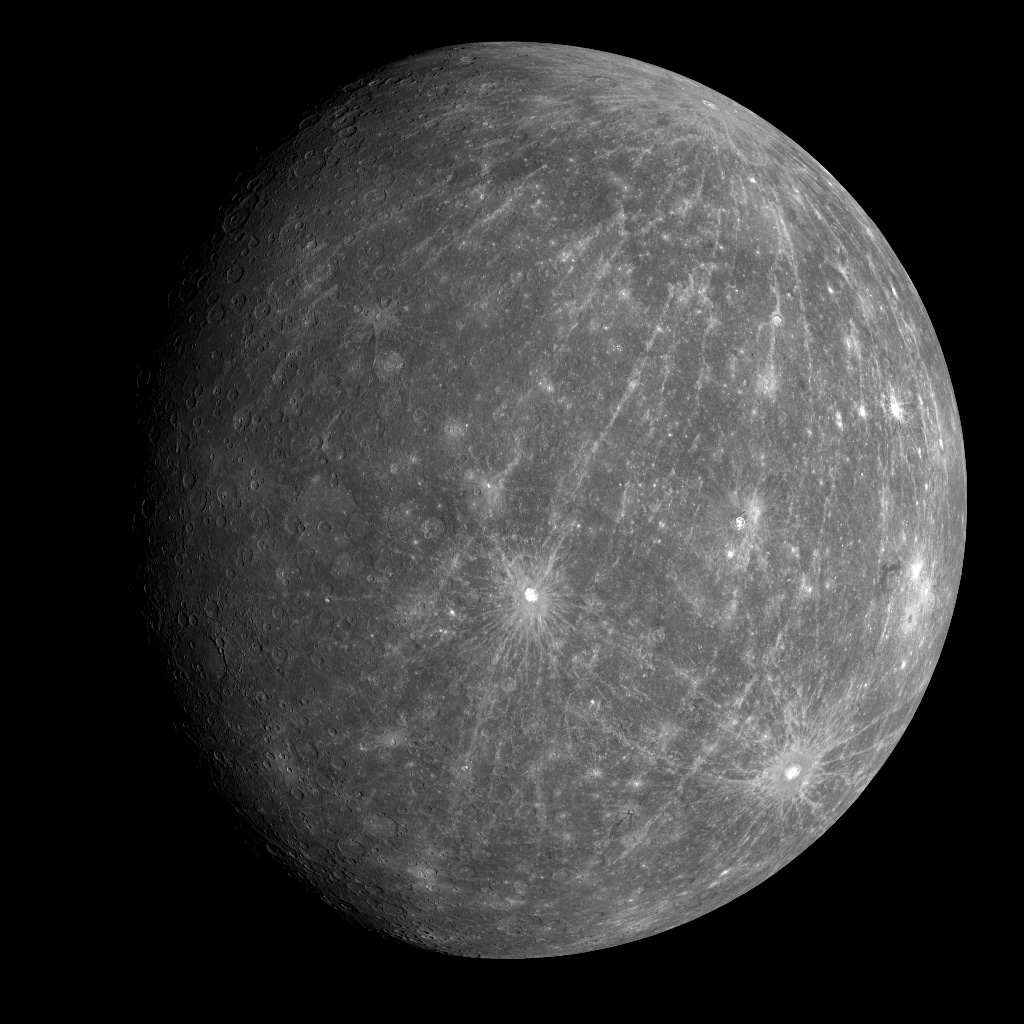
Mercury as seen by the MESSENGER spacecraft. Credit: NASA / JHU APL / Carnegie Institution of Washington. Public domain, via Wikimedia Commons.
When and Where to Watch: A Practical Guide
Mercury is the hardest planet to see in the solar system. Not because it is faint, but because it never strays very far from the Sun. On November 20, 2026, it reaches its greatest western elongation: about 19° west of the Sun. This is a morning elongation: Mercury rises before the Sun.
The viewing window is narrow. 30 to 45 minutes before sunrise, look low in the east-southeast. The sky is beginning to brighten, but Mercury is still visible. Too early: Mercury is too low. Too late: the Sun drowns it out with its brilliance.
From Switzerland (latitude 46–47° N), Mercury reaches an altitude of about 10–15° above the horizon at the optimal viewing time. This is better than the eastern elongation in October (8–10°), because in November the ecliptic forms a wider angle with the eastern horizon. But it’s still low: a tree, a building, or a hill to the east-southeast is enough to block it from view. Choose a clear horizon.
How to Spot Mercury
Look for a bright, pinkish-white point of light that shines brighter than the surrounding stars. At magnitude -0.4, Mercury is brighter than most stars visible to the naked eye. But it is low on the horizon, where atmospheric refraction and haze make it harder to see.
Through 10×50 binoculars: Mercury appears as a bright point, not as a disk. This is enough to locate it and confirm its presence. Through a 70 mm+ telescope at 50x–100x magnification: a small disk appears, showing a phase (gibbous, approximately 60–70 %). This is one of the rare cases where a planet displays a visible phase through a telescope.
Use an app (Stellarium, SkySafari, Star Walk) to locate Mercury before looking for it with the naked eye. Point toward the east-southeast, and the app will tell you exactly where to look.
Mercury's Sodium Tail: When Astrophotography Gets Wild
Mercury looks like a comet. This was revealed by Dr. Sebastian Voltmer, a German astrophotographer based in Spicheren, France, in a series of photos that went viral on social media and was selected as NASA’s Image of the Day (APOD, May 3, 2022).
The solar wind and micrometeorites strip sodium atoms from Mercury’s surface. This sodium, illuminated by the Sun, forms a yellow-orange tail of sodium gas about 2.5 million kilometers long. It’s like a comet’s tail, but emanating from a planet. The phenomenon was predicted in the 1980s and observed for the first time two decades later.
Voltmer captured this tail from the Roque de los Muchachos Observatory on La Palma, using a 135-mm lens and a 589-nm filter tuned to the sodium emission line. Without this filter, the tail is invisible to the naked eye. With it, the tail appears in its full length. Voltmer also photographed Mercury’s surface (craters) using planetary imaging with a C11 EdgeHD telescope and documented the rapid evolution of the sodium tail over the course of a week.
His Ph.D. in scientific photography (University of Applied Arts Vienna) and his work at the intersection of media theory and astronomy have enabled him to take this type of photography to a level rarely achieved. His images are protected by copyright: we do not reproduce them here, but you can view them on his website (voltmer.photo) and his X account (@SeVoSpace).
For those who’d like to give it a try: you’ll need a 589-nm filter (sodium filter), a 135-mm lens or a telescope, a sensitive CCD or CMOS camera, and a very dark sky. The tail is most visible when Mercury is near the Pleiades, which isn’t the case in November 2026. However, the elongation on November 20 remains the best time to observe the planet itself.
Why this stretch is better than the one in October
The elongation on October 12, 2026 (already covered on the blog) was an evening elongation: Mercury was visible after sunset, low in the west. In the fall, the ecliptic forms a shallow angle with the western horizon in the Northern Hemisphere. Mercury remained very low (8–10°).
The western elongation on November 20 is a morning elongation. In the fall, the ecliptic is more open toward the eastern horizon. Mercury rises higher before dawn: 10–15° in altitude, sometimes higher depending on the latitude. This makes for more comfortable observing, even if it means getting up early.
Recommended Equipment
With the naked eye : enough to spot Mercury in a clear sky with an unobstructed horizon.
10×50 Binoculars : to locate and confirm. The best value for the money.
70–100 mm Telescope : to observe the phase of Mercury (gibbous). A compact Maksutov (MK105 Pro for CHF 299) or a planetary telescope is ideal.
150 mm+ Telescope : to analyze the phase in greater detail. Caution: Never point the telescope at the Sun.
A planetarium app (Stellarium, SkySafari) is essential for locating Mercury before sunrise.
Why shop at Deep Space Astronomy?
We're not just a retailer. We test, advise, and provide support.
Personalized Advice : We can advise you on choosing the right instrument for observing the planets based on your local sky conditions and your budget. By phone, WhatsApp, or by appointment in Nyon.
After-Sales Support : Do you have a question about the location, equipment, or processing of your images? We're here to help.
14-Day Return Policy : Not satisfied? Return the product within 14 days.
Secure payment : Twint, credit card, invoice, Apple Pay, Bitcoin. Pay in 3 or 4 installments with no fees.
Free shipping in Switzerland Starting at CHF 200. Free pickup in Nyon.
This article is based on the ephemeris data from EarthSky (Mercury’s greatest western elongation, November 2026), In-The-Sky.org (Mercury elongation, November 20, 2026), and on Dr. Sebastian Voltmer’s work on Mercury’s sodium tail (APOD, May 3, 2022; voltmer.photo; @SeVoSpace). The image of Mercury is from the MESSENGER spacecraft (NASA / JHU APL / Carnegie Institution of Washington), in the public domain, via Wikimedia Commons.
To provide the best experiences, we use technologies such as cookies to store and/or access device information. Consenting to these technologies will allow us to process data such as browsing behavior or unique IDs on this site. Failure to consent or withdrawal of consent may adversely affect certain features and functions.
Functional
Always active
Storage or technical access is strictly necessary for the legitimate purpose of enabling the use of a specific service explicitly requested by the subscriber or user, or for the sole purpose of transmitting a communication over an electronic communications network.
Preferences
Storage or technical access is necessary for the legitimate purpose of storing preferences not requested by the subscriber or user.
Statistics
Storage or technical access used exclusively for statistical purposes.Storage or technical access which is used exclusively for anonymous statistical purposes. In the absence of a subpoena, voluntary compliance by your Internet service provider or additional third-party records, information stored or retrieved for this sole purpose generally cannot be used to identify you.
Marketing
Storage or technical access is necessary to create user profiles in order to send advertisements, or to track the user on a website or on several websites with similar marketing purposes.