The Askar SQA70 Pro has just been announced. It’s the Pro version of the SQA70: same compact 70 mm format, but the lens has been upgraded from a quintuplet to a sextuplet Petzval design with SD and ED glass. It’s faster (f/4.6 vs. f/4.8), delivers more uniform performance, and features a flat field over 44 mm. Priced at CHF 1,765 (tax included) in our store, it’s Askar’s new high-end compact telescope for portable deep-sky astronomy.
All the info at a glance
Optics: Petzval APO sextuplet, SD glass (2nd element) + ED glass (4th element)
Opening: 70 mm
Focal length: 322 mm, f/4.6
Field flattener: built-in (Petzval), 44 mm image circle (full frame)
Optical throw: 55 mm recommended (36–68 mm possible)
Price: CHF 1,765, including tax (Swiss VAT included)
Availability: Made to order; lead time: 10 days to 3 weeks
Warranty: 2 years
Brand: Askar, in-store
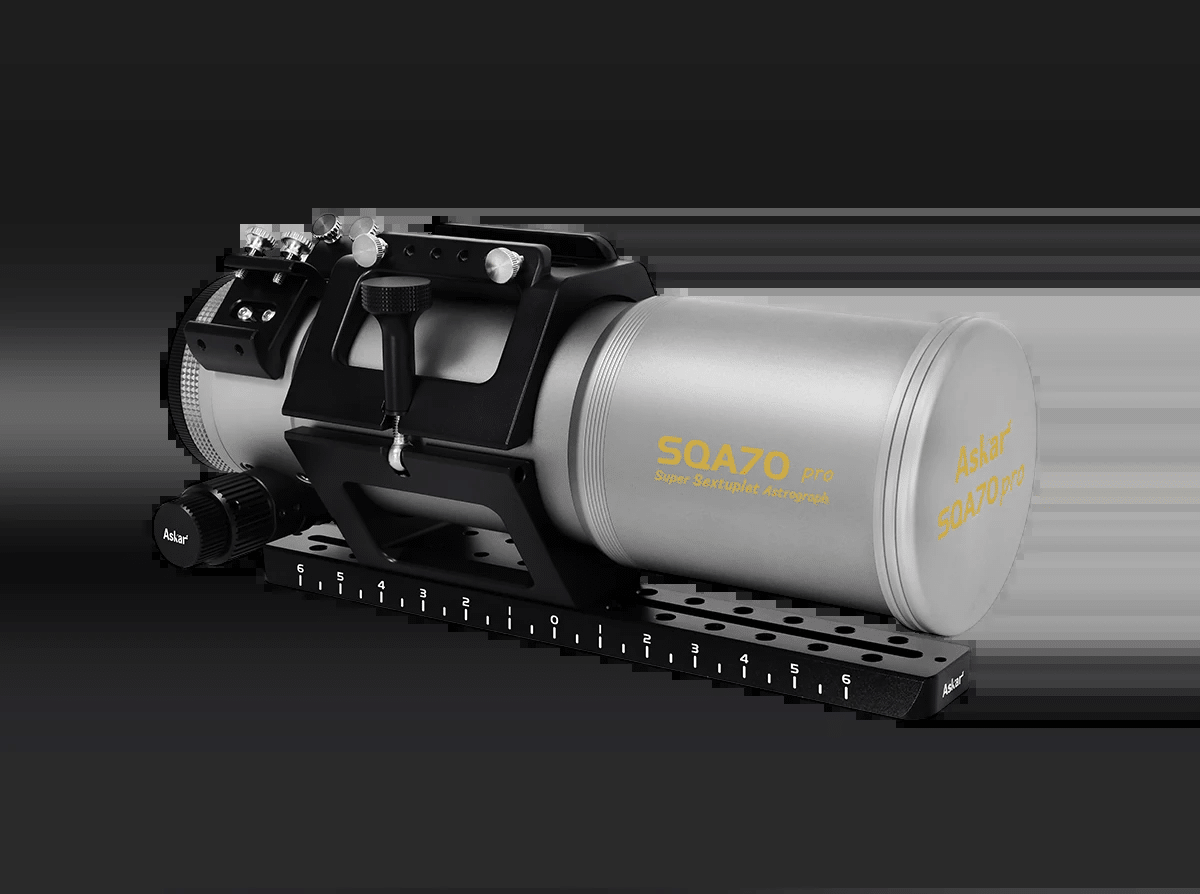
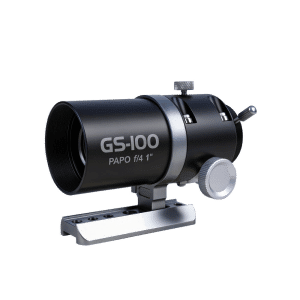
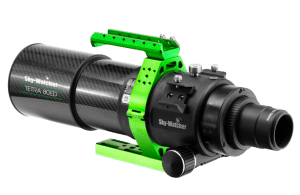
Askar SQA70 Pro: 70 mm f/4.6 Petzval APO sextuplet. Credit: Askar. Photo by Photoroom, background removed.
From Quintuplets to Sextuplets: What Changes
The standard SQA70 is a Petzval quintuplet with 2 ED elements. The SQA70 Pro upgrades to a sextuplet: six lenses, with one SD (ultra-low dispersion) element in addition to the ED element. The result: enhanced chromatic correction, more uniform stars across the entire field, and a flat field over 44 mm without an external flattener.
The focal length changes from 336 mm to 322 mm, and the aperture ratio from f/4.8 to f/4.6. It’s faster: at f/4.6, you capture about 8 % more light per second than at f/4.8. For 60-second exposures, that’s a gain of 5 seconds. Over a 2-hour session, that adds up.
70 mm at f/4.6: the portable lens that thinks big
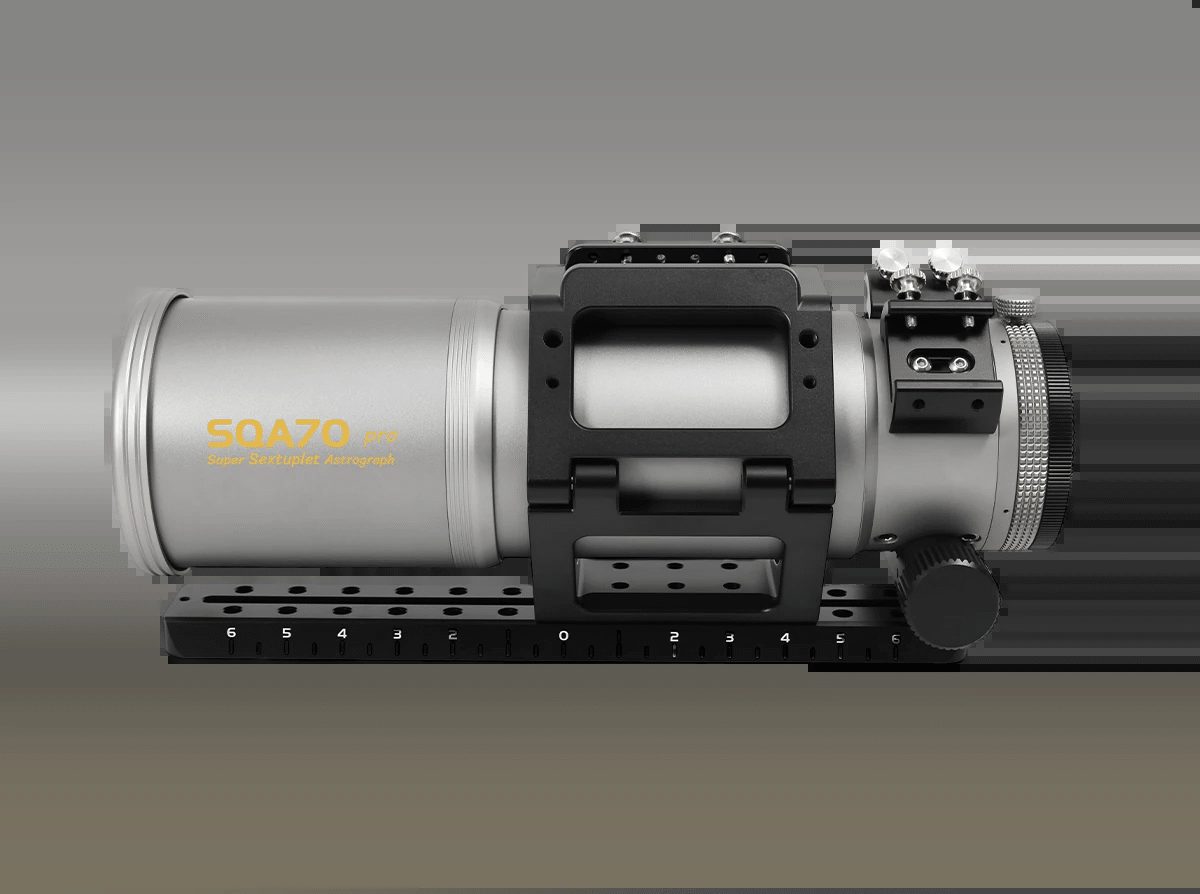
Askar SQA70 Pro: Meticulously crafted, with Vixen clamps and mount included. Credit: Askar. Photo by Photoroom, background removed.
With a focal length of 322 mm and an aperture of f/4.6, the SQA70 Pro is designed for observing large objects: the California Nebula, the North America Nebula, the Rosette Nebula, Heart and Soul, the entire Andromeda Galaxy, and the Pleiades. Exposure times of 60 to 120 seconds are sufficient with a modern camera. With a narrowband filter (H-alpha, OIII), f/4.6 remains bright enough for reasonable exposure times.
Weighing 3 kg and measuring 331 mm, the SQA70 Pro fits in a backpack. It’s the astrograph you take with you under a truly dark sky, far from the city. On a lightweight mount (AM3N, Wave 100i), it doesn’t add much weight. With the camera, filter wheel, and guider, expect a total weight of 5 kg: an HEQ5-R Pro offers plenty of headroom.
SQA70 Pro vs. SQA70: Is It Worth Paying the Extra?
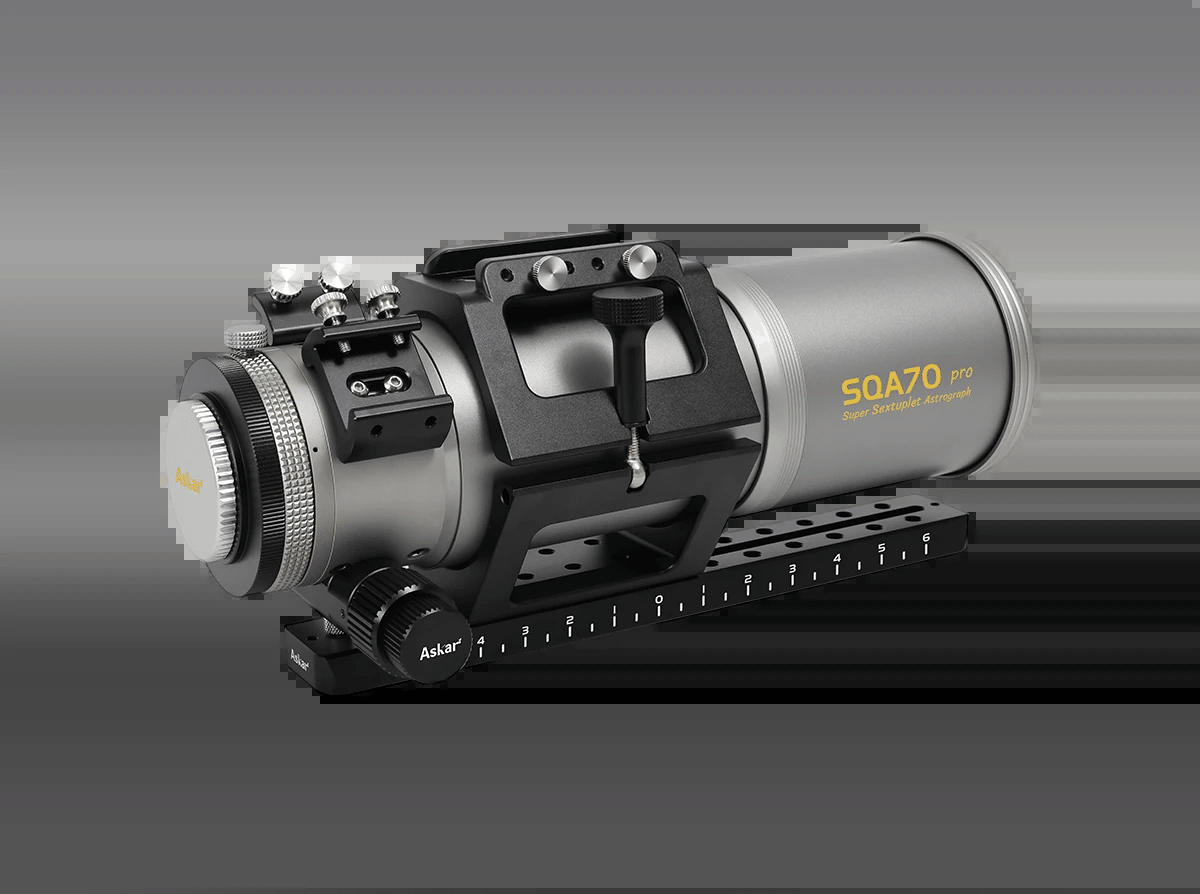
Askar SQA70 Pro: Petzval sextuplet lens with SD + ED glass. Credit: Askar. Photo by Photoroom, background removed.
The standard SQA70 costs CHF 1,399 (including tax). The SQA70 Pro costs CHF 1,765 (including tax). The difference is CHF 366. What do you get for that extra cost?
SD + ED Sextuplet Compared to the ED quintuplet: enhanced chromatic correction, more uniform stars.
f/4.6 Compared to f/4.8: 8 % more light, shorter focal length (322 mm vs. 336 mm), slightly wider field of view.
3 kg compared to 2.68 kg: 320 g more, but that's the price you pay for sextuplets.
For those looking for the best 70 mm compact lens: the SQA70 Pro. For those looking for the best value: the standard SQA70 at CHF 1,399. Both cover the full frame, and both are Petzval lenses without an external flattener.
The Askar SQA Series: Where Does the SQA70 Pro Fit In?
The Askar SQA series includes: SQA55 (55 mm), SQA60 Pro (60 mm, SD sextuplet, f/4.6), SQA70 Pro (70 mm, SD+ED sextuplet, f/4.6, CHF 1,765), SQA85 (85 mm), SQA106 (106 mm), SQA130 (130 mm). All are Petzval lenses with an integrated flat field.
The SQA70 Pro falls between the SQA60 Pro (60 mm, more compact) and the SQA85 (85 mm, wider aperture). It’s the ideal compromise: enough aperture for deep-sky observing, light enough for travel, and Pro-grade optics for the most demanding applications.
Which camera should I use with the SQA70 Pro?
The 44 mm image circle covers the full-frame format (24×36 mm). With an APS-C camera (Sony IMX571, ASI2600MC), the scale is approximately 2.41″ per pixel. With a full-frame camera (IMX455, ASI6200MC), the entire field of view is utilized. M42, M48, and M54 adapters are included. The M48 adapter features a 2-inch filter thread.
Why shop at Deep Space Astronomy?
We're not just a retailer. We test, advise, and provide support.
Personalized Advice : We can advise you on choosing between the SQA70 and SQA70 Pro, or between the SQA60 Pro and SQA70 Pro, depending on your mount and your targets. By phone, WhatsApp, or by appointment in Nyon.
After-Sales Support : Do you have a question about optical reproduction, f/4.6 imaging, or image processing? We're here to help.
14-Day Return Policy : Not satisfied? Return the product within 14 days.
Secure payment : Twint, credit card, invoice, Apple Pay, Bitcoin. Pay in 3 or 4 installments with no fees.
Free shipping in Switzerland Starting at CHF 200. Free pickup in Nyon.
This article is based on the official specifications from Askar (Sharpstar Optics, sharpstar-optics.com), the product page in our store, and the specifications published by High Point Scientific, First Light Optics, and Mile High Astro (2026). Store price: CHF 1,765 (tax included). Standard SQA70: CHF 1,399 (tax included).
To provide the best experiences, we use technologies such as cookies to store and/or access device information. Consenting to these technologies will allow us to process data such as browsing behavior or unique IDs on this site. Failure to consent or withdrawal of consent may adversely affect certain features and functions.
Functional
Always active
Storage or technical access is strictly necessary for the legitimate purpose of enabling the use of a specific service explicitly requested by the subscriber or user, or for the sole purpose of transmitting a communication over an electronic communications network.
Preferences
Storage or technical access is necessary for the legitimate purpose of storing preferences not requested by the subscriber or user.
Statistics
Storage or technical access used exclusively for statistical purposes.Storage or technical access which is used exclusively for anonymous statistical purposes. In the absence of a subpoena, voluntary compliance by your Internet service provider or additional third-party records, information stored or retrieved for this sole purpose generally cannot be used to identify you.
Marketing
Storage or technical access is necessary to create user profiles in order to send advertisements, or to track the user on a website or on several websites with similar marketing purposes.