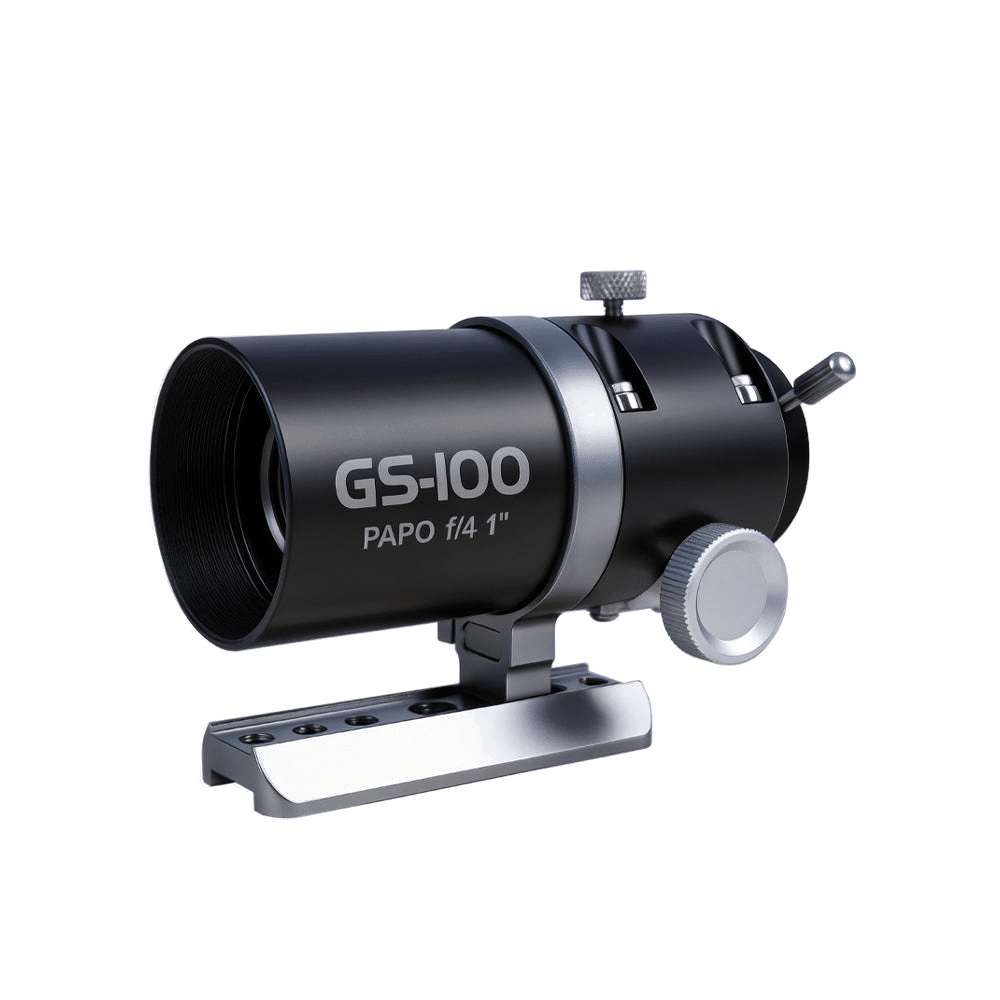
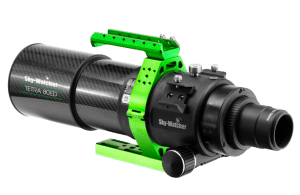
I tested the ToupTek GS-100 PAPO. It’s a 25/100 mm f/4 apochromatic guide scope with four elements and ED glass, which also functions as a wide-field imager. Priced at CHF 149 (including tax) in our store, it’s a three-in-one solution: autoguiding, entry-level wide-field imaging, and a visual observation tool. Here’s what I think of it after using it.
All the info at a glance
Optics: 4 PAPO (plan-apochromatic) elements, ED glass
Aperture: 25 mm (100 mm focal length), f/4
Flat image circle: 1″ (inches)
Two versions: GS-100AC (Crayford) or GS-100AR (rack-and-pinion)
2-inch filter: M48 thread on the front, on the anti-fog screen
Mounting plate: Vixen mini rail with M6 mounting points and 3/8″-16 thread
Price: CHF 149, including tax (Swiss VAT included)
Warranty: 2 years
Brand: ToupTek, in-store
Review: Extremely well-crafted construction, very rigid map
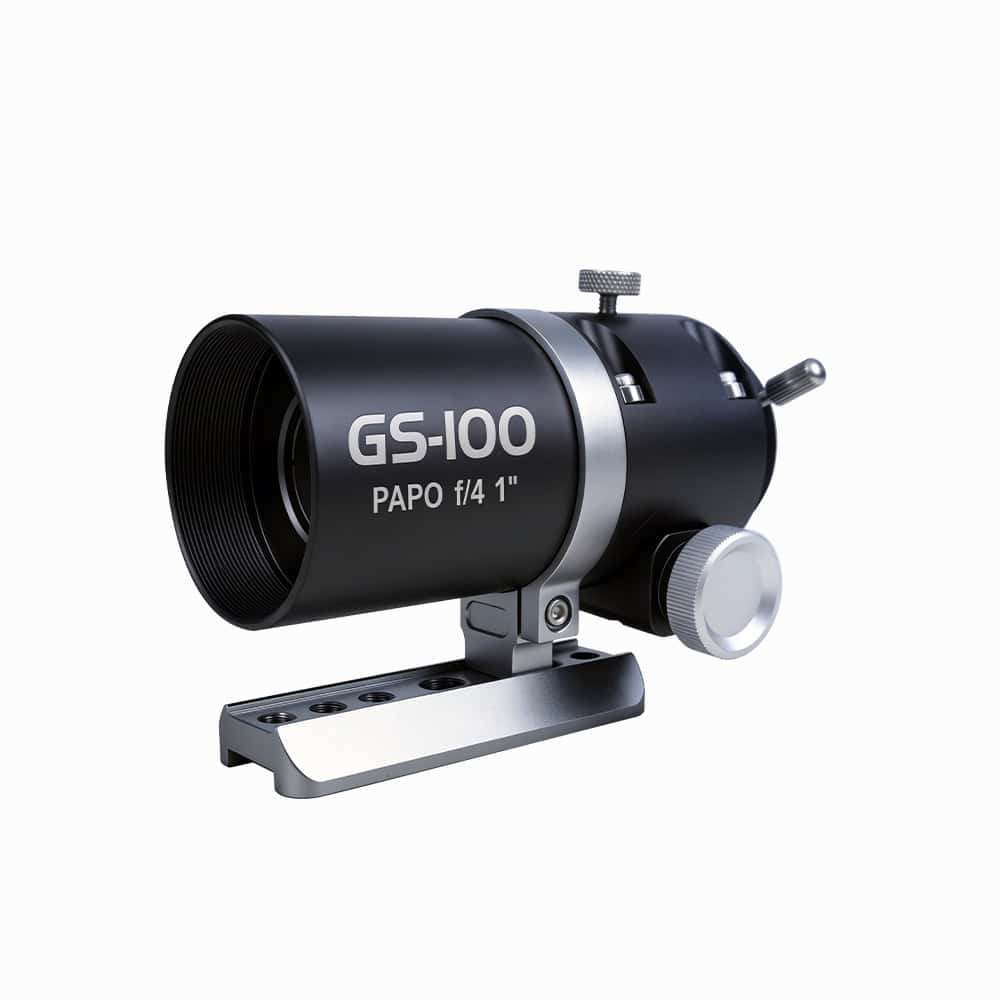
I got the GS-100 PAPO in the GS-100AR version, the one with rack-and-pinion focusing. First impression: the build quality is exceptional. The body is very rigid; nothing moves, and there’s no play in the focusing mechanism. It’s a well-finished piece of equipment that inspires confidence the moment you take it out of the box.
As a guiding instrument, it's really great. The stars are sharp, perfectly round, and there's no purple fringing on the bright ones. ToupTek has reduced the purple fringing compared to the older GS models, and it really shows. Autoguiding locks on without any problems.
In wide-field imaging, it’s definitely worth a try. At a 100 mm focal length and f/4, you can capture wide fields: expansive nebulae, the Milky Way, and large objects. The stars appear extremely fine across the entire field of view. The 1″ flat image circle covers an ASI290, ASI678, or similar sensor without distortion at the edges.
The only thing to keep in mind: focusing
Manual focusing is tricky. The focus point is very precise at f/4—it’s easy to overshoot it. The depth of field is shallow, as with all f/4 lenses. You have to take it slowly, turning the focus ring in tiny increments. But that doesn’t prevent you from using it: once you’ve found the focus, it holds. And with an AAF motor (AR version), the problem disappears completely.
ToupTek GS-100 PAPO, GS-100AR version with rack-and-pinion focusing system. Credit: ToupTek Astro.
The 2-inch filter on the anti-fog screen: a detail that matters
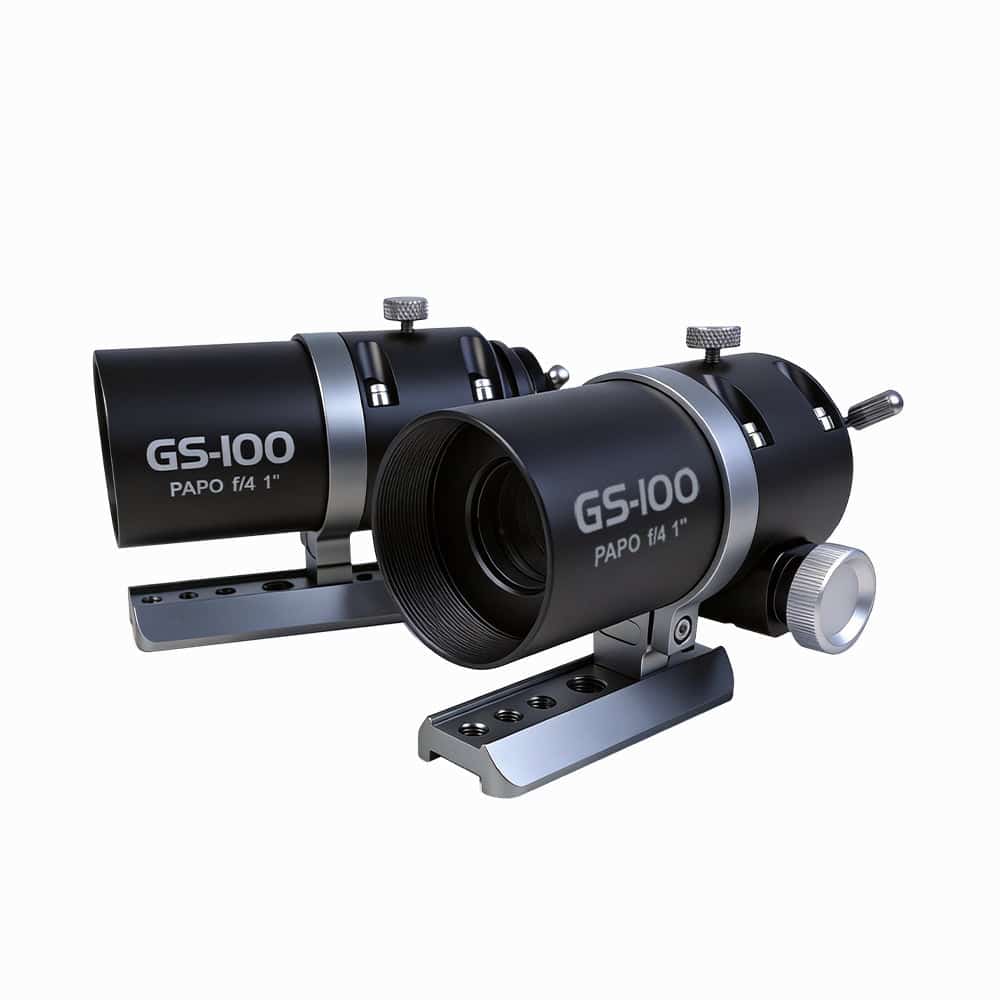
My favorite feature: You can screw a 2-inch filter directly onto the front anti-fog screen. Standard M48 × 0.75 thread. That means you can attach a filter, an IR-cut filter, or an H-alpha filter directly to the telescope, without an adapter or filter wheel. This is very convenient for wide-field imaging with filters.
For a multi-filter setup, a filter drawer or filter wheel can be mounted using an M54-to-M48 adapter. But for a single filter, screwing it onto the anti-fog screen is the simplest solution.
GS-100 vs. GS PAPO 150-350: Which guide scope should you choose?
ToupTek GS-100 PAPO: front view with M48 thread for a 2-inch filter on the dew shield. Credit: ToupTek Astro.
ToupTek offers two lines of PAPO eyepieces: the GS-100 with a 100-mm focal length, and the GS PAPO 150–350-mm series. Here’s how they compare:
GS-100 PAPO (CHF 149): 100 mm focal length, f/4. For guiding with short- to medium-focal-length telescopes (60–80 mm refractors, small Newtons) and wide-field imaging. The most compact and lightweight option.
GS PAPO 150–350 mm (CHF 119–209): focal lengths from 150 to 350 mm. For precise guiding with long focal lengths (SCT, Maksutov, large Newtonian). The longer the guide scope’s focal length, the more precise the guiding.
The rule: The focal length of the guide scope must be at least equal to the focal length of the main telescope, and ideally longer. For an 80 mm f/5 (400 mm) telescope, a 100 mm GS-100 is too short for guiding, but sufficient for short exposures. For a C8 at 2000 mm, you’ll need a GS PAPO 300 or 350 mm.
But the GS-100 has an advantage that the others don’t: at a 100 mm focal length and f/4, it’s capable of wide-field imaging. The GS PAPO 150–350 mm models are too long for wide-field imaging. The GS-100 is the only one that serves as both a guide scope and an imager.
GS-100AC or GS-100AR: Crayford or rack-and-pinion?
Two versions: GS-100AC (Crayford) and GS-100AR (rack-and-pinion). I chose the AR version, with the rack-and-pinion mechanism. The rack-and-pinion mechanism is stiffer; it doesn’t slip under the weight of a heavy camera. The Crayford is smoother and sleeker, but it can slip under the weight of a heavy camera. For guiding with a small camera, the Crayford is sufficient. For imaging with a cooled camera, the rack-and-pinion system is more reliable.
The AR version is also compatible with ToupTek's AAF focusing motor. For autoguiding and control, this is the option to choose.
What I Use with the GS-100
For guiding: a ToupTek G3M or ZWO ASI290 camera on the eyepiece holder, mounted on the main telescope’s Vixen rail. The GS-100 is lightweight and does not overload the mount.
For wide-field imaging: a color or monochrome camera with a 2-inch filter on the dew shield. At f/4 and 100 mm, a 30- to 60-second exposure is sufficient for bright objects. Faint objects require more time, but this is a 25 mm lens: we’re not going to be looking for faint galaxies with this. We’re looking for wide, bright fields.
Why shop at Deep Space Astronomy?
We're not just a retailer. We test, advise, and provide support.
Personalized Advice : I’ve tested the GS-100 PAPO myself. We can advise you on choosing between the GS-100 and the GS PAPO 150-350, as well as between AC and AR, depending on your mount and your targets. By phone, WhatsApp, or by appointment in Nyon.
After-Sales Support : Do you have a question about focusing, autoguiding, or filters? We're here to help.
14-Day Return Policy : Not satisfied? Return the product within 14 days.
Secure payment : Twint, credit card, invoice, Apple Pay, Bitcoin. Pay in 3 or 4 installments with no fees.
Free shipping in Switzerland Starting at CHF 200. Free pickup in Nyon.
This article is based on my personal review of the ToupTek GS-100 PAPO (GS-100AR version), the official specifications from ToupTek Astro (touptekastro.com), and customer reviews posted on the ToupTek website (Lance McIntosh, Dave Pritchard, Jay Cooper-Groves, 2026). Retail price: CHF 149, including tax.
To provide the best experiences, we use technologies such as cookies to store and/or access device information. Consenting to these technologies will allow us to process data such as browsing behavior or unique IDs on this site. Failure to consent or withdrawal of consent may adversely affect certain features and functions.
Functional
Always active
Storage or technical access is strictly necessary for the legitimate purpose of enabling the use of a specific service explicitly requested by the subscriber or user, or for the sole purpose of transmitting a communication over an electronic communications network.
Preferences
Storage or technical access is necessary for the legitimate purpose of storing preferences not requested by the subscriber or user.
Statistics
Storage or technical access used exclusively for statistical purposes.Storage or technical access which is used exclusively for anonymous statistical purposes. In the absence of a subpoena, voluntary compliance by your Internet service provider or additional third-party records, information stored or retrieved for this sole purpose generally cannot be used to identify you.
Marketing
Storage or technical access is necessary to create user profiles in order to send advertisements, or to track the user on a website or on several websites with similar marketing purposes.