
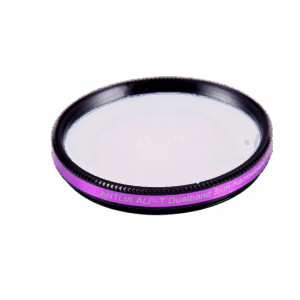
Antlia ALP-T 5 nm H-alpha/OIII Filter
H-alpha/OIII filter for nebulae with a color camera; choose the 2-inch mounted version and check the focal ratio and mount.
Price range: CHF 275.35 through CHF 351.12
CHF 459.00incl. Swiss VAT







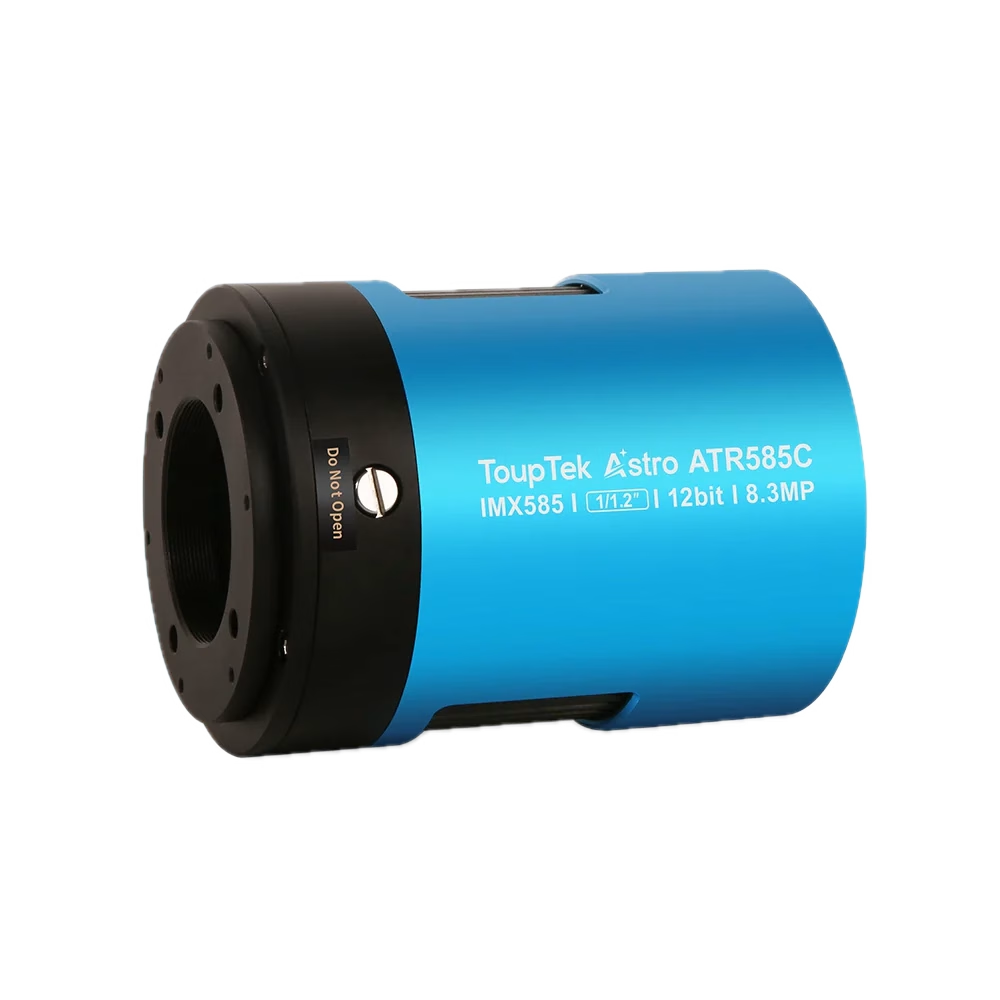
Visit ToupTek ATR585C, manufacturer's part number ATR3CMOS08300KPA, is a color astronomical camera equipped with the 8.3-megapixel Sony IMX585 STARVIS 2 sensor. Designed for deep-sky astrophotography, it features 2.9 µm pixels, a two-stage thermoelectric cooling system, and an amp-glow-free design. With the right instrument and framing, it allows you to photograph nebulae, galaxies, and star clusters.
Its color sensor captures color information in a single exposure, without requiring separate sequences using red, green, and blue filters. The ATR585C can also be used for lunar and planetary imaging thanks to its video modes and the ability to select a region of interest (ROI).
The 1/1.2″ back-illuminated CMOS sensor offers an image area of approximately 11.2 × 6.3 mm. Its 2.9 µm pixels allow for fine sampling, which can be adjusted to match the focal length of your spotting scope or telescope. The field of view depends on this focal length: check the framing of your target objects before choosing your setup.
Two-stage TEC cooling lowers the sensor temperature to reduce dark current. ToupTek reports a maximum temperature difference from ambient air of 35 °C for short exposures and 45 °C for exposures longer than one second. The actual temperature reached depends on operating conditions. A stable setpoint makes it easier to capture calibration images at the same temperature.
The advertised operating noise level goes as low as 0.46 electrons depending on the selected gain and mode. The absence of amp-glow prevents unwanted glow caused by the sensor’s electronics. The LCG, HCG, and HDR modes allow you to adjust the balance between readout noise, saturation capacity, and dynamic range.
The 512 MB of DDR3 memory helps ensure a stable transfer of images to the computer. The four-level adjustable optical window heating helps minimize condensation during imaging sessions.
| Sensor | Sony IMX585 color, back-illuminated (BSI) CMOS, STARVIS 2 technology |
|---|---|
| Format and Active Area | 1/1.2″; approximately 11.2 × 6.3 mm; diagonal of 12.85 mm |
| Image resolution | 3,840 × 2,160 pixels, or about 8.3 MP |
| Pixel size | 2.9 × 2.9 µm |
| Conversion and Modes | 12-bit analog-to-digital converter; 8/12-bit outputs and HDR mode with 16-bit RAW output |
| Expected Playback Noise | Approximately 0.46 to 5.18 e⁻, depending on the mode and gain |
| Saturation capacity (full well) | Up to approximately 40,000 e⁻ in low-gain LCG mode |
| Maximum advertised signal-to-noise ratio | 46 dB |
| Cooling | Two-stage TEC, PID control; up to 35 °C below ambient temperature for short exposure times and 45 °C for exposure times > 1 s |
| Laying time | From 0.1 ms to 3,600 s (1 hour) |
| Shutter | Rolling-shutter electronics |
| Buffer memory | 512 MB of DDR3 |
| Binning | Hardware from 1 × 1 to 2 × 2 by average; digital up to 8 × 8 by sum or average |
| Connecting to the Computer | USB 3.0, USB 2.0 compatible; USB 2.0 hub for accessories |
| Optical connection | M42 × 0.75 mm thread |
| Mechanical zoom on the camera | 17.5 mm between the contact surface and the sensor |
| Optical window | IR-cut or AR glass, depending on the model; specified wavelength range of 380 to 690 nm with the IR-cut filter |
| Power supply | 12 V DC / 3 A; 5.5 × 2.1 mm connector; external power supply required for operation |
| Dimensions and Weight | Diameter 80 mm × height 107.1 mm; approximately 577 g |
Maximum performance corresponds to different settings: the minimum noise of 0.46 e⁻ and the capacity of 40,000 e⁻ cannot be achieved simultaneously. The resolution and sampling rate values above are in accordance with the ATR585C manufacturer's manual, version 1.2.
| Resolution | 12-bit mode | 8-bit mode |
|---|---|---|
| 3840 × 2160 pixels | 24 frames per second | 47 frames per second |
| 1920 × 1080 pixels | 70 frames per second | 70 frames per second |
Actual transfer rates depend, among other things, on the connection time, the connection itself, and the computer. HDR mode reduces the transfer rate; the values in the table do not apply to this mode.
The camera connects via its M42 × 0.75 thread, either directly or with an adapter designed for the eyepiece holder. Its mechanical focus travel is 17.5 mm. If your corrector or reducer requires a distance of 55 mm to the sensor, there are nominally 37.5 mm remaining to be filled with rings and accessories, taking into account filters and the optics manufacturer’s recommendations.
A 12 V / 3 A external power supply is required: The USB cable is used for data transfer and does not provide enough power to run the ATR585C.
For data acquisition, the ATR585C can be used with ToupSky, N.I.N.A., or SharpCap, with the appropriate drivers. The ASCOM and INDI interfaces allow it to be integrated into compatible setups. Install the drivers that correspond to your system and software from the ToupTek Astro Download Center.
DeepSkyStacker and PixInsight are used for stacking or processing captured images; their role is distinct from that of the software that controls the camera.
The package described by ToupTek includes the ATR585C camera, a power adapter with its cord, a USB 3.0 cable, and connectors. The exact list of rings, adapters, and spacers depends on the specific model offered. Check the accessories listed for the selected model, as well as the type of optical window: IR-cut or AR-coated glass.
Yes. The ATR585C is primarily designed for deep-sky photography with a cooled sensor. It can also be used to photograph the Moon and planets in video mode. The choice of focal length, framing, and readout mode remains critical for each application.
The value of 45 °C refers to the maximum reported deviation from ambient temperature during long exposures. For example, at an ambient temperature of 20 °C, this deviation would correspond to a sensor reading of −25 °C, if conditions allow it to be reached. This is not a guaranteed fixed temperature.
The ATR585C features a 12-bit analog-to-digital converter. Its HDR mode enables 16-bit RAW output to take advantage of an extended dynamic range. Therefore, 16-bit output does not mean that the native converter is a 16-bit model.
The Sony IMX585 sensor in the ATR585C is a color sensor: separate red, green, and blue filters are not required. Whether an additional filter is needed depends on the chosen IR-cut or AR filter, the lens, and the subject being photographed.
No. Eliminating amp-glow removes a source of unwanted glow, but calibration images are still useful for correcting hot pixels, vignetting, and dust, among other things. Which ones to use depends on your acquisition and processing methods.
Technical documentation: ToupTek ATR585C Official Manual (PDF, in English). The values stated by the manufacturer do not represent measurements taken on every individual unit.
La ToupTek ATR585C est destinée à la photographie du ciel profond en poses longues : nébuleuses, galaxies et amas. Son refroidissement (35 °C sous la température ambiante) maintient le bruit thermique très bas pendant des poses de plusieurs minutes. Avec ses pixels de 2,9 µm, elle s'accorde bien avec des instruments d'environ 300 à 600 mm de focale (échantillonnage de 1 à 2″ par pixel). En couleur, une seule série de poses donne l'image ; avec un filtre double bande, elle vise les nébuleuses en émission même depuis un ciel pollué. Sa cadence de 47 images/s lui permet aussi la Lune et les planètes (et le Soleil avec un filtre solaire adapté).
Le Sony IMX585 (technologie STARVIS 2) combine un très faible bruit de lecture (0,46 e⁻), une capacité de puits élevée pour des pixels de 2,9 µm (40 ke⁻) et une sensibilité marquée dans le proche infrarouge. Sans amp glow et rapide (47 images/s), c'est un capteur très polyvalent, du planétaire au ciel profond, avec un excellent rapport prix-performances.
Elle fonctionne en 12 V CC, 3 A (fiche 5,5 × 2,1 mm). L'adaptateur secteur 12 V est fourni avec la caméra. Sur le terrain, un boîtier Pegasus Astro comme le Pocket Powerbox Advance alimente caméra, monture et résistances chauffantes depuis une seule batterie ou alimentation.
Le backfocus de la caméra est de 17,5 mm. Raccordement : M42 × 0,75. Avec un correcteur ou un réducteur qui demande 55 mm, complétez la distance avec des bagues-allonge, en comptant la roue à filtres ou le tiroir à filtres s'il y en a un.
Nous recommandons le filtre Antlia ALP-T 5 nm Hα/OIII : ce filtre double bande isole les raies Hα et OIII des nébuleuses en émission et réduit fortement la pollution lumineuse. Il existe en 2″ monté (pour un tiroir à filtres ou un correcteur fileté) et en 36 mm non monté avec support. Pour les galaxies, les nébuleuses par réflexion et les amas, le filtre Antlia Quad Band réduit la pollution lumineuse tout en transmettant les raies Hα, Hβ, OIII, SII et NII.
With a diviseur optique ToupTek OAG-L et une petite caméra de guidage comme la ToupTek GPM662M, vous guidez à travers le télescope principal. Une lunette guide comme l'Askar 32 mm est l'alternative la plus simple.
Oui : un hub USB 2.0 intégré permet de brancher une roue à filtres, une caméra de guidage ou un focuser directement sur la caméra, ce qui réduit le nombre de câbles vers l'ordinateur.
La version couleur est la plus simple : une seule pose donne l'image en couleurs. La version monochrome, la ToupTek ATR585M, demande une roue à filtres et plus de temps de pose. En échange, elle est plus sensible et donne de meilleurs résultats en bande étroite.
Le manuel du fabricant (en anglais) est disponible ici : manuel ToupTek ATR585C (PDF).
Here are a few accessories we've selected for this model, depending on your needs.
H-alpha/OIII filter for nebulae with a color camera; choose the 2-inch mounted version and check the focal ratio and mount.
2-inch SII/OIII filter to complement H-alpha/OIII images. Check the focal ratio and mount of your instrument.
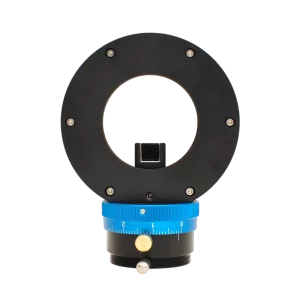
ToupTek divider for use with a compatible guide camera (sold separately). Select the adapter based on your tool and check the assembly, focus, and position of the prism.