In this guide :
🔭 Did you know? There is no such thing as «the best telescope in the world». There's only the telescope that will often come out of the box because it's right for you.
1. Why the choice of the first instrument is critical
Let's face it: the wrong choice is the #1 cause of telescopes that end up gathering dust in an attic or classified ad. An instrument that's too complex, too heavy or optically mediocre turns a budding passion into frustration.
On the other hand, a «good» telescope is a window onto the infinite, allowing :
- To get the immediate «Whaou»: See Saturn's rings or lunar craters in sharp focus from the very first outings.
- To understand celestial mechanics: Learn to navigate among the stars naturally.
- Stay motivated: Even when it's -5°C outside.
2. What do you really want to observe?
That's the question I always ask first. In Switzerland, we're lucky enough to have quick access to the mountains, but many of us live on the Plateau, where light pollution is rife.
Solar System« option (Moon and Planets)
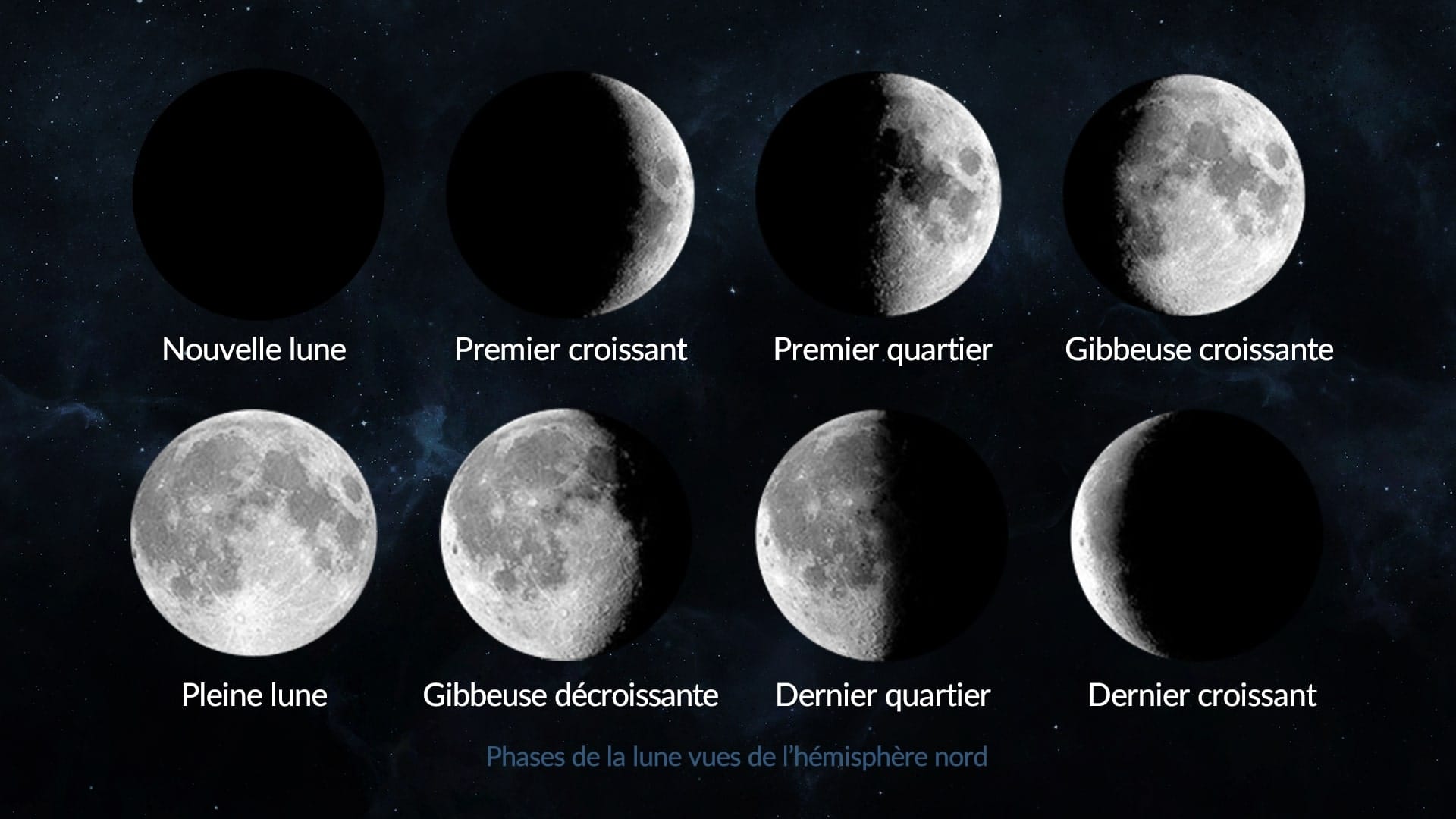
If your dream is to detail Jupiter's cloud bands, Cassini's division of Saturn's rings or the Moon's relief, city light pollution won't bother you. You'll need :
- A good focal length (for easy magnification).
- High contrast.
- Fast heat-up.
👉 My pro tip: Telescopes of the Maksutov-Cassegrain (compact and formidable in planetary mode) or Newtons from 130 to 150 mm are perfect here.
Deep Sky« option (Nebulae, Galaxies, Clusters)

Want to take the plunge? See the Orion Nebula or the Andromeda Galaxy? There's only one rule here: diameter is king. The wider your mirror, the more photons (light) it collects. A telescope is first and foremost a light funnel.
👉 My pro tip: Visit Dobson is the ultimate deep-sky weapon. To start really «seeing» and not just «guessing», I recommend a diameter of 200mm (8 inches). It's the standard that never disappoints.
Family observation (with children)
With children, patience is limited. It has to work, right away. The priority is sturdiness and simplicity.
👉 The Table dobs are brilliant. What's more, new technologies like the StarSense Explorer (which uses your smartphone to guide the telescope) have revolutionized initiation: the child sees on the screen where to push the telescope to find the object. It's fun and educational.
3. What type of telescope should I choose?
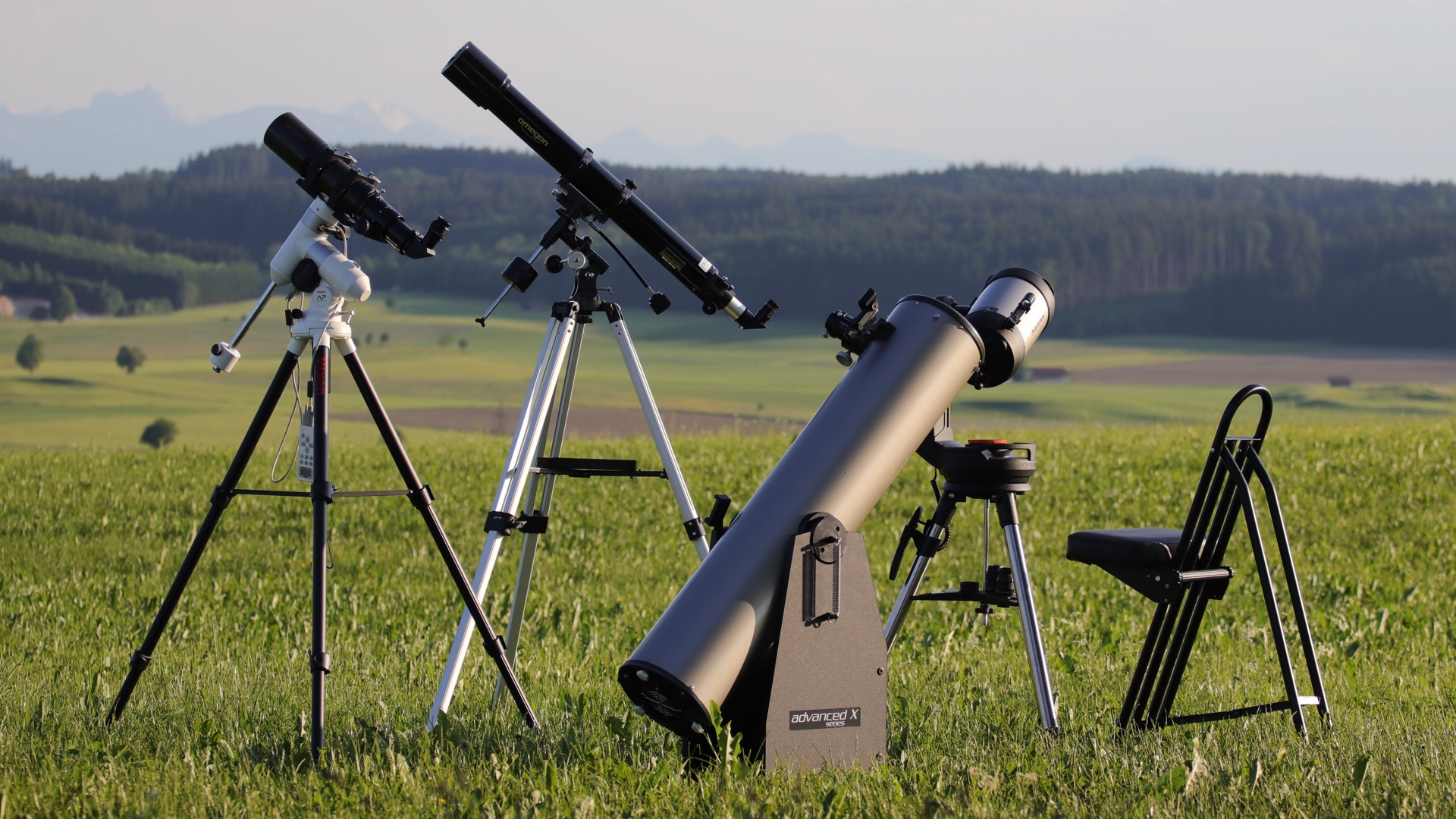
The Dobson: The best Diameter/Price ratio

It's often the No. 1 choice of enthusiasts, and not by chance. A Dobson is a large tube on a wooden base (the «rocker»).
- Advantages : You pay for the lens, not the frame. It's intuitive (up-down, left-right).
- Disadvantage : It's manual (except for more expensive motorized models) and sometimes cumbersome.
In Switzerland, where you sometimes have to drive a few kilometers to escape the fog, make sure the tube fits into your car!
The Astronomical Telescope (Refractor): Zero maintenance
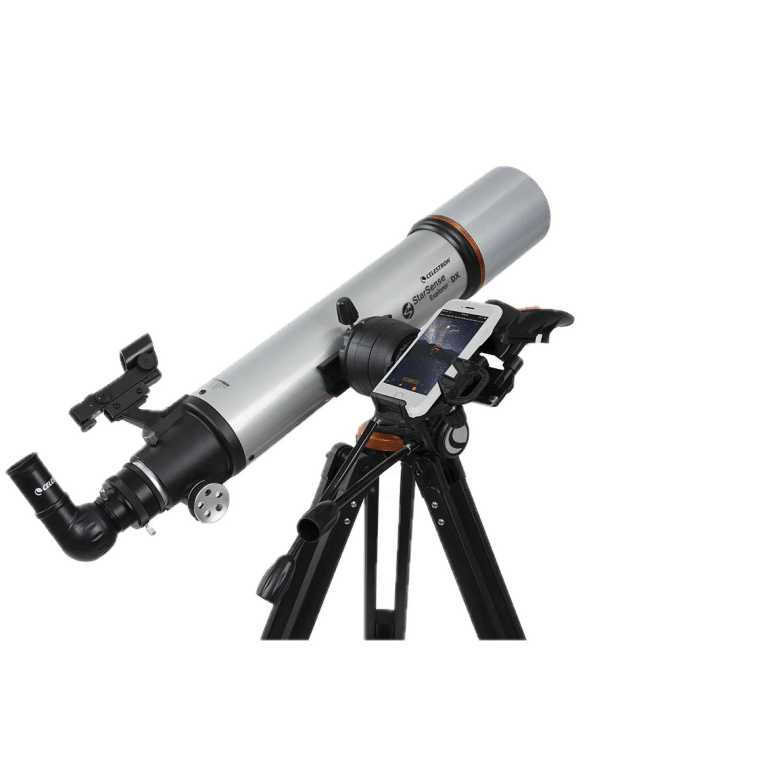
This is the slim tube with a lens in front. Ideal for those afraid of making adjustments (collimation).
- Advantages : Very sharp image, ready for immediate use, no need to adjust mirrors.
- Disadvantage : At the same price, the diameter is much smaller than that of a mirror telescope. Less light = fewer faint objects visible.
👉 A bezel I really like: https://deep-space-astronomy.ch/produit/lunette-celestron-starsense-explorer-dx-102az/
The Equatorial Mount trap for starters
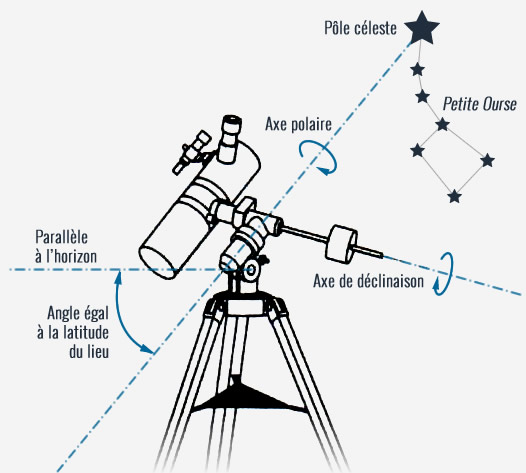
Image source: https://associationastronomiqueindre.jimdofree.com/partie-ciel-et-instruments/mise-en-station/
It's a strong opinion, but I stand by it: avoid German equatorial mounts (on tripods with counterweights) for a very first instrument, unless you're aiming for astrophoto in the short term.
Why? Set-up is technical and ergonomics can be visually acrobatic. If you only want to observe, stick to an azimuth or Dobson mount.
4. What is a realistic budget (price in CHF)?
Astronomy is an investment. Here's what you can expect within your budget on the current Swiss market:
- Less than CHF 200 : Beware of the minefield. There are some decent little instruments for children, but also a lot of «toys».
- CHF 200 to 450 : The serious gateway. You get access to 130mm or 150mm Dobsons, or beautiful introductory glasses. Enough to keep you busy for years.
- CHF 450 to 800 : The comfort zone. This is the price of a 200mm Dobson (250mm second-hand) or a good Maksutov on a stable mount. This is durable equipment.
⚠️ The «600x magnification» scam»
Absolutely avoid any telescope sold with «500x or 600x magnification» written in large letters on the box. It's physically impossible to get a clear image at this level with a small instrument.
5. My selection: The best models by use
Rather than long technical speeches, here are the models I recommend with my eyes closed. They're sure-fire values that I've tested and validated.
👶 For beginners and children (Small budget)
No set-up, just take it out, put it down and observe. Ideal for discovering the Moon and planets without breaking the bank.
🪐 For the serious Planetary (Moon, Jupiter, Saturn)
A Maksutov-type instrument on a motorized mount (GoTo). It points at the stars all by itself. Absolute comfort for urban or planetary observation.
🏅 The «Swiss Army Knife»: Ideal Deep Sky & Planetary (Best-Seller)
If you have to choose just one, this is it. With a diameter of 200mm, you can see everything (galaxies and planets). It's the best performance/price ratio on the market. It requires a bit of training (settings), but the show is worth it.
📱 Ciel Profond with Pointing Aid
Worried about not finding objects in the sky? This model uses your smartphone to guide you. It's the power of 200mm combined with the ease of technology.
🚗 Maximum transportability (254mm)
Even brighter than the 200mm (+56% of light!), this 250mm can still be transported in a standard car (the tube is around 1m20 long). Excellent for finding details in nebulae.
🦅 The exceptional: 300mm Ultra-Light
We enter the category of very large diameters. Usually untransportable, this «Serrurier» model can be completely dismantled. A total immersion in the deep sky for enthusiasts.
🏰 Le Monstre (Poste Fixe recommended)
A diameter of 400mm (16 inches) with automatic tracking. It's a huge well of light. Ideal if you have a large garden or a fixed position, as it's a great baby to move around!
6. Common mistakes (and how to avoid them)
- Wanting to do everything right away: Looking for a telescope that does planetary, deep-sky and photo work, and fits in a backpack. This five-legged sheep doesn't exist.
- Neglecting accessories: A quality red dot finder, a rotating sky chart (indispensable!) or a better quality eyepiece radically change the experience.
- Buying from a supermarket or a web giant: You'll receive a box, period. If you can't focus, you're on your own.
7. Why Deep Space Astronomy?
I'm not just a cardboard reseller. I'm a Swiss amateur astronomer who knows the challenges of our skies.
When choosing your equipment Deep Space Astronomy :
- We discuss YOUR project: I analyze your observation site (garden, balcony, mountain trip, etc.).
- Zero forced sales: If a 300 CHF telescope suits you better than a 1000 CHF one, I'd recommend the former.
- Quality control : I check the equipment. No unpleasant surprises on unpacking.
- Local support : Do you have a question about collimation after 3 months? I'm here to help.
Conclusion: The sky's the limit
Choosing your telescope is the beginning of an adventure that can last a lifetime. Don't be paralyzed by technology.
Still deciding between two models? Don't be in doubt. Contact me directly. A 10-minute chat is often worth hours of solitary internet research.