On November 15 and 16, 2026, Jupiter and Mars will be separated by just 1.2° in Leo. That’s two full-moon diameters between the two brightest planets in the morning sky. Visible to the naked eye throughout Switzerland and France, as well as through binoculars or a telescope. Here’s how to observe this conjunction.
All the info at a glance
Date: November 15–16, 2026 (minimum separation of 1.19° at 02:04 UTC on the 16th)
Jupiter: magnitude -2.1 (bright, creamy white)
March: magnitude +0.7 (fainter, orange-red)
Separation: 1.2° (both planets fit within the field of view of 10×50 binoculars)
Jupiter is 12 times brighter than Mars
Constellation: Leo, 4.4° from Regulus (magnitude +1.4)
Sunrise: around 11:00 p.m. (CET) in the east-southeast
Peak: around 5:30–6:00 a.m. (CET), with a declination of more than 50° in the south
Coverage: All of Switzerland and all of France, starting at sunrise
Best viewing time: 4:00 a.m.–6:00 a.m. (CET), high in the sky before dawn
Instrument: naked eye (two nearby points of light), 10×50 binoculars, telescope (disk of Mars, Jupiter's belts)
Best viewing period: November 13–18 (the conjunction lasts for several nights)
Two planets 1.2° apart: What does that mean?
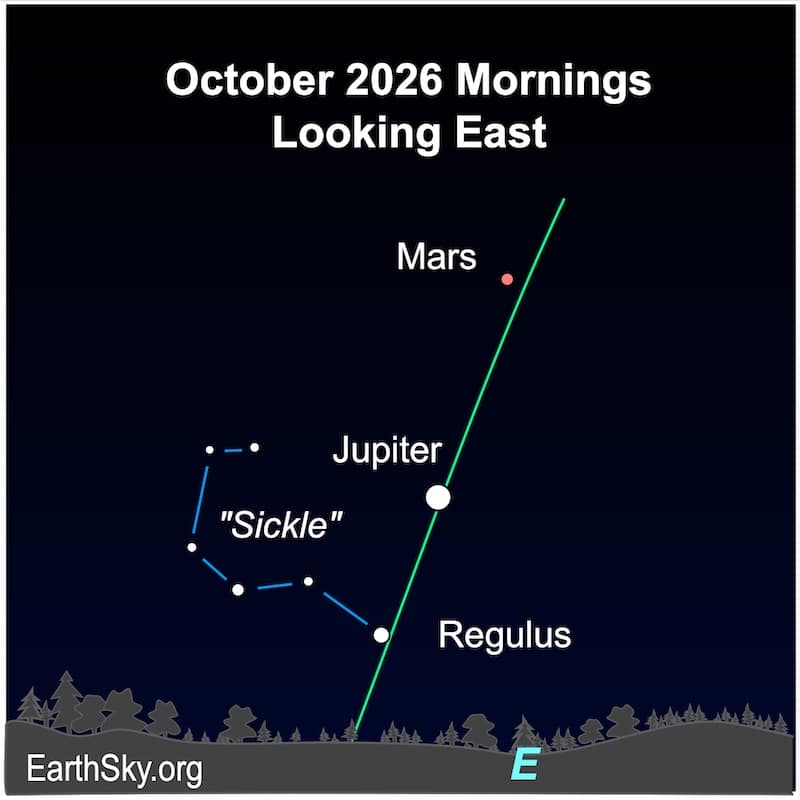
Mars-Jupiter conjunction, November 15–16, 2026, in Leo. Credit: EarthSky.
1.2° is about twice the apparent diameter of the full Moon. To the naked eye, Jupiter appears as a bright, creamy-white dot, and Mars as a fainter, orange-red dot just above and to the left of Jupiter when facing south. The two are separated by a tiny gap.
Through 10×50 binoculars, both planets fit within the same field of view. You can see two points of light in different colors—one brilliant (Jupiter), the other more subdued (Mars)—with Regulus 4–5° lower to the left. It’s a simple and elegant sight.
Through a telescope, the view changes. At low magnification (25–50x), both planets fit within the field of view: you can see Jupiter’s disk with its Galilean moons, and the small disk of Mars right next to it. At higher magnifications, you have to choose: either frame Jupiter to see its cloud belts and the Great Red Spot, or frame Mars to see its orange disk (7.1 arcseconds in diameter, 89 % illuminated).
Jupiter: The Cloud Belts and the Great Red Spot
At magnitude -2.1, Jupiter is the brightest object in the morning sky. Its disk is 37.4 arcseconds in diameter. Through a telescope, even at 50x magnification, you can see the two main equatorial bands (the bright equatorial zone between the two dark bands). At 100x magnification and higher, details become visible: the Great Red Spot when it is facing us, the temperate belts, and the light and dark zones.
The four Galilean moons (Io, Europa, Ganymede, and Callisto) are visible through binoculars as points aligned on either side of Jupiter. Their positions change night after night.
Mars: an orange disk 7 arcseconds in diameter
Mars has a magnitude of +0.7, making it 12 times less bright than Jupiter. Its disk measures only 7.1 arcseconds, compared to 37.4 for Jupiter. That’s small: you need at least 100x magnification to see a sharp disk, and 200x to begin distinguishing details. Mars is at 89 % illuminated (almost full), which is favorable for observation.
Mars is approaching its opposition (November 25): the conjunction with Jupiter is a good opportunity to start observing it night after night. Its magnitude will decrease from +0.8 to +0.5 in November, and its disk will grow larger. Now is the time to start.
Regulus: the third star in the triangle
Regulus (Alpha Leonis, magnitude +1.4) is 4.4° from the conjunction. It forms a triangle with Jupiter and Mars: Regulus at the bottom, Jupiter in the center, and Mars at the top. Regulus is the brightest star in Leo, a blue-white B-type star that is 150 times more luminous than the Sun.
How to Observe from Switzerland and France
From both Switzerland and France, the two planets rise around 11:00 p.m. (CET) in the east-southeast. They are 20° above the horizon around 2:00 a.m., 40° around 4:00 a.m., and reach their highest point at over 50° around 5:30–6:00 a.m. before dawn. The best viewing window is between 4:00 a.m. and 6:00 a.m. (CET), when the planets are high in the sky and atmospheric turbulence is minimal.
With the naked eye : two nearby points of light, one bright (Jupiter) and the other fainter and orange (Mars), with Regulus nearby.
10×50 Binoculars : Both planets are in the same field of view. Jupiter shines brightly, Mars is next to it, and Regulus is below them. Jupiter's Galilean moons may be visible.
70–100 mm Telescope : At 25–50x magnification, both planets are in the field of view. Jupiter’s disk with its belts, and the orange disk of Mars next to it.
150–200 mm Telescope : At 100–200x magnification, details on Jupiter (the Great Red Spot if visible), and the Martian disk with possible details under good seeing conditions.
Why shop at Deep Space Astronomy?
We're not just a retailer. We test, advise, and provide support.
Personalized Advice : We can advise you on choosing an instrument for planetary observation. By phone, WhatsApp, or by appointment in Nyon.
After-Sales Support : Do you have a question about collimation, eyepieces, or tracking? We're here to help.
14-Day Return Policy : Not satisfied? Return the product within 14 days.
Secure payment : Twint, credit card, invoice, Apple Pay, Bitcoin. Pay in 3 or 4 installments with no fees.
Free shipping in Switzerland Starting at CHF 200. Free pickup in Nyon.
Sources
This article is based on predictions from Sterngucker.de (Night Sky November 2026), TelescopeAdvisor.com (Mars-Jupiter Conjunction November 2026), EarthSky, and the Astroshop.eu Blog. The positions and magnitudes are verified for November 15–16, 2026, from 47°N.
To provide the best experiences, we use technologies such as cookies to store and/or access device information. Consenting to these technologies will allow us to process data such as browsing behavior or unique IDs on this site. Failure to consent or withdrawal of consent may adversely affect certain features and functions.
Functional
Always active
Storage or technical access is strictly necessary for the legitimate purpose of enabling the use of a specific service explicitly requested by the subscriber or user, or for the sole purpose of transmitting a communication over an electronic communications network.
Preferences
Storage or technical access is necessary for the legitimate purpose of storing preferences not requested by the subscriber or user.
Statistics
Storage or technical access used exclusively for statistical purposes.Storage or technical access which is used exclusively for anonymous statistical purposes. In the absence of a subpoena, voluntary compliance by your Internet service provider or additional third-party records, information stored or retrieved for this sole purpose generally cannot be used to identify you.
Marketing
Storage or technical access is necessary to create user profiles in order to send advertisements, or to track the user on a website or on several websites with similar marketing purposes.