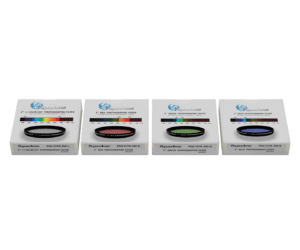
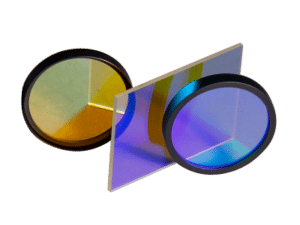
H-beta 3nm filter from Chroma Technology
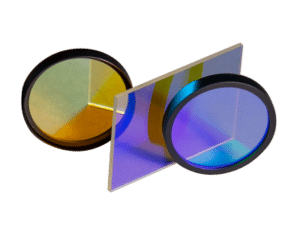
Visit 3nm H-beta filter from Chroma Technology is an ultra-narrow band filter designed for astronomical imaging. It is specifically optimized to capture the H-beta line at 486.1 nm, ideal for nebulae and other objects rich in ionized hydrogen. This filter is particularly well-suited to astrophotographers wishing to obtain detailed, high-contrast images, even under conditions of light pollution.
Key features
- Bandwidth : 3 nm, enabling extremely precise isolation of the H-beta line while effectively blocking unwanted wavelengths.
- High transmission : Up to 90 % at 486.1 nm, guaranteeing an excellent signal-to-noise ratio.
- Optical quality :
- Surface polished to an accuracy of λ/4.
- Multi-layer anti-reflective coatings to avoid halos and stray reflections.
- Available formats :
- Assembled: 1.25" and 2".
- Unmounted: Custom formats available.
- Substrate thickness : Approx. 3 mm, guaranteeing exceptional durability.
Applications
- Imaging specific nebulae :
- Ideal for capturing objects like the Horsehead Nebula or the California Nebula, which emit strongly in the H-beta line.
- Reducing light pollution :
- Effectively blocks artificial light sources (sodium and mercury lamps) and sky background light.
- Advanced astrophotography :
- Ideal complement to H-alpha and OIII filters for creating false color or scientific palette images.
- Compatibility with high-speed systems :
- Works perfectly with focal ratios up to f/4.0. For faster systems (f/2.6 to f/3.6), an optimized version may be required.
Technical highlights
- Exceptional durability :
- Sputtered hard coatings guarantee long-term spectral stability.
- Resistant to extreme variations in temperature and humidity.
- Anti-halos design : Anti-reflective coatings eliminate halos around bright stars, delivering sharp, detailed images.
- Universal compatibility :
- Fits most filter wheels and drawers on the market (ZWO EFW, QHY CFW, etc.).
Conclusion
The filter Chroma H-beta 3nm is an indispensable tool for astrophotographers seeking to capture the subtle details of nebulae rich in ionized hydrogen. Its optical precision, high transmission and ability to effectively reduce light pollution make it a top-of-the-range choice for deep-sky imaging.