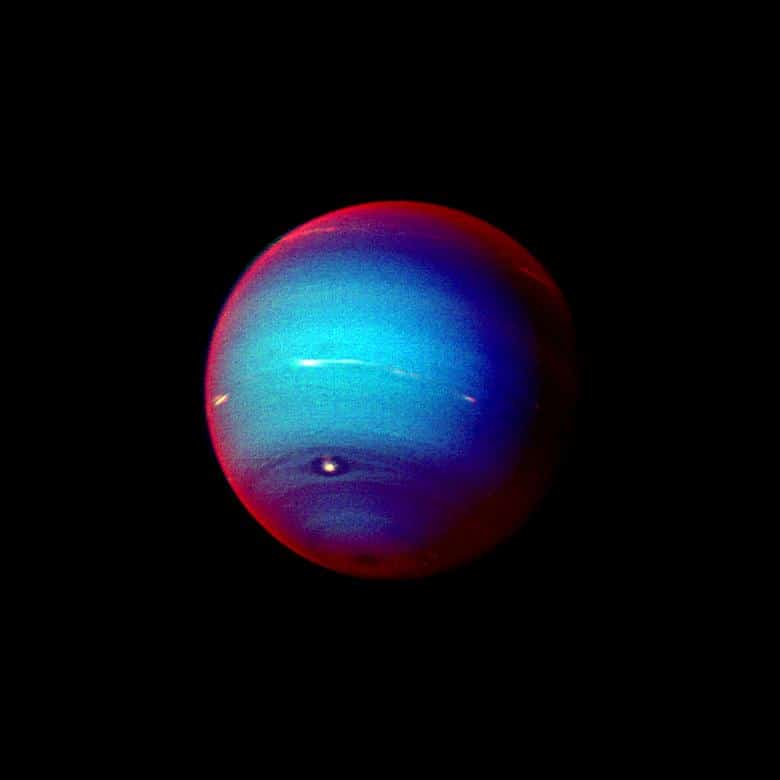
On September 26, 2026, Neptune reaches opposition—the farthest planet in the Solar System will then be exactly opposite the Sun in our sky. This is the best time of the year to observe it. But Neptune isn’t easy to spot: it has a magnitude of +7.8, is a tiny disk measuring just 2.4 arcseconds, and to top it all off, the Harvest Full Moon occurs on the same night. Here’s how to find it despite these challenges—and why it’s perfectly doable from Europe.
The fact: opposition on September 26 at 02:00 UTC
Neptune reaches opposition on September 26, 2026, at approximately 02:00 UTC (01:28 GMT according to the ephemeris). At that precise moment, Earth will be aligned between the Sun and Neptune, at a distance of about 28.9 astronomical units—or 240 light-minutes. Neptune will then be at its closest distance to Earth and at its brightest.
But «maximum» is relative. Unlike Mars or Jupiter, whose brightness and apparent size vary considerably between opposition and conjunction, Neptune is so far away that the difference is imperceptible to the naked eye. The disk measures 2.4 arcseconds at opposition—barely less than at other times of the year. The main advantage of opposition is that the planet is visible all night long: it rises at sunset and sets at sunrise.
Is it visible from Europe?
Yes, and it’s actually an excellent year for Europe. Neptune is in the constellation Pisces, at a declination of about -2°. From our European latitudes, this places its culmination (the moment when it is highest in the sky, directly south) at a comfortable altitude:
- From the United Kingdom (~51° N): approximately 37° in altitude
- From Zurich (~47° N): approximately 41°
- From Paris (~49° N): approximately 39°
- From Marseille (~43° N): approximately 45°
- From southern Spain (~37° N): approximately 51°
By way of comparison, 37° is higher than Saturn appears from the United Kingdom during certain oppositions. From central and southern Europe, Saturn reaches an altitude of 40 to 50°—more than enough to overcome most atmospheric absorption.
The best time to observe is around midnight local time, when Neptune is directly overhead in the south. This is also the time indicated by Pete Lawrence in the Sky at Night Magazine : 1:00 a.m. BST (12:00 a.m. UT) for the United Kingdom, which is midnight local time in Central Europe.
To the naked eye: no, impossible
Neptune is not never visible to the naked eye. It is the only major planet in the Solar System in this category. At magnitude +7.8, it is about five times fainter than the faintest star visible to the naked eye under a perfectly dark sky (theoretical limit ~+6.5). Even under the clearest skies of the Alps or the desert, you’ll need at least binoculars.
This isn't a failure—it's just the nature of Neptune. The eighth planet is 30 times the distance between Earth and the Sun. Its light takes 240 minutes to reach us.
Through binoculars: a speck among the stars
Through 10×50 binoculars or a more powerful pair, Neptune appears as a pale blue point of light, indistinguishable from a star without a detailed chart. Here’s the trick: first locate Saturn, which is visible to the naked eye (magnitude approximately +0.9 in September 2026), then scan 9° to the west-southwest. Neptune is located in this area, in Pisces, halfway between Saturn and the large galaxy M74.
A star chart or an app (Stellarium, SkySafari, Sky Tonight) is essential. Note that Neptune shows no apparent movement from one night to the next—it appears as a fixed point among the stars. The surest way to confirm your sighting is to return a few nights later and check that the point has moved slightly.
Through the telescope: the blue disk
That's where Neptune differs from the stars. Using a telescope with a 150 mm aperture, the 2.4-arcsecond disk becomes visible. The blue color, caused by methane in the planet’s atmosphere, is distinctive—it is a deep blue, darker than the bluish-green hue of Uranus.
A magnification of 150× to 200× is recommended. At lower magnifications, Neptune still looks like a star; at higher magnifications, atmospheric turbulence degrades the image more than it adds detail. The disk is small—patience and careful focusing are required.
Triton: The Satellite Challenge
Neptune's largest moon, Triton (magnitude ~+13.5), is visible with telescopes of approximately 200 mm under good conditions. Pete Lawrence states in the Sky at Night Magazine Stable seeing conditions can allow for detection even with slightly smaller apertures. Triton orbits Neptune with a period of about six days, which means it is sometimes at a sufficient angular distance to escape the glare near the planet. Check Triton’s position using an app before your observing session.
The Problem with the Full Moon
Here’s the catch: On September 26, 2026, at 4:49 p.m. UTC, the Moon reaches its full phase—this is the Harvest Moon, the full moon closest to the fall equinox (September 22). And since Neptune is in opposition, the full Moon—also opposite the Sun—is located in the same region of the sky, about 20° from Neptune.
Specifically, the Full Moon is up all night from the 25th to the 26th and remains full at over 99 % the following night. Its brightness obscures the sky background and makes it difficult to spot Neptune with binoculars. But two things work in our favor:
- Neptune is a point source, not an extended deep-sky object. At magnitude +7.8, it remains visible through a telescope even when the Moon is nearby—it is not a faint nebula that fades in moonlight.
- Neptune’s opposition doesn’t last just one night. Neptune can be observed at nearly the same altitude from late August through late October. On the nights of September 22–23 or 28–29, the planet will be at the same altitude, with a disk of the same size, and a gibbous Moon that is significantly less overwhelming.
If you have a choice, try to observe a few days before or after the full moon. If you’re observing on the night of the opposition, wait until Neptune reaches its highest point in the sky (around midnight, due south) to get the best view, and turn your back to the Moon.
Practical Tip: Saturn as a Guide
Saturn’s proximity is your best guide for finding Neptune. In September 2026, Saturn will be about 9° east-northeast of Neptune in Pisces. Saturn is bright (mag ~+0.9), visible to the naked eye, and impossible to miss. Starting from Saturn, sweep west-southwest by about one binocular field of view (5 to 6°) to reach the area where Neptune is located.
Another method: The galaxy M74 (NGC 628) is located about 5° northeast of Neptune. If you’re using a finder scope or binoculars with a detailed map, M74 can serve as an intermediate reference point—although at magnitude +9.8, the galaxy itself is affected by moonlight.
Saturn and Neptune in Pisces: A Favorable Context
Saturn and Neptune will both be in Pisces in September 2026, following a close conjunction in February 2026 (just 0.1° apart—their closest approach in 37 years). Since then, the two planets have drifted apart, but Saturn remains the most obvious reference point.
In a nutshell
Neptune at opposition on September 26, 2026: This event is observable from Europe—and even quite comfortable to observe—with a culmination of 40 to 50° from Central Europe. The planet is not visible to the naked eye, but binoculars are sufficient to spot it. Through a telescope, a 150 mm aperture reveals the blue disk measuring 2.4 arcseconds, and a 200 mm aperture opens up the possibility of seeing Triton. The Harvest Full Moon complicates observations on the exact night of opposition, but Neptune remains observable under nearly identical conditions for weeks afterward. The best advice: locate Saturn first, then scan 9° toward the west-southwest.
Sources : Sky at Night Magazine (Pete Lawrence, September 3, 2026); ; EarthSky ; Time and Date (Harvest Moon 2026).
See also on Deep Space Astronomy: Retrieving Raw Data from Your Smart Telescope – Seestar, DWARFLAB, and Vespera
Signature: CBurkhalter