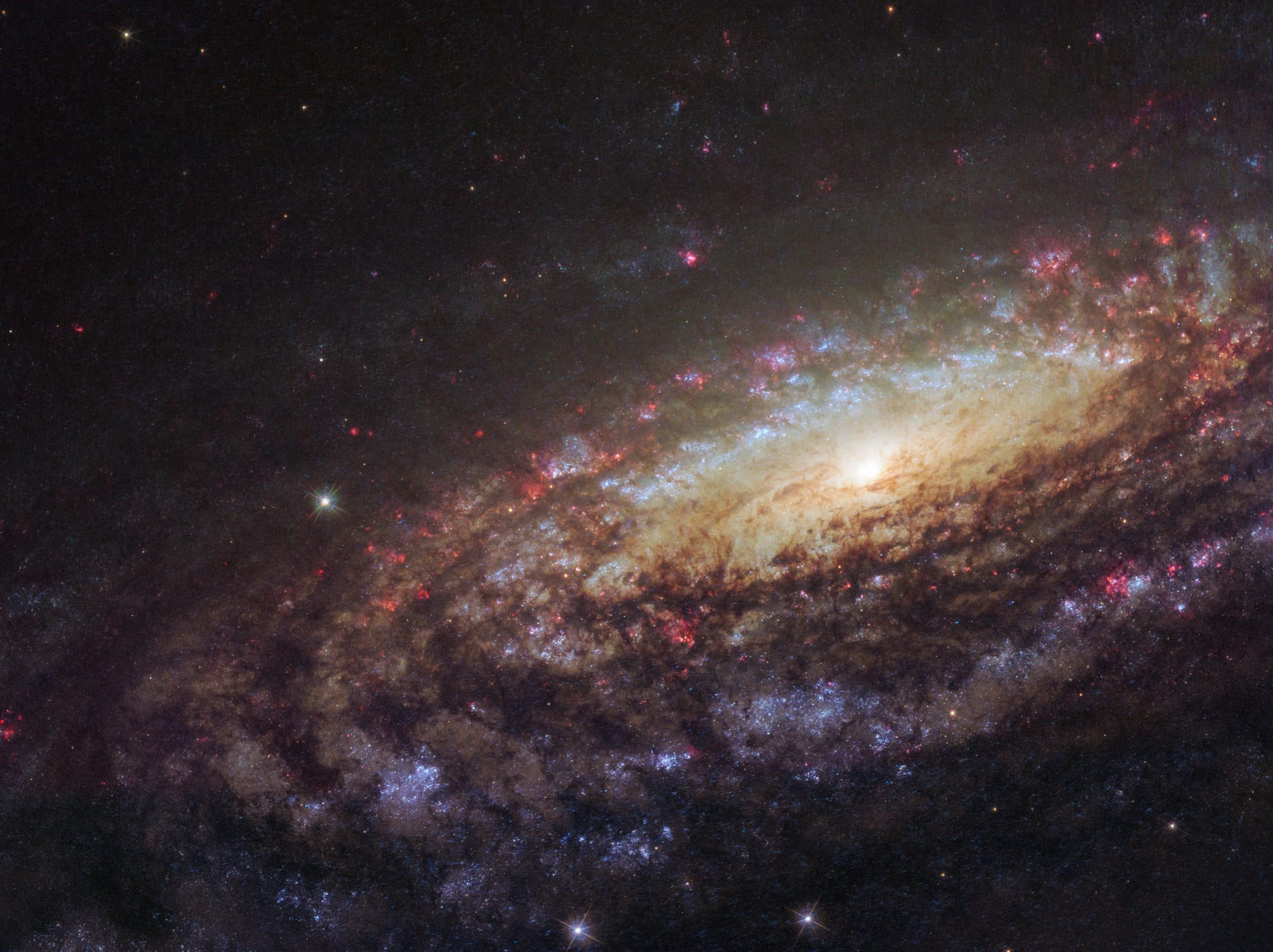
Archive image: NGC 7331 and the former supernova SN 2014C, observed by Hubble. This image, published in 2018, does not show SN 2026aaiv and is not a photograph I took with the S50 Pro. Credit: ESA/Hubble & NASA/D. Milisavljevic (Purdue University). Bachelor's Degree CC BY 4.0.
The beautiful galaxy NGC 7331, in the constellation Pegasus, has done it again! A little over a year after SN 2025rbs, a new supernova was discovered on September 1, 2026. It is named SN 2026aaiv and it, too, appears very close to the central nucleus of this spiral galaxy.
Photographed from Marseille with the S50 Pro
I was able to take a picture of it from Marseille with my The Seestar S50 Pro has just arrived. This is a great target to start enjoying this little telescope! Photographing a supernova in another galaxy is definitely doable with a smart telescope.
To locate SN 2026aaiv in your images, look for a small bright spot near the nucleus. A reference image taken before it appeared will help you clearly see what has changed. That’s exactly what makes this exercise so interesting: this tiny spot tells the story of a massive event.
A rapidly evolving outbreak
To provide a specific date as a reference, the observations by Jean-Claude Merlin published by the Société astronomique de France indicate a magnitude 13.9 in the V band on September 4, then 12.0 on September 10, 2026. It has therefore become significantly brighter between these two measurements. Before attempting to capture an image, check recent observations rather than relying on a fixed magnitude.
If you're looking for a target with your smart telescope that's a little different from the usual classics, NGC 7331 is well worth checking out. From Marseille, the S50 Pro allowed me to capture a very vivid image of it.
Sources : SN 2026aaiv Data Sheet and Monitoring ; Observations by the French Astronomical Society. To make the most of what you've learned: Retrieve the raw data from your smart telescope.