On September 7, 2026, DWARFLAB opened pre-orders for the Draco, a smart telescope that combines in a single unit features typically found in a dedicated imaging setup. It features a 90 mm aperture, a TEC-cooled sensor, built-in guiding, and a sensor rotator that eliminates the need for polar alignment. All of this weighs just 5.5 kg and fits into a backpack.
What's Changing for the Amateur
Deep-sky astrophotography using smart telescopes has become commonplace. The Seestar S50, the DWARF 3, and the Vespera have made it accessible to a wider audience. These instruments share a common limitation: a small aperture (30 to 50 mm) and an uncooled sensor.
The Draco has an aperture of 90 mm. In terms of diameter, that’s 1.8 times that of a Seestar S50 (50 mm). The focal length is 340 mm, or f/3.8. DWARFLAB refers to it as an «aberration-corrected optical system» with a folded design. The distributor, High Point Scientific, describes the optics as a «catadioptric reflector with APO elements.» The optical formula intrigues me: DWARFLAB describes a folded optical system with aberration correction; that alone isn’t enough to classify it as a Maksutov.
As for the sensor, the Draco features an OmniVision OV50Q40. The native resolution is approximately 50 MP, but for deep-sky imaging, the Draco uses 2×2 pixel binning — four native 1.2 μm pixels merged into a single effective 2.4 μm pixel — to produce images of approximately 12 MP with a better signal-to-noise ratio. The key detail: this sensor is TEC-cooled. The FAQ states that it cools to approximately 5 to 10 °C below ambient temperature, depending on conditions, with no adjustable setpoint temperature.
Guiding, derotation, and 300-second exposures
The Draco incorporates three systems that are normally housed in a dedicated imaging station.
First, a built-in sensor guide : A dedicated sensor monitors the drift of the stars and corrects the tracking in real time.
Next, a sensor rotator : The CMOS sensor physically rotates to compensate for the field rotation inherent in Alt-Az tracking. On a conventional Alt-Az mount, field rotation limits the duration of exposures. The Draco eliminates this need by rotating the sensor instead. No polar alignment, no wedge.
Finally, a precision drive system with microstepping to stabilize tracking and reduce vibration and backlash.
DWARFLAB announces Single exposures up to 300 seconds in a single exposure, without an equatorial mount. The FAQ states that the 300 seconds represent the maximum advertised duration and that perfectly round stars are not guaranteed under all conditions. These are advertised specifications, not performance figures measured in independent tests.
DWARFLAB also notes that field rotation correction becomes difficult near the zenith. An equatorial mode is recommended for very high targets.
SHO with one click: two editions, four filters
The Draco features four built-in filters, which can be selected from the app:
- a broadband filter for galaxies and clusters; ;
- a Ha-OIII dual-band filter (13 ± 3 nm bandpass) for emission nebulae; ;
- a dark-frame filter for calibration; ;
- either a solar ND filter (Standard Edition) or an SII-OIII dual-band filter (SHO Edition).
The SHO edition adds an SII-OIII filter which, when combined with the Ha-OIII filter, allows you to capture all three channels—SII, Hα, and OIII—to produce a Hubble palette (SHO) with a single tap. The Draco automatically sequences acquisitions with both filters, separates the channels, and applies color mapping. The SHO edition also includes an external solar ND filter (to be mounted manually).
The price
As of September 19, 2026, the prices listed on the DWARFLAB U.S. page are, for informational purposes only:
- Standard : $1,399 — currently listed as «Sold Out»; ;
- SHO : $1,599.
The promotional pre-order prices (1,299 / 1,499 USD) were valid through September 14, 2026, and are no longer available. These prices are the manufacturer’s suggested retail prices, excluding taxes and shipping costs; they do not represent an all-inclusive price in Switzerland.
To put this in perspective: an equivalent traditional setup—a 90-mm tube, a cooled camera, a guide camera, an equatorial mount, a filter wheel, and a rotator—generally costs more, not to mention the time required for wiring, alignment, and setting up. The Draco offers the same hardware configuration in a single 5.5-kg unit.
My opinion: The price seems very competitive. Building your own setup is still much more expensive once you add up the cost of the tube, the mount, the cooled camera, the guide camera, the filter wheel, and the rotator. The derotator is impressive. So is the cooled sensor.
What Needs to Be Tempered
This is a pre-order. The first Draco units have not yet been shipped. Orders placed between September 7 and 9, 2026, are expected to ship within two months—meaning November. Orders placed on or after September 10 are expected to ship within three months. DWARFLAB notes that these timelines are estimates and are subject to change.
The images currently circulating are from test units—they may not necessarily be representative of what will be released in mass production. The actual sharpness at the edge of the frame and the performance of the derotator during 300-second exposures under real-world conditions have yet to be confirmed.
The 1/1.3-inch sensor is large for a smart telescope, but is still smaller than an APS-C or full-frame sensor. 2×2 pixel binning for deep-sky imaging limits the final resolution to about 12 MP—sufficient for the web and medium-sized prints, but not comparable to a dedicated large-sensor camera.
Finally, DWARFLAB notes that de-rotation becomes difficult near the zenith. For very high targets, equatorial mode is recommended.
In a nutshell
The Draco combines in a single unit features that were previously found only in a dedicated imaging setup: a large aperture, a cooled sensor, guiding, a rotator, and dual-band filters. The price is competitive compared to an equivalent setup.
This is a pre-order, and we haven't seen any official product images yet. On paper, it's a particularly well-designed smart telescope.
Sources : DWARFLAB Draco Official Page ; US product page ; DWARFLAB FAQ ; Shipping Policy ; High Point Scientific Technical Data Sheet.
See also on Deep Space Astronomy: Retrieving Raw Data from Your Smart Telescope — Seestar, DWARFLAB, and Vespera
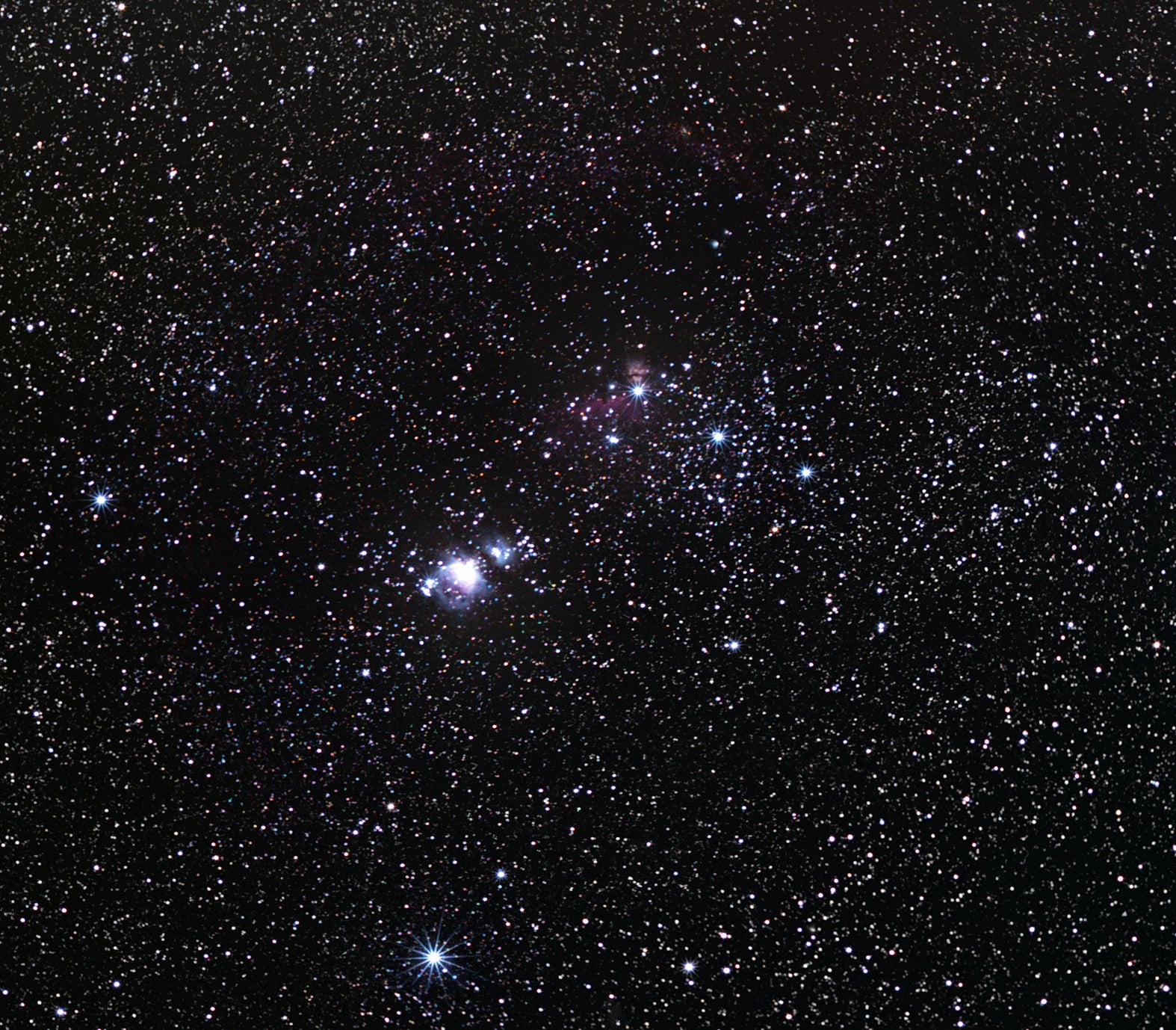
Illustration: Orion Nebula by ESO/S. Brunier - CC BY 4.0. This photograph is a standalone illustration; it was not taken with the Draco.
Signature: CBurkhalter
Image: ESO/S. Brunier. License: CC BY 4.0. Original source.