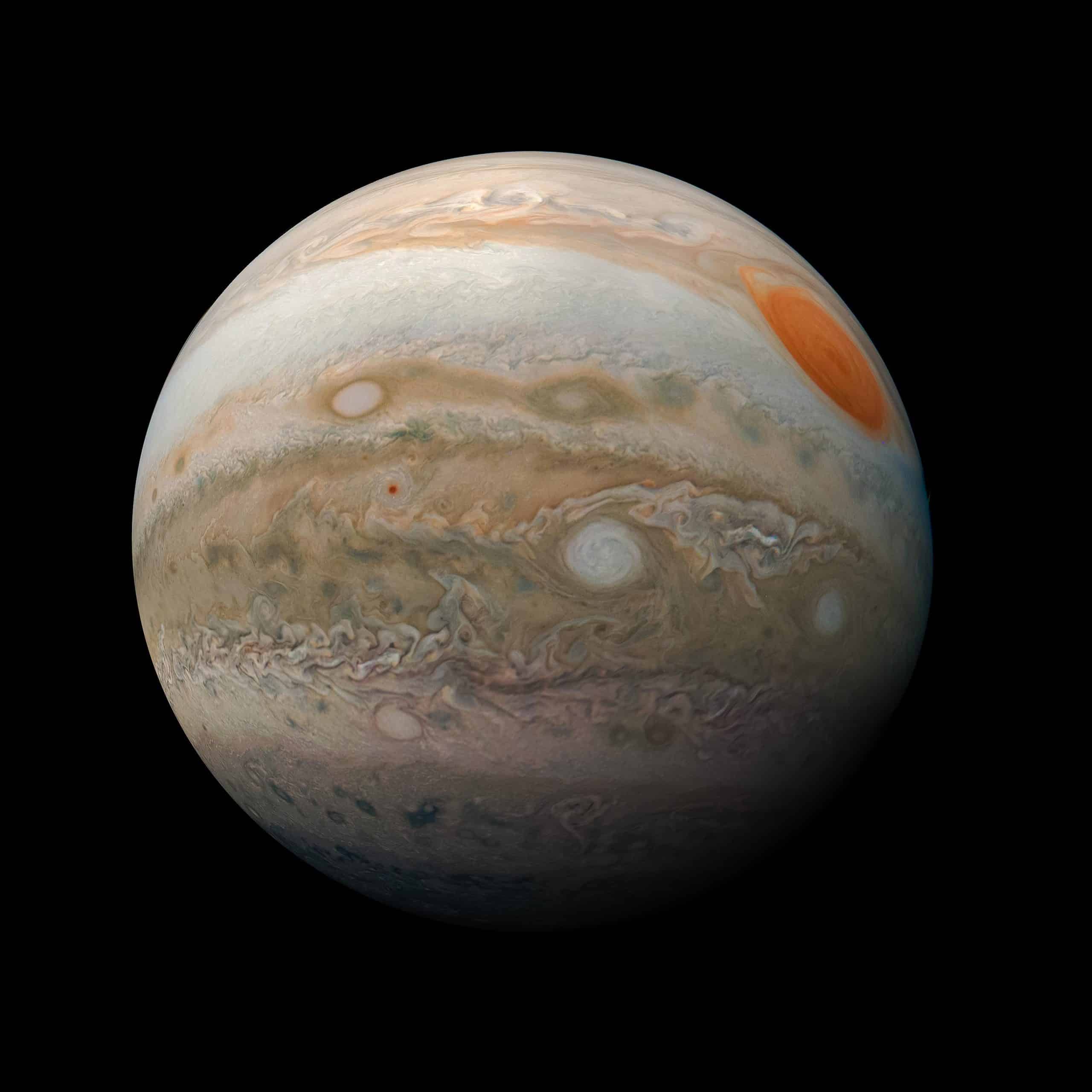
About every five years, the orbits of Jupiter’s four largest moons align as seen from Earth. For a few months, one moon passes in front of another, or its shadow crosses in front of another. This is the season of mutual eclipses, and it’s in full swing right now. The peak of the season is in mid-October 2026. It’s an event not to be missed.
What is a mutual eclipse?
Imagine this: You’re on Jupiter, looking at the Sun. If a moon passes in front of the Sun, you see a solar eclipse. Now imagine you’re on a moon, and another moon passes in front of the Sun: you’ll also see a solar eclipse. That’s exactly what happens during a mutual eclipse.
As seen from Earth, two types of events occur:
- Blackout : One moon passes in front of another. The two moons seem to merge into a single point, then separate. It's like a double star that moves closer and farther away.
- Eclipse : The shadow of one moon passes across the disk of another. The eclipsed moon slowly fades, sometimes until it disappears completely, then reappears. It’s like watching a light dim and then brighten again.
Like solar eclipses on Earth, each event has three types: total (completely obscured), annular (ring-shaped), and partial (only a portion is obscured).
Why now?
The orbits of the Galilean moons lie almost in Jupiter’s equatorial plane, which is itself inclined by a little more than 3° relative to Jupiter’s orbit around the Sun. Most of the time, the moons pass above or below one another as seen from Earth. But about every five years, when Earth crosses Jupiter’s equatorial plane, the orbits align and mutual eclipses become possible.
The current season began when Jupiter entered conjunction with the Sun on July 29, 2026. Events have been occurring with increasing frequency ever since. The season peaks in mid-October 2026. The season lasts until early 2027, with Jupiter in opposition on February 11, 2027.
The next triple shadow (three moons casting their shadows on Jupiter simultaneously) is expected in March 2032. The last one occurred in January 2015. This season is therefore an event not to be missed.
The Four Galilean Moons
Jupiter has 95 known moons, but only four are visible through an amateur telescope: the Galilean moons, discovered by Galileo in 1610.
- Io : the closest to Jupiter, the most volcanically active in the Solar System. Apparent diameter: about 1.0″. Intense volcanic activity, yellow-orange surface.
- Europe : The second one, covered in ice, with an ocean of liquid water beneath its crust. Diameter: about 1.1″. It is the most interesting moon for the search for extraterrestrial life.
- Ganymede : the largest moon in the Solar System, larger than Mercury. Apparent diameter: about 1.3″. It is the largest and easiest to spot.
- Callisto : the farthest, the most heavily cratered. Diameter: about 1.2″. It is the only one of the four that can sometimes «miss» Jupiter, because its orbit is the most inclined.
The three inner moons (Io, Europa, and Ganymede) are in a 1:2:4 resonance: Io completes two orbits for every one completed by Europa, and Europa completes two orbits for every one completed by Ganymede. This resonance keeps their orbits stable and synchronized.
How to Observe
The telescope
The Galilean moons are tiny: Ganymede, the largest, has a disk measuring barely 1.3 arcseconds. By comparison, Saturn’s disk measures 19 arcseconds. But mutual eclipses do not require resolving the moons’ disks: it is enough to observe the dimming of brightness when the shadow of one moon passes across another.
A telescope with a diameter of 100–150 mm is sufficient for observing mutual eclipses. At a magnification of 100x to 200x, the four moons are clearly separated from Jupiter, and changes in brightness are detectable. A larger telescope (200–250 mm) allows for better resolution of the moons and enables you to see the occultations as distinct mergers.
When to observe
Jupiter is currently visible before dawn in the constellation Leo. In October 2026, Jupiter rises around 11:00 p.m. to midnight and reaches its highest point in the sky in the early morning. The best time to observe it is between 1:00 a.m. and 5:00 a.m., when Jupiter is high in the sky.
Jupiter will be in opposition on February 11, 2027: at that time, Jupiter will be visible all night long and will reach a maximum altitude of about 50° as seen from Switzerland.
Predictions
To know when to observe them, you need predictions of mutual events. Several resources are available:
The Technique
- Check the predictions : Note the date, time, and type of event (occultation or eclipse, and which moons).
- Get there early : Please arrive 30 minutes before the event to allow the telescope to adjust to the temperature.
- Look for the four moons : At 100-200x magnification, the four Galilean moons are visible as bright spots around Jupiter.
- Observe the moon in question : During an eclipse, the eclipsed moon slowly fades. During an occultation, the two moons move closer together, merge, and then separate.
- Make a note of the time : Events last from a few minutes to half an hour. Note the start, peak, and end times.
Recognizing the Moons
An experienced observer can identify which moon is casting the shadow based on its appearance: Callisto’s shadow is broad and diffuse, while Io’s is a sharp black dot. Europa and Ganymede fall somewhere in between. But for a beginner, the easiest approach is to note the moons’ positions in Stellarium before observing and then identify them based on their positions.
For the photo
Mutual eclipses pose a challenge for astrophotography because of the small size of the moons (1–1.3″). However, a planetary camera (Player One Mars, ZWO ASI462) paired with a 200 mm telescope and a 2x or 3x Barlow lens can capture the occultations as two points merging together.
For eclipses (brightness attenuation), the method is different: we measure the moon’s brightness with a camera and plot the brightness curve as a function of time. This is photometry, not imaging. A digital camera in video mode, or a continuous-exposure planetary camera, can record the decrease in brightness.
Why It's Special
Mutual eclipses of Jupiter’s moons are a rare and subtle phenomenon. They do not produce spectacular images like those of a nebula or a galaxy, but they offer something no other observation can: the sensation of seeing the Solar System in motion, in real time, right before your eyes.
When you see Io’s shadow pass across Ganymede, what you’re seeing is a solar eclipse as viewed from Ganymede. And when the two moons merge into a single point and then separate, you’re witnessing an orbital ballet that has been unfolding for 4.5 billion years.
The season lasts until early 2027. The peak is now, in mid-October 2026. Get your telescope out.
Sources : Universe Today – Catching the 2026 Season of Mutual Eclipses of Jupiter's Moons ; British Astronomical Association – Joint Events 2026–27 ; IMCCE – Phemu ; Sky & Telescope – Mutual Event Season
See also on Deep Space Astronomy: Saturn in opposition on October 4, 2026 ; Draconids on October 9, 2026
Signature: CBurkhalter