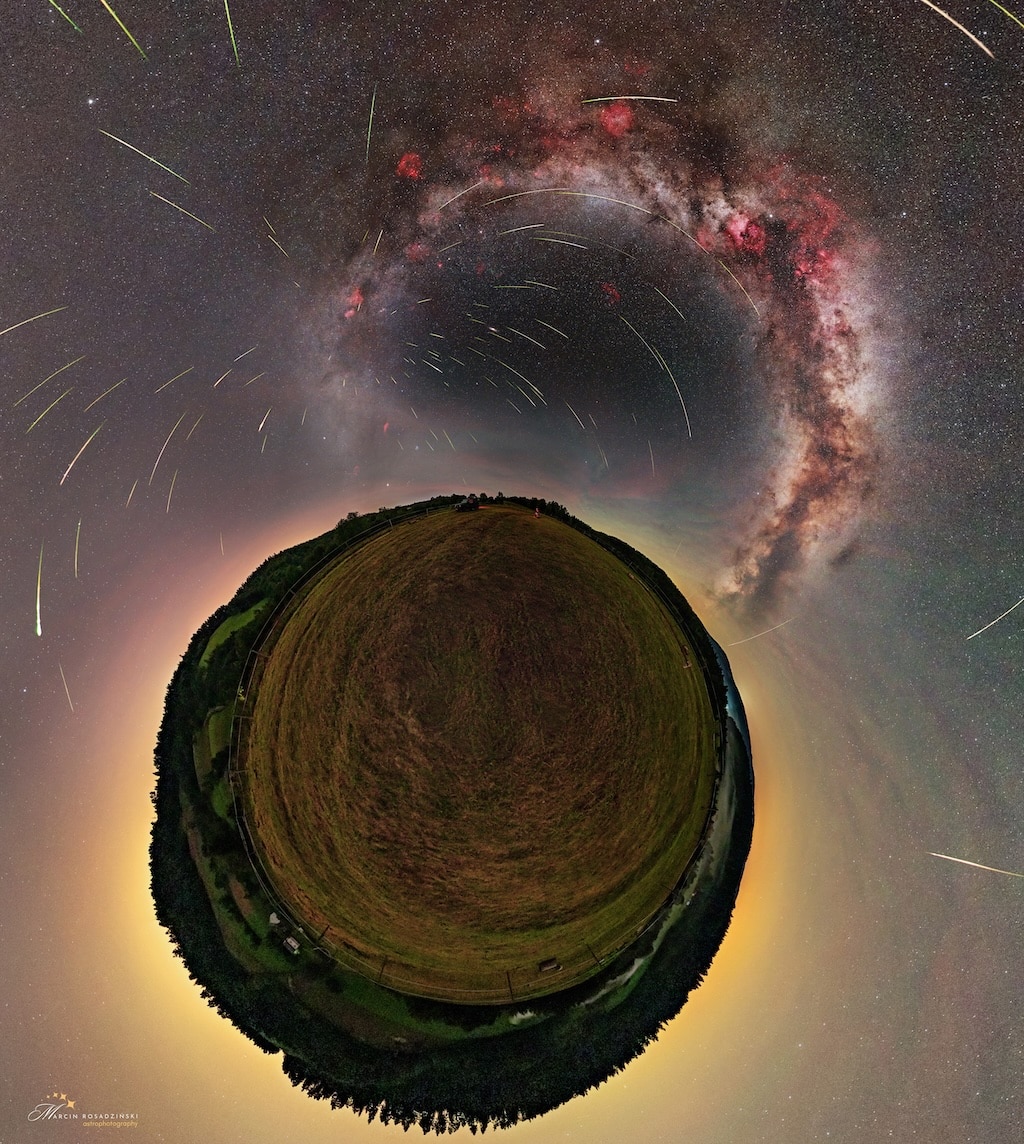
Most meteor showers require you to stay awake past midnight. The Draconids are the opposite: they can be seen as soon as night falls on the evening of October 8. And in 2026, the Moon will be virtually absent. Conditions will be nearly perfect.
Where do the Draconids come from?
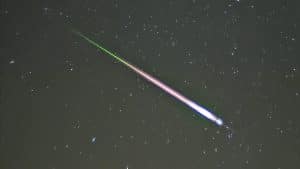
The Draconids originate from Comet 21P/Giacobini-Zinner, which was discovered by Michel Giacobini in 1900 and rediscovered by Ernst Zinner in 1913. This comet orbits the Sun every 6.6 years, trailing dust particles behind it that are distributed along its orbit. When Earth passes through this dust stream, the grains enter the atmosphere at a speed of about 20 km/s—slow for a shooting star—and burn up, creating what is known as a shooting star.
The radiant of the meteor shower—the point from which the meteors appear to originate—is located in the constellation Draco (the Dragon). This is where the Draconids get their name.
Why Is This an Atypical Swarm?
Most meteor showers reach their zenith in the sky after midnight or in the early morning. This is the case for the Orionids (late October), the Leonids (November), and the Geminids (December). To observe these meteor showers, it is generally recommended to go outside after midnight, when the radiant is high in the sky.
The Draconids are the opposite. Their radiant in the constellation Draco is highest in the sky as soon as night falls, at dusk. This means you should observe them in the evening, not after midnight. Between 8:00 p.m. and 10:00 p.m., the radiant is already high in the sky, toward the northwest. After midnight, it has disappeared below the horizon.
This is a huge advantage for enthusiasts: no need to stay up until 3 a.m. You just set up your chair, look up at the sky, and wait.
Where to Look in the Sky
The radiant of the Draconids is located in the Dragon’s head, the part of the constellation Draco that lies between Polaris and Vega (the brightest star in the Summer Triangle). To find this area:
- Find the North Star—the only star that doesn't move in the sky, around which everything else revolves. It is in the north, at an altitude equal to your latitude (about 47° from Switzerland).
- Head west, past the North Star, until you find Vega—the bright star at the top of the Summer Triangle.
- The Draconid meteor shower lies between the two, in the region of the Dragon's Head.
But here's the important point: you must not not Look directly at the radiant. Meteors originate from the radiant, but they are visible across the entire sky. The best place to watch is about 45° from the radiant—that’s where the meteor trails are longest. In practice, sit facing northwest and look toward the middle of the sky.
What to Expect
In 2026, the ZHR (Zenithal Hourly Rate—the number of meteors visible per hour when the radiant is at the zenith and the sky is perfectly dark) is estimated to be around 10. That’s modest. By comparison, the Geminids in December have a ZHR of 120–150.
But that figure of 10 is an average. The Draconids are known for their unpredictability. In 1933, 1946, 2011, and 2018, the meteor shower produced storms—thousands of meteors per hour. These storms occur when Earth passes through a particularly dense filament of the dust trail left behind by Comet Giacobini-Zinner during a recent close approach.
No storms are forecast for 2026. Models indicate that Earth will pass through a moderate region of the stream, with a ZHR of around 10. But as astronomers say: «Keep an eye on the Dragon, just in case it wakes up.»
In practice, expect to see about 5–10 shooting stars per hour if you’re under a truly dark sky (Bortle 1–4). In suburban areas (Bortle 5–6), expect 2–3 per hour instead. The Draconids are slow—20 km/s—which makes them easy to see and distinguish from sporadic meteors. They often appear as slow, lingering streaks, rather than quick flashes.
The equipment: your eyes
To observe the Draconids, the equipment you need is simple: your eyes. No binoculars, no telescope, no instruments. Meteors are visible to the naked eye, and that is the only way to observe them effectively—the field of view of a telescope or binoculars is far too narrow to capture a meteor shower.
The necessary materials are:
- A dark sky—stay away from city lights. A Bortle 3–4 location or better is ideal.
- An armchair or a lounge chair—you'll be looking up for an hour or two.
- Warm clothing—in early October, once night falls, the temperature drops even if it was still mild during the day. Bring a jacket, a hat, and gloves.
- Be patient—get comfortable, let your eyes adjust to the dark for 20–30 minutes, and wait. Don't look at your phone—the screen ruins your night vision.
- Optional: a thermos of hot coffee or tea.
For the photo: a digital camera and an intervalometer
If you want to photograph the Draconids, you don't need any complicated setup. A simple digital camera with a wide-angle lens and an intervalometer is all you need. Here's how to do it:
The Principle
Shooting stars appear unpredictably and briefly—from half a second to two seconds. You can’t «press the shutter at just the right moment.» The method is to take a continuous series of long exposures, one after another, and let the sky «imprint» itself on the sensor. If a shooting star crosses the frame during an exposure, it will leave a trail in the image.
The Setup
- Camera : Any digital camera or mirrorless camera with a manual mode (M). An entry-level DSLR will do.
- Objective : a wide-angle lens, 18–35 mm on APS-C or 24–50 mm on full-frame. The wider the lens, the more of the sky you cover, and the better your chances of capturing a meteor.
- Aperture : f/2.8 to f/4 – open the aperture as wide as possible to capture as much light as possible.
- ISO : 1,600 to 3,200 – enough to capture meteors, but not too much to avoid excessive noise.
- Poses : 30 seconds per frame. This is the ideal exposure time: long enough to capture a meteor, but short enough to prevent the stars from becoming streaks (at 30 seconds with a wide-angle lens, the stars remain as points).
- Interval : continuous – take a photo every 30 seconds, continuously. An intervalometer (or the built-in intervalometer feature on some digital cameras) does this automatically. Take continuous shots without pausing between exposures.
- Focusing : Manual, set to infinity. Focus on a bright star in Live View mode using digital zoom, then secure the focus ring with adhesive tape.
- Format : RAW – always. Shooting in RAW allows you to capture details in meteor trails and adjust the white balance during post-processing.
- Support : A stable tripod is essential. No tracking—we want still shots of the sky.
The Foreground
The trick to taking photos that stand out: Find a nice foreground. A tree, an old barn, a chapel, a lake, mountains—any earthly element that provides context and scale to the image. A shooting star against a black sky is nice. A shooting star that appears to be streaking past a fir tree or an alpine chalet is much better.
To do this, set up your tripod so that the foreground is at the bottom of the frame and the sky is at the top. The foreground will be illuminated by residual natural light (twilight or ambient light), and the stars and meteors will appear in the upper part of the frame.
What We Can Capture
With this setup—a digital camera, a wide-angle lens, and 30-second exposures at regular intervals—you won’t capture every shooting star you see. A meteor of magnitude +2 or +3 (visible to the naked eye but faint) may not leave a trail on the sensor. But a meteor of magnitude 0 or brighter will leave a beautiful trail.
With a ZHR of 10, over a 2-hour session (that is, 240 30-second exposures), you can expect to capture 3 to 8 meteors in your images. That’s not a huge number, but every one you capture is a reward. And if the Dragon awakens (a meteor shower), you could capture dozens.
During post-processing
After the session, import your images into your software (PixInsight, SiriL, or even Lightroom/Photoshop). Look for images with streaks—they’re easy to spot when browsing through the thumbnails. Select the images with meteors, process them individually (white balance, contrast, noise reduction), and combine them into a final image if you have multiple captures.
Moon Conditions in 2026
In 2026, the new moon occurs on October 10 at 3:50 p.m. UTC. On the evening of October 8, the moon is a thin waning crescent that rises just before dawn—so it is virtually nonexistent During the evening of the 8th and the night of the 8th into the 9th. Conditions were nearly perfect: no moonlight to obscure the faint meteors.
This is a significant advantage. Compare this to the Orionids, which occur later in October and will be disrupted by a waxing gibbous Moon after midnight in 2026. The Draconids have the best Moon conditions of the entire month of October.
When exactly should you observe it?
- The evening of October 8 : This is the main night. Get settled as soon as it gets dark (around 8:00–8:30 p.m. local time in Switzerland). The Dragon’s radiant is already high in the sky. Observe until 11:00 p.m.–midnight, after which the radiant sinks below the horizon.
- The evening of October 9 : second chance, slightly lower rate but still active. Same hours.
- The evening of October 7 : Activity begins early, before the peak. It's possible to see a few meteors, but not as many.
The viewing window is short: about 3–4 hours, from dusk until the radiant sets. That’s the advantage of an evening swarm—you set up, watch, and are in bed before midnight.
Why Go There Despite the Low ZHR?
With a ZHR of 10, the Draconids aren't the most spectacular meteor shower of the year. The Geminids (December, ZHR 150) and the Perseids (August, ZHR 100) are much more prolific. But the Draconids offer three unique advantages:
- Observation in the early evening – No need to stay up past midnight. Perfect for kids, a family outing, or fans who have to get up early the next day.
- Perfect Moon Conditions in 2026 – New Moon on the 10th, so the sky will be perfectly dark.
- Unpredictability – The Dragon could awaken at any moment. The storms of 1933, 1946, 2011, and 2018 were unpredictable. If a storm breaks out in 2026, being outside is a surefire way to create an unforgettable memory.
In practice
- When : The evening of October 8, 2026, as soon as night falls (8:00 p.m.–11:00 p.m. local time in Switzerland).
- Where : under a dark sky, far from city lights. A Bortle 3–4 site or better.
- Management : Facing northwest, look at medium height. The radiant is in the constellation Draco, between the North Star and Vega.
- Equipment : your eyes, an armchair, warm clothes. For the photo: a wide-angle digital camera, a tripod, an intervalometer, continuous 30-second exposures.
- Waiting : 5–10 meteors per hour under a dark sky. Slow, lingering, and easy to spot.
- Moon : virtually none (new moon on the 10th).
And if the Dragon awakens, you'll be in the right place at the right time.
Sources : EarthSky – Draconid Meteor Shower 2026 ; EarthSky – 2026 Meteor Shower Guide ; Royal Observatory Greenwich – Draconids 2026 ; Society for Popular Astronomy – Draconids
See also on Deep Space Astronomy: Saturn in opposition on October 4, 2026 ; September Equinox, 2026
Signature: CBurkhalter