The SVBONY MK127 is a compact 127 mm f/11.8 Maksutov-Cassegrain telescope that costs CHF 369.10 (excluding tax) in our store. At this price, can it really compete with the Sky-Watcher Skymax models? Detailed review, specs, and comparison.
All the info at a glance
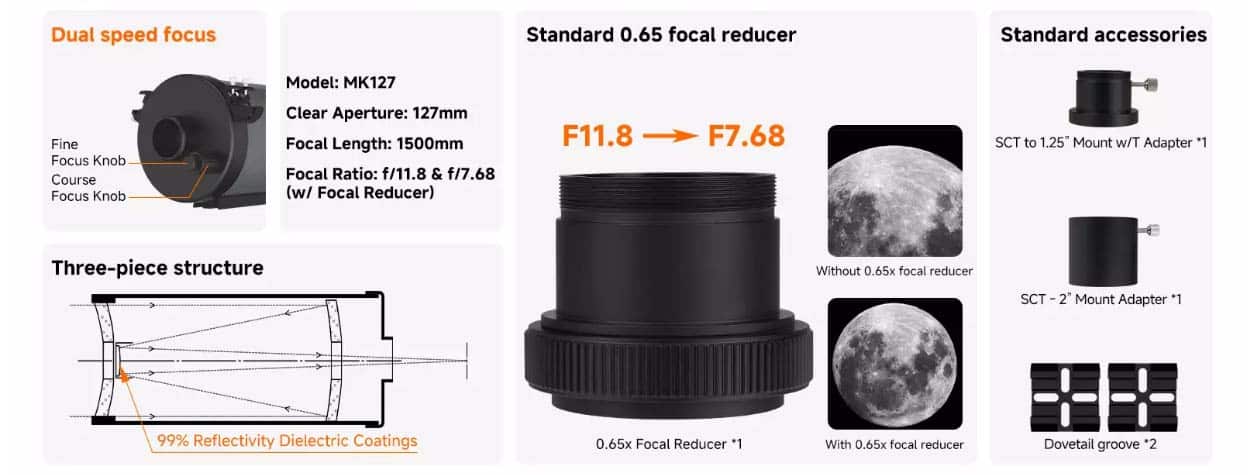
Aperture: 127 mm
Focal length: 1,500 mm, f/11.8 (f/7.15 with 0.65x extender included)
Optics: Maksutov-Cassegrain, 3 mirrors, separate secondary mirror
Design: flat-field, sharp images across the entire field of view
Interfaces: 1.25" and 2"
Rail: Vixen
Weight: 2.9 kg
Price: CHF 369.10 (excluding tax) in our store
Availability: Made to order; ships between November 4 and 9, 2026
0.65x reducer included
Why Use a Maksutov-Cassegrain Telescope for the Moon and the Planets?
A Maksutov-Cassegrain (Mak) is a compact, long-focal-length telescope. The design uses a meniscus lens at the front (the stop lens) to correct spherical aberration, and a concave primary mirror paired with a spot secondary mirror focused on the meniscus. The result is a short, enclosed tube with a long focal length (1,500 mm in this case) in a compact design.
Why is it ideal for planetary observation? Because the Moon, Jupiter, Saturn, and Mars require high magnification, and therefore a long focal length. A 127 mm Mak at f/11.8 provides a focal length of 1,500 mm: with a 10 mm eyepiece, you get 150x magnification. With a 6 mm eyepiece, 250x. This is exactly the useful range for planetary observation.
The sealed tube has another advantage: it minimizes internal turbulence. No air currents inside the tube means no convection to degrade the image. And the sealing plate protects the mirrors from dust and moisture.
The MK127: How It Differs from the MK105 and the MK90
SVBONY offers three Maks: the MK90 (90 mm, f/13.9), the MK105 (105 mm, f/13), and the MK127 (127 mm, f/11.8). The MK127 is the largest and most advanced model in the series.
The main difference lies in the coatings. The MK127 uses dielectric coatings on the secondary mirror with a reflectivity of 99 %. The MK105 tops out at 82 %, and the MK90 at 89 %. In practical terms, 99 % reflectivity means less light lost with each reflection, greater contrast in planetary details, and sharper images.
The MK127 features a dual-speed focus mechanism (coarse + fine), whereas the MK105 and MK90 have a single internal focus mechanism. When observing planetary objects, fine focusing is crucial: at 250x magnification, the sharp focus zone is narrow, and the dual-speed focuser allows you to find it without overshooting it.
Comparison with the Sky-Watcher Skymax 127
The Sky-Watcher Skymax 127 AZ-Go2 WiFi is the industry standard for 127 mm Mak telescopes. It retails for CHF 569 (AZ-Go2 WiFi mount included) in our store. The tube alone (Skymax-127T OTA) costs CHF 429.
The optical specifications are identical: 127 mm, 1,500 mm, f/11.8. The difference: the Skymax 127 comes with a WiFi-enabled GoTo alt-azimuth mount, while the MK127 is sold as a tube only. The MK127 adds 99 % dielectric coatings, a flat-field design, and an included 0.65x reducer.
At CHF 369.10 (excluding tax) for the MK127 compared to CHF 429 (excluding tax) for the Skymax-127T, the MK127 is CHF 60 cheaper while offering superior coatings and an included reducer. That’s what makes it a planetary tube at an unbeatable price.
For whom?
SVBONY MK127 in action. Credit: SVBONY.
The MK127 is designed for three types of users:
1. The music lover who wants a compact, world-class speaker without breaking the bank. For CHF 369.10, you get a 127-mm Mak telescope with 99 % coatings and a dual-speed focuser. All you need is a stable alt-azimuth mount and a few eyepieces to observe the Moon, Jupiter, Saturn, and Mars in detail.
2. The planetary astrophotographer. The MK127 mounted on an equatorial mount, paired with a planetary camera (ASI462MC, ASI678MC), allows you to capture high-resolution images of Jupiter, Saturn, and Mars. The dual-speed focuser and enclosed tube are major advantages for planetary photography.
3. The finishing touch to a deep-sky setup. A 127 mm Mak is the ideal companion for a wide-field astrograph: one for nebulae, the other for planets. Compact and lightweight (2.9 kg), it mounts piggyback on an existing mount.
What we see with focal lengths of 127 mm and 1,500 mm
With an aperture of 127 mm and a focal length of 1,500 mm, here's what you see:
The Moon : the craters Tycho, Copernicus, Clavius, and Plato; the Apennine Mountains; the Valley of the Alps; and the Tycho striations. At 200–250x magnification, the lunar surface appears detailed and three-dimensional.
Jupiter : the two main equatorial bands, the Great Red Spot when it is visible, and the Galilean moons in alignment.
Saturn : Rings A and B, the Cassini Division under good seeing conditions, Titan, and the other moons.
March : the polar cap, the dark regions of Syrtis Major and Mare Acidaliaum during a favorable opposition.
Recommended Setup and Accessories
The MK127 is a bare tube (OTA): it requires a mount. For visual observation, a manual alt-azimuth mount is sufficient (the Sky-Watcher AZ-Go2 or an astrophotography mount with a ball head). For planetary astrophotography, an equatorial tracking mount is required (EQM-35, HEQ5, or similar).
Recommended accessories:
1.25-inch eyepieces: 10 mm (150x), 6 mm (250x), 4 mm (375x in excellent seeing conditions)
ND or polarizing filter to reduce the glare from the full moon
Planetary camera: ASI462MC or ASI678MC for imaging
This article is based on the official SVBONY specifications published on September 18, 2026, at svbony.com and on the product pages in our store (SVBONY MK127, Sky-Watcher Skymax 127).
To provide the best experiences, we use technologies such as cookies to store and/or access device information. Consenting to these technologies will allow us to process data such as browsing behavior or unique IDs on this site. Failure to consent or withdrawal of consent may adversely affect certain features and functions.
Functional
Always active
Storage or technical access is strictly necessary for the legitimate purpose of enabling the use of a specific service explicitly requested by the subscriber or user, or for the sole purpose of transmitting a communication over an electronic communications network.
Preferences
Storage or technical access is necessary for the legitimate purpose of storing preferences not requested by the subscriber or user.
Statistics
Storage or technical access used exclusively for statistical purposes.Storage or technical access which is used exclusively for anonymous statistical purposes. In the absence of a subpoena, voluntary compliance by your Internet service provider or additional third-party records, information stored or retrieved for this sole purpose generally cannot be used to identify you.
Marketing
Storage or technical access is necessary to create user profiles in order to send advertisements, or to track the user on a website or on several websites with similar marketing purposes.