The Leonids return from November 6 to 30, 2026, peaking on the night of November 17–18. With 10 to 15 meteors per hour under a dark sky, lingering trails, and the Moon setting around midnight, conditions are good. Here’s how to observe fall’s fastest meteor shower from Switzerland and France.
All the info at a glance
Peak: the night of November 17–18, 2026 (11:45 p.m. UTC on the 17th)
Moon: first quarter on Nov. 17; sets around midnight
Dark Window: After midnight until dawn
Equipment: eyes only (no binoculars or telescope)
Visible from: all of Switzerland and all of France
Jupiter and Mars: in conjunction right next to the radiant on Nov. 15–16.
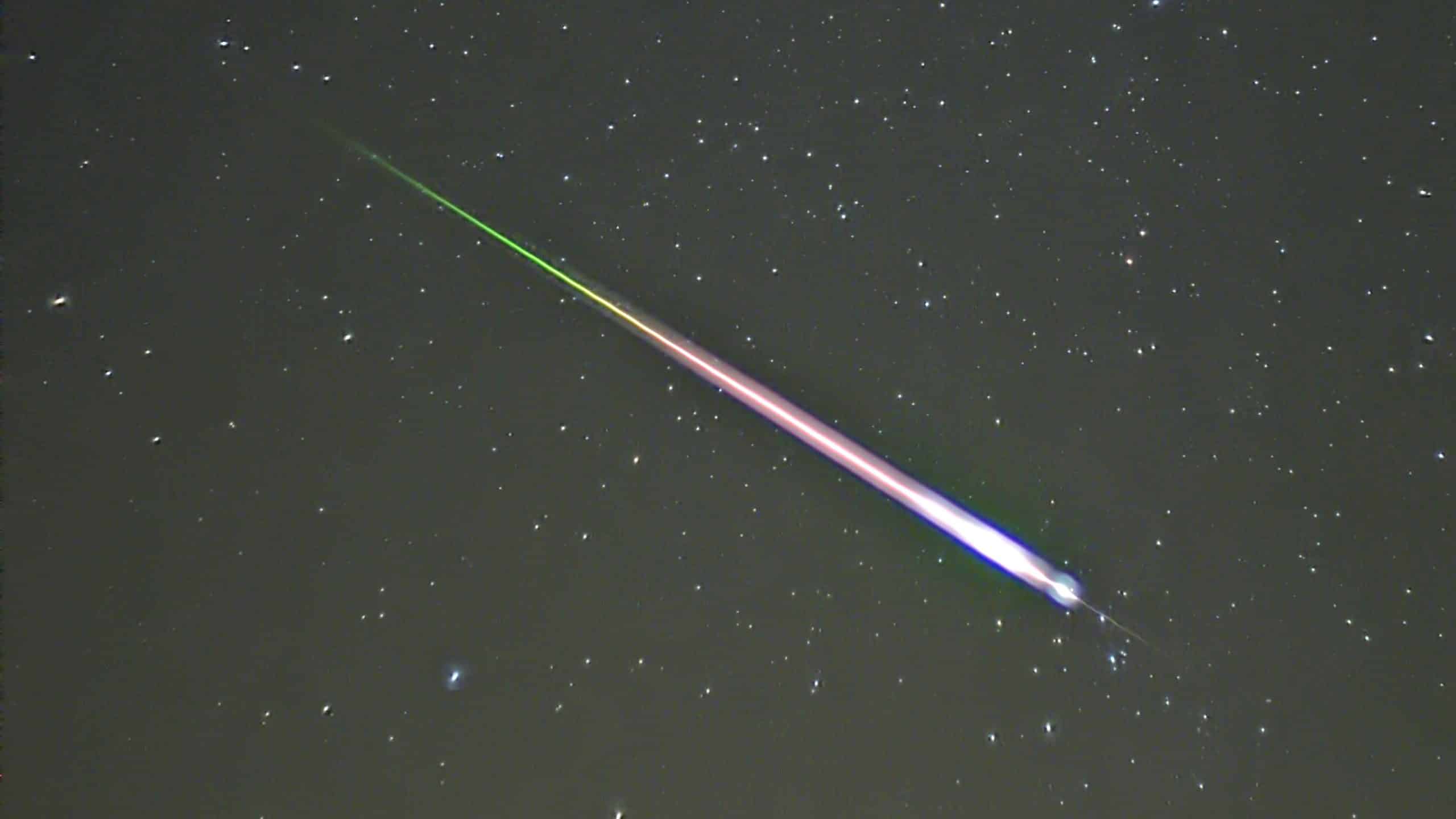
A Leonid meteor with its lingering trail during the 2009 peak. Credit: Navid Baraty, CC BY 3.0 license, via Wikimedia Commons.
Where do the Leonids come from?
The Leonids originate from Comet 55P/Tempel-Tuttle, which orbits the Sun every 33 years. With each pass, it leaves behind a cloud of dust. When Earth passes through this cloud in November, the dust particles enter the atmosphere at 71 km/s: this is the fastest meteor shower of the fall. This speed produces bright meteors with lingering trails, sometimes colored (green, blue, yellow).
About every 33 years, when Tempel-Tuttle passes close to the Sun again, the stream can produce a meteor shower: thousands of meteors per hour. The showers of 1833, 1966, and 2001 remain famous. In 2026, no storm is expected: Tempel-Tuttle’s last pass was in 1998, and the next one is predicted for around 2031. A moderate peak of 10 to 15 meteors per hour is expected.
When to observe: from midnight to dawn
The radiant of the Leonids is in the constellation Leo, near the star Regulus. From Switzerland, Leo rises around 11:00 p.m. to midnight in November. The radiant does not reach a high point in the sky until after midnight, peaking around 3:00–4:00 a.m.
The Moon is in its first quarter on November 17. It sets around midnight, leaving the sky dark for the rest of the night. The optimal viewing window runs from 12:30 a.m. to 5:30 a.m.: the radiant is high, the sky is dark, and dawn has not yet broken.
The peak itself is expected around 11:45 p.m. UTC on November 17 (12:45 a.m. CET on November 18). But activity will remain strong over several nights: from November 16 to 19, you can see Leonids.
Where to look: 45 degrees from the radiant
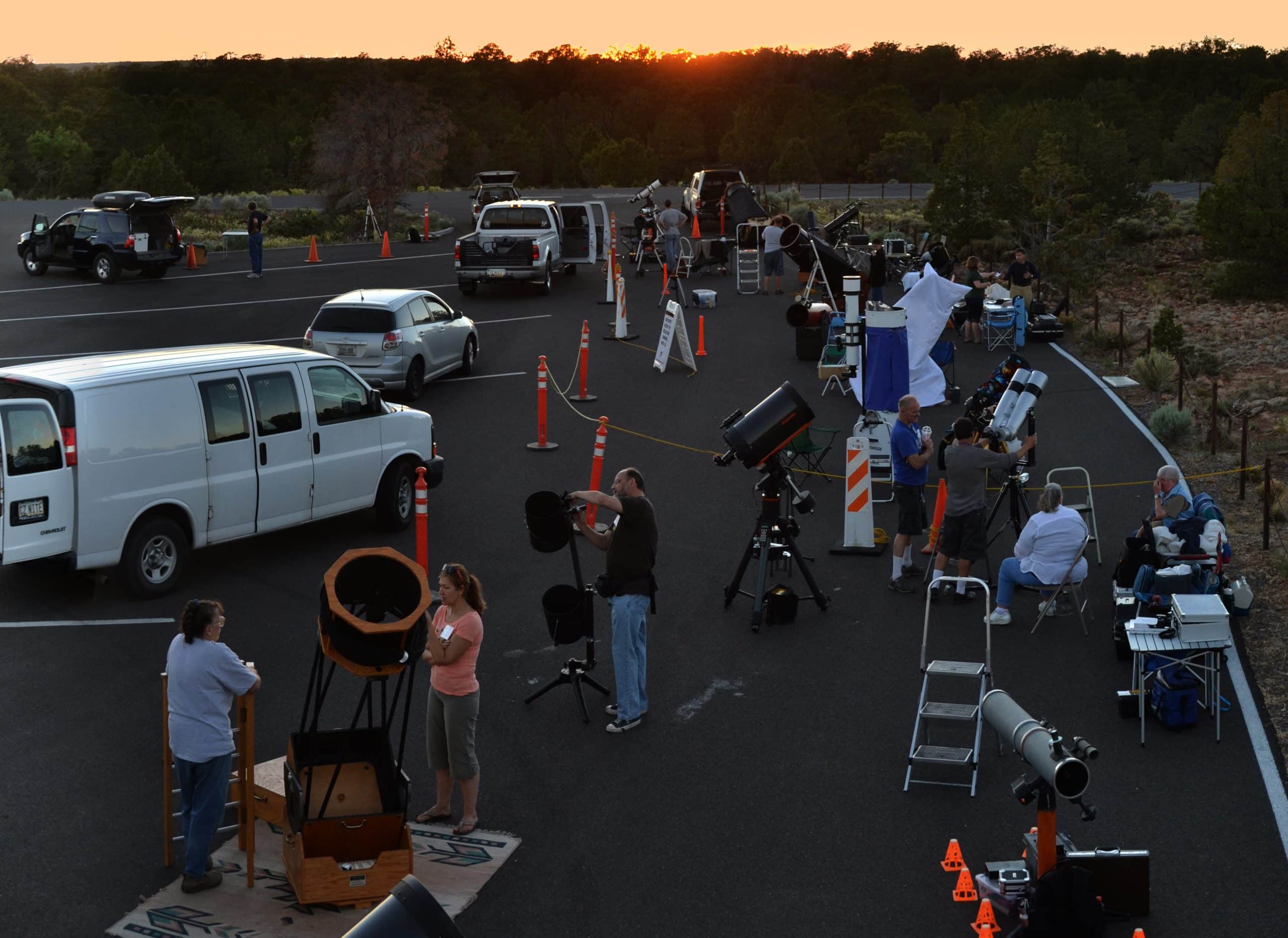
Under a dark sky, meteors appear all over the sky. Credit: National Park Service, public domain.
Do not look directly at the radiant. Meteors appear all over the sky, but they all seem to come from the radiant. If you look directly at the radiant, the meteors will appear short (due to perspective). Look at a 45-degree angle from the radiant: the trails will be longer and more spectacular.
From Switzerland, Leo rises in the east. Look toward the southeast after midnight, then toward the south as the radiant rises. Jupiter and Mars are right next to the radiant, in conjunction on November 15–16: a beautiful setting for observation.
The equipment: the eyes—and that's it
For meteors, no binoculars, no telescope. An instrument’s field of view is too narrow to capture a meteor. Your eyes are enough, as long as you’re under a dark sky and have let your eyes adjust for 20–30 minutes.
What you’ll need: a lounge chair or deck chair, warm clothes (it gets cold at night in November), a blanket, and patience. Plan on at least an hour of observation to see several meteors. Under a truly dark sky (Bortle 1–3), you can see 10 to 15 meteors per hour. In the city, far fewer.
Photographing the Leonids
To photograph meteors, use a mirrorless or DSLR camera with a wide-angle lens (14–24 mm) with a maximum aperture of f/2.8 or wider, mounted on a tripod, and equipped with an intervalometer. Take continuous 30-second exposures at ISO 1600 to 3200. You’re not photographing the meteor itself—you’re taking continuous shots of the sky and hoping that a meteor crosses the frame during one of the exposures.
The 500 Rule (500 divided by the focal length in mm) gives the maximum exposure time before star trails appear: at 24 mm, 20 seconds; at 14 mm, 35 seconds. A nice foreground (trees, mountains, a cabin) makes the photo more interesting.
Leonids vs. Orionids vs. Taurids: What's the Difference?
Fall has three meteor showers. The Taurids (early November, ZHR 5) are slow and produce fireballs. The Orionids (late October, ZHR 20) are fast, like the Leonids, which originate from Halley’s Comet. The Leonids (Nov. 17–18, ZHR 15) are the fastest (71 km/s) and produce persistent trails. The Taurids are slow (27 km/s), the Orionids are of moderate speed (66 km/s), and the Leonids are the fastest.
Already covered on the blog: the Orionids and Draconids. The Leonids round out the fall trio.
Why shop at Deep Space Astronomy?
We're not just a retailer. We test, advise, and provide support.
Personalized Advice : We can advise you on choosing the right instrument for deep-sky and general stargazing. By phone, WhatsApp, or by appointment in Nyon.
After-Sales Support : Do you have a question about observation, photography, or editing your photos? We're here to help.
14-Day Return Policy : Not satisfied? Return the product within 14 days.
Secure payment : Twint, credit card, invoice, Apple Pay, Bitcoin. Pay in 3 or 4 installments with no fees.
Free shipping in Switzerland Starting at CHF 200. Free pickup in Nyon.
This article is based on data from EarthSky (Leonid Meteor Shower 2026), NASA (Skywatching November 2026), and the Natural History Museum (Meteor Showers Guide). The image of the meteor is by Navid Baraty (CC BY 3.0, Wikimedia Commons), taken during the peak of the 2009 Leonids. The image of the star party is from the National Park Service (public domain).
To provide the best experiences, we use technologies such as cookies to store and/or access device information. Consenting to these technologies will allow us to process data such as browsing behavior or unique IDs on this site. Failure to consent or withdrawal of consent may adversely affect certain features and functions.
Functional
Always active
Storage or technical access is strictly necessary for the legitimate purpose of enabling the use of a specific service explicitly requested by the subscriber or user, or for the sole purpose of transmitting a communication over an electronic communications network.
Preferences
Storage or technical access is necessary for the legitimate purpose of storing preferences not requested by the subscriber or user.
Statistics
Storage or technical access used exclusively for statistical purposes.Storage or technical access which is used exclusively for anonymous statistical purposes. In the absence of a subpoena, voluntary compliance by your Internet service provider or additional third-party records, information stored or retrieved for this sole purpose generally cannot be used to identify you.
Marketing
Storage or technical access is necessary to create user profiles in order to send advertisements, or to track the user on a website or on several websites with similar marketing purposes.