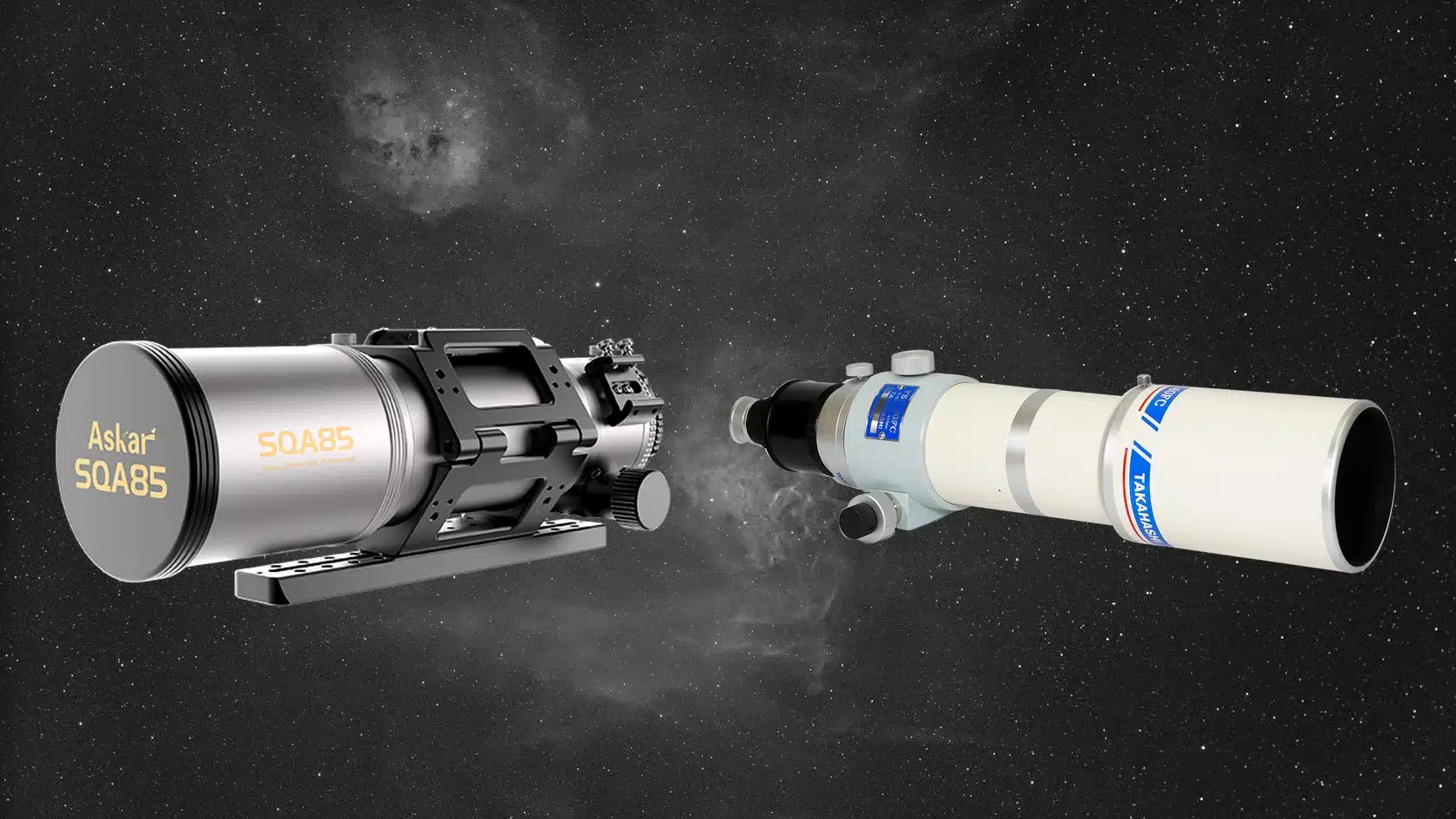
There’s one question that no spot diagram will ever ask you. When you buy a telescope, what brings you joy? The image you’ll capture at the end of the night? The telescope itself? Or both?
Between the Askar SQA85 and the Takahashi FSQ-80FC, I prefer the Takahashi. However, I would gladly recommend the Askar to someone who photographs the same subjects as I do, using the same camera. To understand why, you have to look at the numbers, then ask yourself how much weight you give them once you’re in front of your screen… or looking through your telescope.
How the Two Lenses Compare
The first detail that changes how the comparison is interpreted. Takahashi publishes his ads in RMS diameter and Askar in RMS radius. So I brought both values back to the radius. The smaller the value, the more the rays emanating from a star are concentrated in the same location in the simulation. Takahashi Data · Askar Diagram
At Home
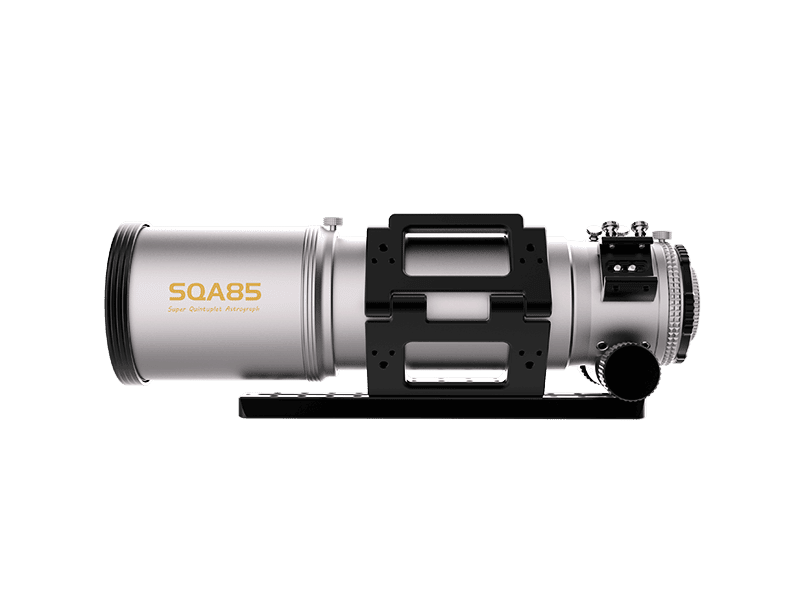
Askar SQA85
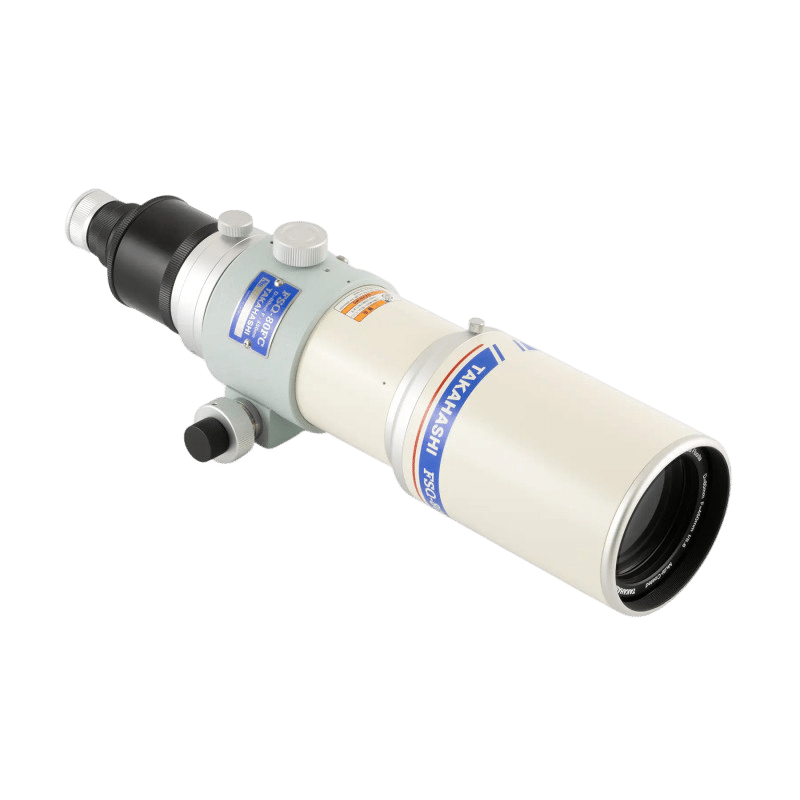
Takahashi FSQ-80FC
Diameter and Focal Length
85 / 408 mm
80 / 450 mm
Opening report
f/4,8
f/5,6
RMS radius at the center
1.58 µm
0.40 µm
RMS radius near the corner of the full-frame image
2.46 µm
1.10 µm
Field of view on a 36 × 24 mm sensor
5,05° × 3,37°
4,58° × 3,06°
Based on the published data, the Takahashi offers the best correction both in the center and in the corners. Even taking the difference in focal length into account, its spot radius at the corner is 0.50 arcseconds across the sky, compared to 1.24 for the Askar. This comparison has its limitations. Askar extends its simulation further into the violet and red spectrum, from 420 to 700 nm, compared to 436 to 656 nm for Takahashi. And in a photograph, turbulence, diffraction, and pixels also affect the size of the stars. Askar Diagram · Takahashi Data
The FSQ-80FC is better, but is the difference noticeable?
To decide between these two telescopes when observing the sky, I’d like to see their raw images of the same field, taken on the same night, with the same camera model, the same filter, and the same exposure time. I would then examine them at the same scale across the sky—in the center and in the four corners. I haven’t found any publicly available test images that meet these conditions. Marc Khatchadourian shows a five-minute raw image of Andromeda taken with the SQA85. Takahashi presents the Orion Belt after 84 three-minute exposures with the FSQ-80FC. Both use an ASI6200MC Pro, but the target, the sky, and the integration time differ. These images therefore do not allow us to quantify the difference between the two telescopes.
What I expect from a lens with better correction is contrast in areas with fine detail. Imagine two small stars very close together in a corner of the image. If the lens spreads their light, the gap between them fills in and they begin to merge. The same thing happens with a nebula when a luminous filament borders a thin dark band. The better the optics preserve this transition, the more clearly it is visible right from the moment the image is captured. That’s where the FSQ-80FC’s tighter spot size really stands out to me. The expected benefit will be all the more noticeable as turbulence, tracking, and sampling allow you to take full advantage of it. Optical Data and Contrast Curves for the FSQ-80FC
What about the signal-to-noise ratio? Let’s consider a faint star. For the same amount of light received, if the star is more compact, we can measure the same fraction of its light over a smaller area of the sky. This results in less background noise being captured, which helps in detecting the star. Over a large, nearly uniform area of a nebula, however, it’s a different story. Better optical correction does not create any additional photons. With the same camera, the f/4.8 Askar retains its advantage in light-gathering per pixel over the diffuse signal. The precision of the optics matters most where brightness varies over short distances. Space Telescope Science Institute Photometry Guide · SQA85 Specifications
I myself used an Askar 50P, thinking that BlurXTerminator would make up for everything. Well, I saw the difference after processing, and I also saw its limitations. BlurX can sharpen the stars and restore contrast to a filament. But if the blur has softened the filament so much that it blends into the noise, moving the slider further won’t allow you to accurately determine what shape it originally had. A sharper raw image gives the software a better foundation to work with. and gives me the freedom to stop earlier.
And that, to me, is what matters when choosing the FSQ-80FC. I love being able to open an image, gently boost the levels, and discover that a small star is already clearly separated from the filament behind it. When that level of detail is there right from the start, I can keep my hand light on the processing. That’s also part of the joy of great optics.
So how do you ultimately decide?
If your approach to editing photos is mostly about giving them a good BlurXTerminator, to experiment with colors and enjoy watching the hidden signal of a nebula emerge, I would gladly recommend the SQA85. If the optics themselves aren't that important to your enjoyment, what will you really gain from the Taka? The Askar will give you beautiful images, a wider field of view, and fast image capture. And you've seen how it performs in the corners before processing.
Now, imagine the FSQ-80FC sitting in your living room. You walk past it on your way to make a cup of coffee, glance at the lens, and think to yourself «Good grief, I have some amazing glasses!» If this sounds like you, you know what you have to do. There’s a real sense of pride in owning high-quality equipment, especially when you understand what makes it exceptional. In the case of the FSQ, what I love is knowing just how precisely this lens focuses a star’s light, even right at the edge of the sensor.
And beyond the emotional aspect, the Taka's optical performance will be evident in the final image!
Personally, that kind of enjoyment is part of astronomy. Between the two, I'd choose the Takahashi FSQ-80FC without a moment's hesitation.
To provide the best experiences, we use technologies such as cookies to store and/or access device information. Consenting to these technologies will allow us to process data such as browsing behavior or unique IDs on this site. Failure to consent or withdrawal of consent may adversely affect certain features and functions.
Functional
Always active
Storage or technical access is strictly necessary for the legitimate purpose of enabling the use of a specific service explicitly requested by the subscriber or user, or for the sole purpose of transmitting a communication over an electronic communications network.
Preferences
Storage or technical access is necessary for the legitimate purpose of storing preferences not requested by the subscriber or user.
Statistics
Storage or technical access used exclusively for statistical purposes.Storage or technical access which is used exclusively for anonymous statistical purposes. In the absence of a subpoena, voluntary compliance by your Internet service provider or additional third-party records, information stored or retrieved for this sole purpose generally cannot be used to identify you.
Marketing
Storage or technical access is necessary to create user profiles in order to send advertisements, or to track the user on a website or on several websites with similar marketing purposes.