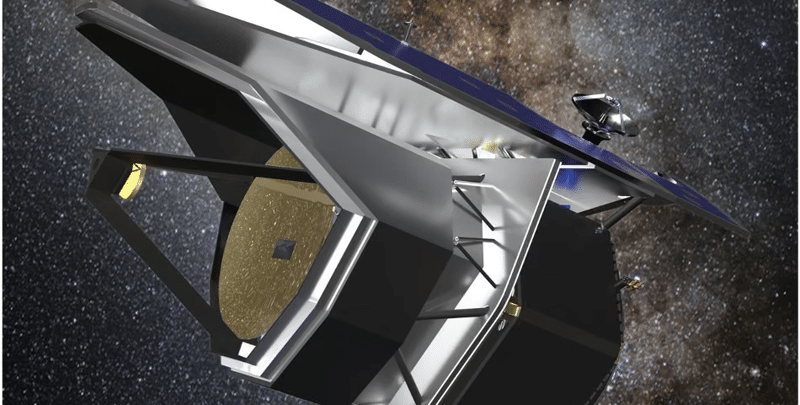
On September 23, 2026, NASA announced the selection of PRIMA (PRobe far-Infrared Mission for Astrophysics) as its next major space observatory. The launch is scheduled for 2033, with a 5-year mission duration and a budget of $1.2 billion, excluding the launch vehicle. PRIMA is the first in a new class of missions, the Probe Explorers, recommended by the 2020 Decadal Survey. It fills a gap that has existed since the end of the Herschel mission in 2013.
What Is Far-Infrared, and Why Do We Need It?
To understand what PRIMA will do, you first need to understand what far-infrared is.
The light that our eyes see occupies a narrow band of the electromagnetic spectrum: the visible spectrum. Red is the longest wavelength we can perceive, at around 0.7 micrometers. Beyond that lies the infrared spectrum. It is divided into several regions:
- Near-infrared (0.7 to 5 micrometers): This is the range that the JWST observes with its primary instruments. It can see through interstellar dust, but it does not detect most of the energy from cold sources.
- Mid-infrared (5 to 24 micrometers): The JWST extends up to 28 micrometers, but its sensitivity decreases at longer wavelengths.
- Far-infrared (24 to 350 micrometers): this is PRIMA’s domain. This is where cold dust, protoplanetary disks, water molecules, and the dustiest galaxies emit most of their energy.
The problem is that far-infrared radiation is virtually opaque from the ground. The Earth’s atmosphere absorbs these wavelengths. You need a telescope in orbit—and, what’s more, one cooled to extremely low temperatures so that its own heat doesn’t mask the signal.
Why the JWST Isn't Enough
JWST is an extraordinary infrared telescope, but its detection limit is 28 micrometers. About half of the energy emitted since the Big Bang has been absorbed by interstellar dust and re-emitted in the far-infrared, beyond the JWST’s 28-micrometer limit. That’s half of the cosmic radiation that escapes us.
Far-infrared is where the fundamental phenomena of modern astrophysics take place:
- Planet formation in the dust disks surrounding young stars, at temperatures ranging from 10 to 100 kelvin.
- Water chemistry: The rotational spectral lines of the water molecule lie in the far-infrared region, which is why the 2020 Decadal Survey explicitly identified the origin of water on Earth as a major objective.
- The Hidden Universe: The brightest active galaxies—those with intense star formation—are so dusty that visible light and near-infrared light cannot penetrate them. Far-infrared light, however, does pass through the dust.
- Heavy elements: The synthesis of elements in stars and their ejection into the interstellar medium results in spectral signatures in the far-infrared.
PRIMA: A 4.5-Kelvin Telescope
PRIMA carries a 1.8-meter primary mirror, smaller than the JWST’s 6.5 meters but considerably larger than Herschel’s 0.35 meters (the last major far-infrared telescope, 2009–2013). The difference isn’t just in size—it’s in temperature.
The telescope and its detectors will be cooled to approximately 4.5 kelvin, or -268.5 °C. At this temperature, the telescope emits almost no thermal radiation of its own, allowing it to detect faint signals from galaxies and cold disks without the telescope’s own noise masking them. This is equivalent to cooling an optical telescope so that it is not illuminated by its own glow.
By comparison, the JWST operates at around 50 K, which is sufficient for the near- and mid-infrared but not for the far-infrared beyond 30 micrometers. Herschel operated using liquid helium, which ran out in 2013, limiting the mission to 3.5 years. PRIMA aims for a 5-year mission with an active mechanical cooling system, in a halo orbit around the Sun-Earth Lagrange point L2, like JWST and Roman.
The tools: FIRESS and PRIMAger
PRIMA is carrying two scientific instruments:
FIRESS (Far-Infrared Enhanced Survey Spectrometer): a grating spectrometer covering the entire 24- to 235-micrometer range in four bands. A Fourier module can be inserted to increase the spectral resolution up to 20,000, making it possible to resolve individual spectral lines of molecules such as HD (deuterium hydride), H₂O, OH, or neutral carbon.
PRIMAger : an imager and polarimeter that consists of two sub-instruments. The PHI (Hyperspectral Imager) scans from 24 to 84 micrometers with a spectral resolution of approximately 8, which makes it possible to map dust temperature and star formation rates. The PPI (Polarimetric Imager) uses four filters ranging from 92 to 235 micrometers to measure the polarization of light; PRIMA will be NASA's first telescope to feature a dedicated polarimeter in the far-IR.
Both instruments read their signals using superconducting kinetic induction detectors (KIDs), a technology that has been refined over two decades through ground-based and stratospheric balloon experiments.
The New Probe Explorers Class
PRIMA is the first in a new class of missions that NASA calls Probe Explorers. The 2020 Decadal Survey (Pathways to Discovery in Astronomy and Astrophysics for the 2020s) recommended creating this class to bridge the gap between small Explorer satellites (such as SPHEREx, launched in March 2025, which maps the entire sky in near-infraredIR) and flagship observatories such as the JWST and the Nancy Grace Roman Space Telescope (launched in 2026).
Probe Explorers targets missions costing approximately one billion dollars that are capable of addressing major scientific questions that a smaller telescope cannot tackle, without reaching the cost of flagship missions. PRIMA was selected following a detailed evaluation of several concepts, based on scientific merit, technical feasibility, and alignment with the recommendations of the Decadal Survey.
International Partners
PRIMA relies heavily on international partners, more so than most missions of this class. CNES (France) co-leads the PRIMAger instrument with the Marseille Astrophysics Laboratory and the CEA. SRON (Netherlands) is co-developing both instruments. The Max Planck Institute in Heidelberg built the beam-steering mirrors. The ASI (Italy), the CSA (Canada), the DLR (Germany), KASI/KASA (South Korea), JAXA (Japan), and the UK Space Agency (United Kingdom) all contributed to the Phase A studies.
NASA has designated the Jet Propulsion Laboratory (JPL) in California as the mission control center, with participation from the Goddard Space Flight Center and the Marshall Space Flight Center.
What This Means for Fans
PRIMA is not intended for amateur observation: it is a space telescope whose images will be processed by professional teams and published in open-access archives. But for amateurs interested in astrophysics, PRIMA will set a new standard for far-infrared imagery.
The Herschel images, taken between 2009 and 2013, remain the standard references for illustrating molecular clouds, star-forming regions, and dusty galaxies. PRIMA, with a mirror more than five times larger than Herschel’s and modern KID detectors, will produce significantly sharper and deeper images. The maps of cold dust, spectra of protoplanetary disks, and images of obscured galaxies that will be shown at conferences and in magazines in the 2030s will come from PRIMA.
And for ground-based observation, the fall sky of 2026 remains the best time to observe the cold objects in our solar system. Saturn is in opposition on October 4, Jupiter is currently visible in the morning sky, and the Orionids peak on October 21–22. As for PRIMA, it will be peering into the universe beyond the reach of our telescopes.
Launch and Schedule
PRIMA is entering Phase B of development, with a planned launch in 2033. The primary mission will last 5 years, of which 25 % of the time is reserved for the PI-led program and 75 % is open to the community via a General Observer call, following the same model as Hubble and JWST. The telescope will be placed in a halo orbit around the Sun-Earth Lagrange point L2, approximately 1.5 million kilometers from Earth.
The main technical challenge remains cryogenics: maintaining a 1.8-meter telescope and two instruments at 4.5 K for 5 years using an active mechanical cooling system—an unprecedented feat on this scale for NASA. This technical challenge explains why the far-infrared spectrum remains so underutilized, and why PRIMA is taking so long to get off the ground.
Sources : NASA – PRIMA Selection ; OrbitalHub – Introduction to PRIMA ; IPAC/Caltech – PRIMA Project Page ; Decadal Survey 2020 (Pathways to Discovery in Astronomy and Astrophysics for the 2020s, National Academies)
See also on Deep Space Astronomy: JWST Detects Water and Dust Near the Milky Way's Central Black Hole ; Saturn at Opposition on October 4, 2026: An Observation Guide
Signature: CBurkhalter