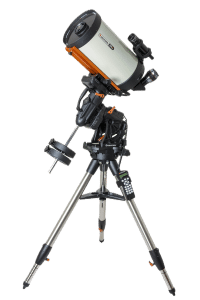
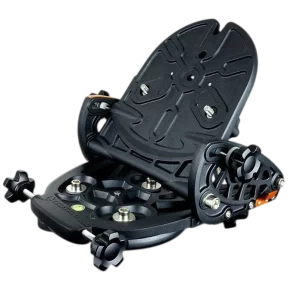
To observe, a alt-azimutale is intuitive: up-down, left-right. For deep-sky photography, you need a equatorial Alignment, which tracks the rotation of the sky without rotating the field of view. Choosing the right mount is essential: make sure you have a good load capacity relative to the weight of your instrument and its accessories.
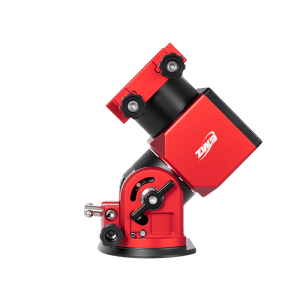
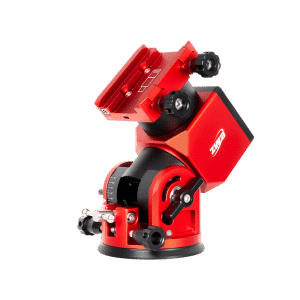
A motorized alt-azimuth mount is sufficient for observing the Moon, the planets, and short exposures; however, it causes the field of view to rotate, which limits long exposures of deep-sky objects. Some mounts switch between the two modes, such as the ZWO AM3N.
These mounts are lightweight and operate without counterweights up to a comfortable load: the'AM3N Weighs 4.1 kg and can support 8 kg without a counterweight, or 13 kg with one. On the other hand, their periodic error is more pronounced: autoguiding is essential for long exposures. We compare the models in AM5N, NYX-101, or HAE29.
Visit Sky-Watcher EQ-AL55i PRO It can carry 10 kg: enough to accommodate a 70- to 80-mm telescope, the camera, and the guiding system with some headroom. It’s still light enough to be transported to a dark sky location. Having some headroom in the load capacity is what makes the difference in the sharpness of the stars.
If your mount has a USB port, all you need is a simple USB-to-ASIAIR cable. Otherwise, an EQDIR cable plugs into the mount's port and replaces it. Send us the exact model and a photo of the connector, and we'll let you know which cable to use.
We do not sell grease, but a lithium grease or an NLGI 2-grade PTFE grease that performs well in cold temperatures (for example, Super Lube 21030, rated for temperatures down to −43 °C) is suitable. First remove the old grease, then apply a thin layer to the worm screw and gears. Never apply grease to the belts or encoders.
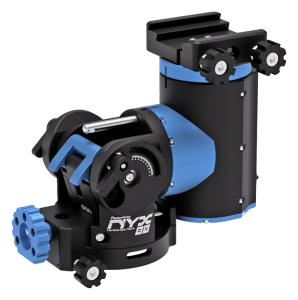
Generally speaking, the HEQ5-R Pro is very popular, and the'EQ6-R Pro is considered a reliable choice that carries a lot of weight. Among the more recent models, the ZWO AM5N and the Pegasus NYX-88 are all the rage. The Sky-Watchers Wave 100i and Wave 150i They, too, sell very well and are highly regarded, and they're also very quiet.
For the Milky Way, constellations, and large nebulae in wide-field shots, a star tracker is sufficient: it compensates for the rotation of the sky when used with a camera equipped with a wide-angle lens or a short telephoto lens, and fits in a backpack. The shorter the focal length, the easier tracking is and the more forgiving the alignment process becomes. The Move Shoot Move Nomad is the most compact. The Star Adventurer 2i and the'iOptron SkyGuider Pro are safe bets. The Star Adventurer GTi Adds GoTo and tracking on both axes. Find them all in our ultra-portable frames.