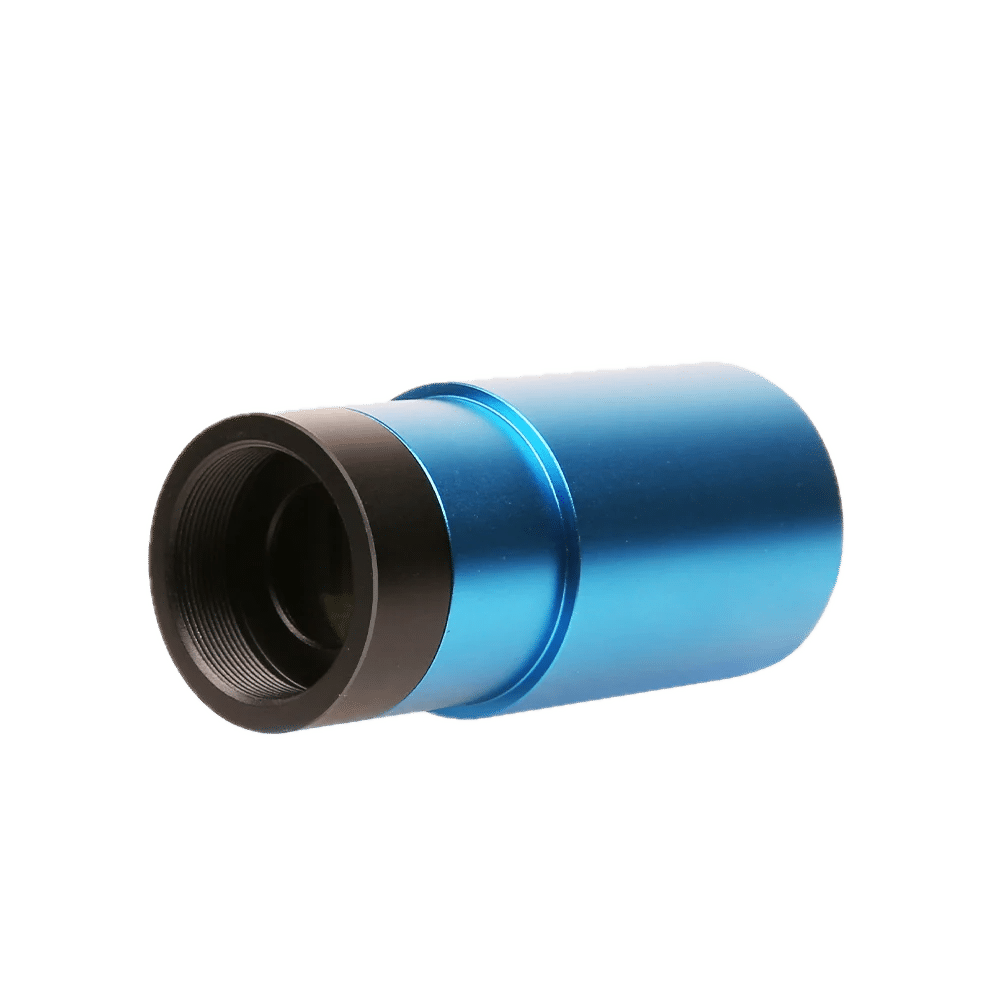
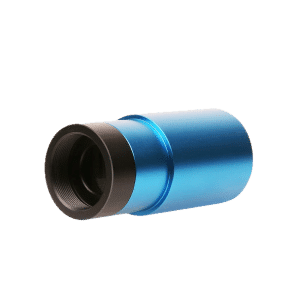
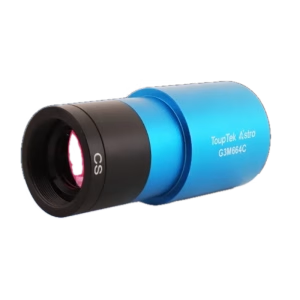
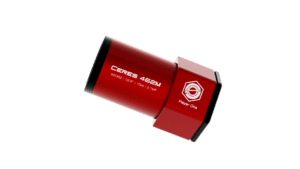
ToupTek GPCMOS02000KPA camera (IMX290 color)
Visit ToupTek GPCMOS02000KPA is a color camera in 1,25″ originally designed for the’self-steering, but versatile enough to also be used in planetary/lunar imaging and for capturing brilliant deep-sky objects (open clusters, luminous nebulae, short exposures).
Its strong point is balance: a highly sensitive sensor, ultra-compact size, broad compatibility (Windows / macOS / Linux), and above all the presence of a ST-4 port integrated to directly guide a mount. In practice, this is typically the camera that is slid like an eyepiece into a guide telescope, a guide finder, or a guide mount. OAG (Off-Axis Guider) when you want a reliable, lightweight solution that's easy to implement.
Sony IMX290 color sensor: sensitivity and precision for guidance
The GPCMOS02000KPA is based on a Sony IMX290 CMOS sensor (optical format 1/2,8″) whose reputation is well established in the guiding and planetary arenas. They include :
- 2.1 MP (resolution 1920 × 1080) for comfortable framing and easy-to-identify guide stars.
- 2.9 µm pixels ideal for using modest guiding focal lengths while maintaining good sampling finesse.
- Very high sensitivity (QE max announced at 81%): a real plus when the field is star-poor (OAG, filters, average seeing, etc.).
- Low reading noise (announced between 0.53 e- and 0.84 e-): helps to “hold” weak stars and stabilize the guidance algorithm.
As a result, you gain in acquisition comfort (faster star detection), and guidance becomes smoother, especially on compact setups where you don't want to multiply constraints.
ST-4 autosteering and modern workflow via USB
The camera features a USB 2.0 for the acquisition of a ST-4 port for “direct mount” guidance. This allows two approaches:
- Guidance via ST-4 simple, practical and universal connection to the frame's autoguider socket.
- Guidance via ASCOM/INDI (depending on your configuration): full software control, very common with PHD2, N.I.N.A, Ekos, etc.
The announced rate (up to 18 fps at full resolution) is also interesting: in planetary/lunar mode, you can edit a usable video stream; in guiding mode, you can adjust the frame rate to optimize responsiveness to turbulence.
Ultra-practical 1.25″ format: OAG, guide bezel, guide finder
The GPCMOS02000KPA is designed to be easy to integrate in an optical train. It offers:
- 1.25″ insert (like an eyepiece): perfect for guide scopes, seeker-guides and most OAGs on the market.
- Thread M28.5×0.6 (standard 1.25″) and C-mount for more “mechanical” adaptations (rings, industrial lenses, etc.).
- Short draw distance useful when backfocusing is limited, especially on certain OAGs.
In concrete terms, it's a camera that takes the hassle out of mounting, focusing and guiding. Its small size and featherweight also limit stress on the eyepiece holder and clamping rings, especially on small guide glasses.
Planetary and deep-sky: a true “3-in-1” camera”
In addition to guidance, the GPCMOS02000KPA can also be used for imaging:
- Moon perfect for Full HD mosaics and quick stacking sequences.
- Planets A very good color entry point, with a sensitive sensor and a frame rate suited to lucky imaging.
- Bright deep-sky objects With short exposures and/or stacking (EAA), you can already produce beautiful results on bright targets, especially with open instruments.
The camera incorporates an input window described as UV/IR cut filter, This helps to avoid some of the focusing problems and “bloat” on stars with certain optics.
Compatibility and software integration
The announced compatibility with Windows, macOS and Linux is an important point: whether you're in a nomadic setup (Windows PC), a Mac environment, or an observatory with a Linux mini-PC (INDI/Ekos), the camera integrates easily into a modern astro ecosystem.
In a typical flow, you can :
- use the camera in PHD2 for autosteering,
- integrate it into a session N.I.N.A (or equivalent) to automate your shots,
- use it in planetary with suitable video capture software, then stack (AutoStakkert!, etc.).
Technical specifications
| Sensor |
Sony IMX290 color CMOS (1/2.8″ format) |
| Resolution |
2.1 MP - 1920 × 1080 |
| Pixel size |
2.9 µm |
| Sensor size |
5.57 mm × 3.13 mm (diagonal 6.39 mm) |
| QE max (announced) |
81% |
| Playback noise (announced) |
0.53 e- to 0.84 e- |
| Laying time |
0.105 ms to 1000 s |
| Max. speed |
18 fps (full resolution) |
| KING |
Supported |
| Autoguider port |
Yes (ST-4) |
| Interface |
USB 2.0 |
| Depth |
12-bit output (12-bit ADC) |
| Input window |
UV/IR cut filter (announced) |
| Connections |
1,25″, M28.5×0.6, C-mount |
| Backfocus (announced) |
8.5 mm (housing only); 17.5 mm (with C-mount adapter); 12.5 mm (with CS adapter) |
| Dimensions |
Ø 35 mm × 62 mm (Ø 35 mm × 82 mm with 1.25″ extension) |
| Weight |
70 g |
| Supported systems |
Windows, macOS, Linux |
Box contents
- ToupTek GPCMOS02000KPA camera
- Dust cap
- C-mount to M28.5×0.6 adapter (1.25″ extension)
- USB 2.0 (Type B) cable
- ST-4 cable (2 m)
Who is the GPCMOS02000KPA designed for?
- You're new to self-guidance and you want a simple, lightweight camera that easily “catches” the stars.
- You use an OAG and you need a sensitive camera to secure guidance, even on weaker stars.
- Looking for a versatile camera : guiding, color planetary photography, and trying out brilliant deep-sky objects in short exposures.
If you have any doubts about mechanical compatibility (OAG, draw, rings, etc.), don't hesitate to ask us: we can check the assembly together and optimize the optical train to avoid unpleasant surprises.