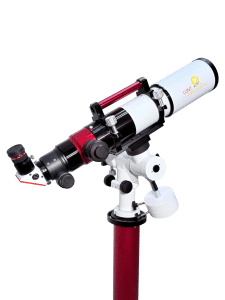
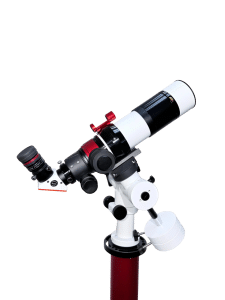
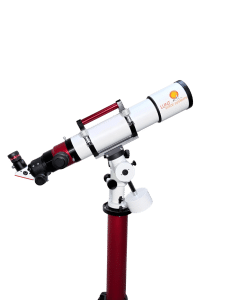
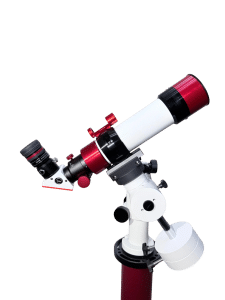
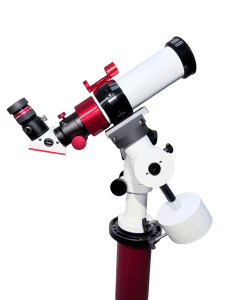
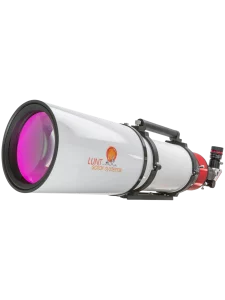
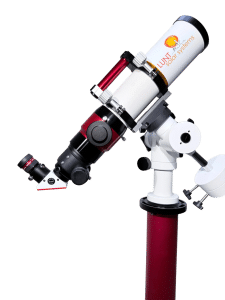
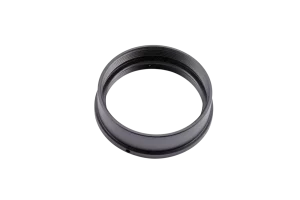
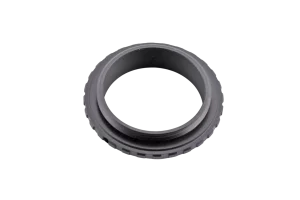
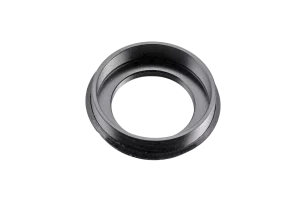
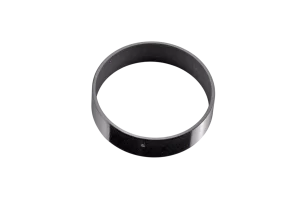
Lunt LS152THa B1800 – 152 mm H-alpha Solar Telescope
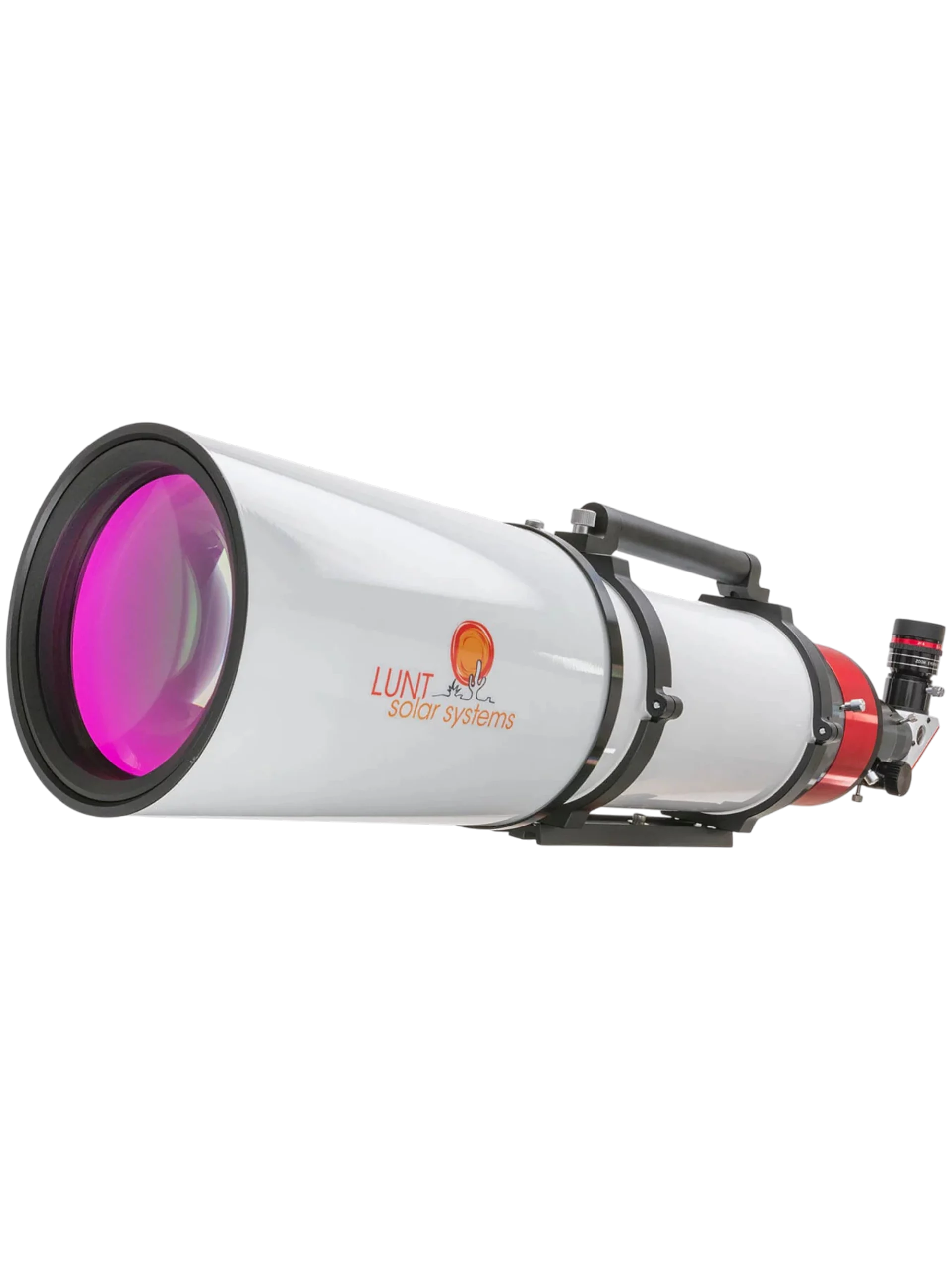
The Lunt LS152THa is one of the most impressive H-alpha solar telescopes in the Lunt line. With its aperture of 152 mm, it is designed for discerning observers, advanced solar astrophotographers, clubs, and observatories seeking a very high level of resolution for images of the Sun.
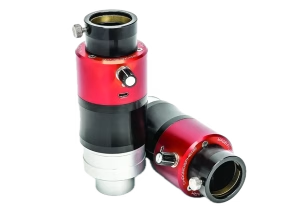
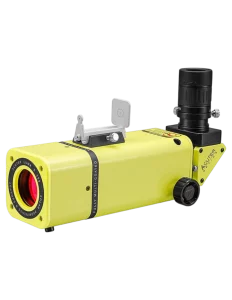
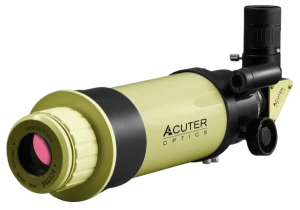
This configuration is available with the B1800 blocking filter with 2″ elbow fittingthe 2″ Rack & Pinion Eyepiece Holder and theLunt 7.2–21.5 mm zoom eyepiece. It is a comprehensive solution designed specifically for advanced visual observation and solar imaging using reasonably sized sensors.
A large-diameter solar instrument
In H-alpha observation, diameter plays a key role: the larger the aperture, the more fine details the instrument can reveal in the solar chromosphere, provided atmospheric conditions permit it. With its 152 mm aperture, the LS152THa allows observers to see fine structures such as filaments, spicules, prominences, active regions, and complex details around sunspots.
The system is based on a high-quality internal H-alpha etalon, combined with a pressure-based adjustment system Pressure Tuner. This system allows for precise adjustment of the bandwidth to optimize contrast based on the structures being observed.
Setup recommended by Deep Space Astronomy
| Element |
Configuration included |
| Telescope |
Lunt LS152THa |
| Aperture |
152 mm |
| Focal length |
900 mm |
| Focus report |
f/6 |
| Blocking filter |
B1800 with 2″ Elbow Joint |
| Lens holder |
2-inch Rack and Pinion |
| Eyepiece |
Lunt 7.2–21.5 mm Zoom Lens |
| H-alpha Adjustment |
Pressure Tuner |
| Accessories |
Clamps, dovetail joints, plugs, and a carrying case |
Why choose the B1800 blocking filter?
The blocking filter is an essential component of any Lunt H-alpha solar telescope. It completes the filtration system and makes it possible to observe the Sun safely when the instrument is used in accordance with the manufacturer’s recommendations.
The B1800 is an excellent choice for this type of instrument, as it offers a more comfortable field of view than the B1200 and greater versatility for solar imaging. It is particularly well-suited for users who want to observe visually but also connect a solar camera to capture fine details of the surface and limb.
| Blocking filter |
Typical Use |
Comment |
| B1200 |
Visual observation |
A more compact solution, particularly suited to the visual aspect |
| B1800 |
Advanced Visualization and Imaging |
An excellent compromise for this setup |
| B3400 |
Imaging with Large Sensors |
A more specialized option for highly demanding configurations |
Pressure Tuner: Fine-Tuning the H-alpha Band
The LS152THa uses the system Pressure Tuner by Lunt. Unlike a simple mechanical tilt adjustment, the pressure adjustment allows for very fine tuning of the H-alpha band’s position across the entire field.
This allows you to optimize the image based on the details you want to see: prominences on the solar limb, filaments on the disk, active regions, bright patches, or fine structures in the chromosphere. In practice, the user can adjust the rendering based on atmospheric turbulence, the magnification used, and the type of observation.
Visual observation
Visually, the Lunt LS152THa offers an incredibly spectacular experience. Its 152-mm aperture provides very high brightness and resolution, allowing for greater magnification than with smaller instruments when atmospheric conditions permit.
L'Lunt 7.2–21.5 mm zoom eyepiece The included feature allows you to quickly adjust the magnification without changing the eyepiece. This is particularly useful when observing the Sun, as conditions often change throughout the day. You can start with moderate magnification to view the Sun as a whole, then gradually zoom in on a prominence, a sunspot, or an active region.
| Observation |
What You Can See |
| Solar Disc |
Filaments, active regions, chromosphere texture |
| Solar Leaf |
Protrusions, jets, arches, and dynamic structures |
| Active regions |
Details around sunspots, bright regions, and complex filaments |
| High resolution |
Spicules and fine structures when turbulence is favorable |
Solar imaging
The LS152THa is also a high-performance instrument for high-resolution solar imaging. Its large aperture allows for the use of high-speed cameras to capture a large number of images in video format, and then select the best ones during post-processing.
With a suitable solar monochrome camera, it becomes possible to produce detailed images of the solar surface and solar prominences. The eyepiece holder 2-inch Rack and Pinion provides good mechanical stability, which is important when using a camera, a Barlow lens, or heavier accessories.
Rack & Pinion 2″ eyepiece holder
This version is equipped with the 2″ Rack & Pinion Eyepiece Holder. This system provides precise, stable, and robust focusing. It is particularly valuable on an instrument of this caliber, as focusing on the Sun at high magnification requires a great deal of finesse.
| Advantage |
Practical Value |
| Robust construction |
Better fit with heavy accessories |
| Precise Focus |
Visual and Imaging Comfort |
| 2″ format |
Extensive compatibility with a wide range of accessories |
Double stack available as an option
For users looking for even higher contrast on the solar surface, a configuration double stack is available as an option upon request.
The double stack reduces the system's bandwidth. The result is a very noticeable increase in contrast on the solar disk: filaments stand out more, active regions become more structured, and the texture of the chromosphere gains depth.
| Configuration |
Expected result |
| Simple stack |
Bright image, highly versatile, excellent for visual applications and imaging |
| Optional double stack |
Enhanced contrast on the solar disk, more pronounced surface details |
The dual-stack module is not included in this standard configuration. It may be offered upon request, subject to availability, supplier lead times, and the desired configuration.
Who is the Lunt LS152THa designed for?
The Lunt LS152THa is not a small, entry-level solar telescope. It is an ambitious instrument, designed for enthusiasts who want to capture spectacular, detailed images of the Sun.
| User Profile |
Adaptation |
| Complete beginner |
Possible, but it's a very high-end instrument that requires a good mount |
| Regular solar observer |
An excellent choice for taking your skills to the next level |
| Solar astrophotographer |
Well-suited for high-resolution imaging |
| Club or observatory |
A spectacular instrument for events, demonstrations, and public viewings |
Recommended frame
With its 152-mm diameter and substantial size, the LS152THa requires a sturdy mount. A mount that is too light will significantly reduce comfort during use, especially at high magnifications or when taking images.
We recommend a sturdy equatorial or alt-azimuth mount with ample load capacity to ensure good stability during observation. For public or semi-permanent use, a very stable setup is strongly recommended.
Technical specifications
| Features |
Value |
| Model |
Lunt LS152THa |
| Type |
Dedicated H-alpha solar telescope |
| Aperture |
152 mm |
| Focal length |
900 mm |
| Focus report |
f/6 |
| Stanchion / stud |
Sealing and adjustment via the Pressure Tuner system |
| Bandwidth |
Less than 0.45 Å in a single stack, according to the manufacturer's specifications |
| Blocking filter included |
B1800 with 2″ Elbow Joint |
| Lens holder |
2-inch Rack and Pinion |
| Eyepiece included |
Lunt 7.2–21.5 mm Zoom Lens |
| Accessories included |
Clamps, dovetail joints, plugs, carrying case |
| Use |
H-alpha Solar Observation and Solar Imaging |
Highlights
- Large 152 mm aperture for high solar resolution
- Dedicated H-alpha instrument for observing the solar chromosphere
- Includes a B1800 blocking filter, suitable for advanced visual observation and imaging
- Stable and precise 2″ Rack & Pinion eyepiece holder
- Lunt zoom eyepiece included for easily adjusting the magnification
- Pressure Tuner for fine-tuning the H-alpha band
- Double stacking is available as an option upon request
- An excellent choice for observatories, clubs, and solar enthusiasts
Solar Safety
Observing the Sun requires the right equipment. The LS152THa is a dedicated H-alpha solar telescope, designed specifically for this purpose. It must be used with a Lunt-compatible blocking filter.
This version includes the B1800. Never modify the optical system, remove the filter, or use accessories not intended for solar observation without technical approval.
Our opinion
The Lunt LS152THa is an exceptional solar telescope. It represents a significant leap in quality compared to smaller-aperture solar telescopes, both for visual observation and imaging. It is an especially good choice for users who want a durable, spectacular instrument capable of revealing the finest details of the Sun when conditions are right.
The configuration with B1800, 2-inch Rack and Pinion and zoom eyepiece In our view, this provides a very solid foundation: it is comprehensive enough to get started in earnest, while leaving room to move on later to a double stack upon request.