EN
More products from the brand :Player One

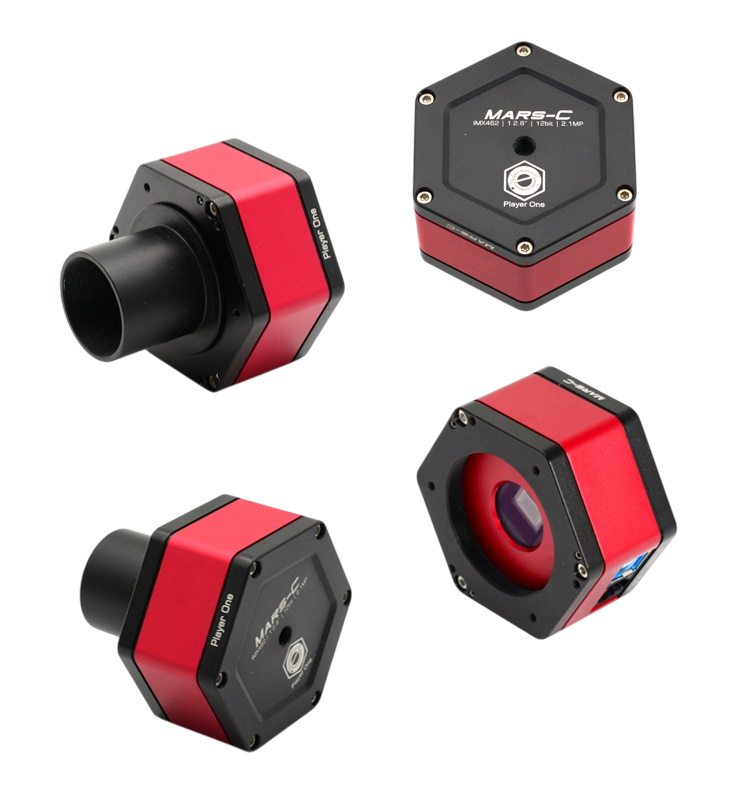
Mars-C - 2.1MP/136FPS color planetary camera

Original price was: CHF 135.83.Current price is: CHF 95.00.incl. Swiss VATCHF 135.83

Reference CAM-0049

Will be ordered for you
Delivery time: 5 to 7 business days
Estimated shipping: Between November 30 and December 1, 2026

Free shipping in Switzerland on orders of 200 CHF or more
14 days to request a return
Credit Card · TWINT · PayPal · Invoice · Klarna
Free pickup in Nyon · credit card or cash
Product description

Product description

Introducing Player One Astronomy's Mars-C camera

Visit March-Cdeveloped by Player One Astronomyis a compact, high-performance color camera designed for planetary, lunar and solar imaging. Equipped with the Sony IMX462 CMOS sensor, it offers an ideal combination of sensitivity, speed and precision, making it an essential tool for demanding astrophotographers.

Main technical data

  • Sony IMX462 CMOS sensor : This 1/2.8" (5.6 mm x 3.2 mm) color sensor offers 2.1 megapixel resolution (1944 x 1096 pixels) with a 6.46 mm diagonal. The 2.9 µm pixel size guarantees excellent sensitivity and precise reproduction of details.
  • Full Well depth : With a maximum capacity of 12 ke, the camera captures images with sufficient dynamic range for planetary applications.
  • High speed : Up to 136 FPS in full-resolution RAW8 mode, freezing atmospheric turbulence for sharp, detailed images.
  • BSI (Back-Side Illuminated) technology : Improves sensitivity and reduces noise, enhancing image quality in low-light conditions.

Imaging performance

  • Increased sensitivity in the near infrared (NIR) : Thanks to its ability to capture infrared wavelengths, the Mars-C can also be used as a monochrome camera with IR850 or CH4 filters to explore invisible details in the visible spectrum.
  • Non-Amp-Glow: Mars-C is totally amp-glow-free, guaranteeing a clean background even during long exposures.
  • HCG (High Conversion Gain) mode : Activated automatically from a gain ≥80, this mode considerably reduces playback noise while maintaining high dynamic range.

Technological advances

  • Integrated DDR3 cache (256 MB) : Stabilizes data transmission and reduces image loss while improving performance, even on a USB 2.0 port.
  • DPS (Dead Pixel Suppression) technology : Automatically corrects defective pixels to ensure clean images.
  • Super AR Plus anti-reflective glass : Ensures high light transmission (310 nm to 1100 nm), improving ultraviolet (UV) and near-infrared (NIR) performance.
  • Advanced protection : Incorporates an overvoltage and overcurrent mechanism to protect your equipment.

Ergonomic design

Player One's iconic hexagonal design combines aesthetics and functionality. The bright red and black finish reflects its planetary orientation while offering excellent heat dissipation. Compact and lightweight, it integrates easily into any configuration thanks to its standard T2 thread.

Applications

Mars-C is ideal for :

  • High-resolution planetary imaging (Jupiter, Saturn, Mars).
  • Solar observation with H-alpha filters or white light.
  • Lunar imaging thanks to its high frame rate, enabling precise details to be captured.

Additional highlights

  • Compatible with software such as SharpCap Pro for precise control of parameters (gain, exposure).
  • Supplied with all necessary accessories: USB3.0 cables, T2/1.25" adapters, protective cap.

With its advanced technical features and design optimized for fast, precise imaging, the Mars-C is the obvious choice for astrophotographers wishing to explore the fascinating details of our solar system.

Back to the sections
Frequently asked questions

Frequently asked questions

What is the Player One Mars-C designed for?

The Player One Mars-C is designed for planetary, lunar, and solar imaging (the Sun only with a suitable filter) using «lucky imaging»: you record for a few minutes at up to 136 frames per second, then stack the best images. With 2.9 µm pixels, aim for an F/D ratio of approximately f/9 to f/15 when photographing planets, using a Barlow lens if necessary. It can also be used as an autoguiding camera.

What makes the Player One Mars-C's sensor stand out?

The Sony IMX462 (STARVIS) is highly sensitive in the near-infrared, making it effective when used with infrared filters for planetary imaging and for locating guide stars. Readout noise of 0.7 e⁻, 136 frames per second, at an affordable price.

Does the Player One Mars-C require a power supply?

No: It is powered by its USB cable. No external power source is required.

What backfocus setting should be used with the Player One Mars-C?

The camera's back focus is 12.5 mm. Mount: 1.25"; M42 × 0.75.

Do you need a filter to photograph planets with the Player One Mars-C?

Yes: its window is only anti-glare. Add a ZWO 1.25" UV/IR-cut filter for sharp images and accurate colors. For planets low on the horizon, a ZWO ADC Atmospheric Dispersion Corrector significantly improves sharpness.

Color or monochrome: Which version of the Player One Mars-C should you choose?

The color version is the simplest: a single exposure produces the color image. The monochrome version, the Player One Mars-M II, requires a filter wheel and a longer exposure time. In return, it is more sensitive and produces better results in narrowband imaging.

Where can I find more information about the Player One Mars-C?

The manufacturer's data sheet (in English) is available here: Player One Mars-C Spec Sheet.

Technical specifications

Technical specifications

Technical specifications

Sensor
Sony IMX462
Color / black-and-white
Color
Sensor Size
1/2.8″
Sensor Dimensions
5.6 × 3.2 mm
Sensor diagonal
6.5 mm
Resolution
2.1 megapixels
Resolution in pixels
1944 × 1096
Pixel size
2.90 µm
Shutter
Roll-up
ADC Converter
12 bits
Playback noise
0.7 e⁻
Well Capacity
12 ke⁻
Maximum quantum efficiency
90 %
Cooling
No
Buffer memory
256 MB DDR3
Interface
USB 3.0 / USB 2.0
ST4 Port (autoguiding)
Yes
Speed
136 frames per second
Backfocus
12.5 mm
Threads / Connections
1.25"; M42 × 0.75
Protective window
Anti-reflective (AR Plus), Ø 21 × 1.1 mm
Case diameter
66 mm
Camera weight
180 g
Power supply
Powered by the USB cable
Camera Uses
Planetary, Guidance, Solar, Lunar
Documentation

Products in the same category

[category_menu_mobile]