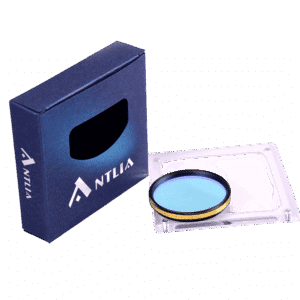
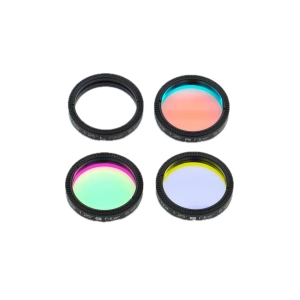
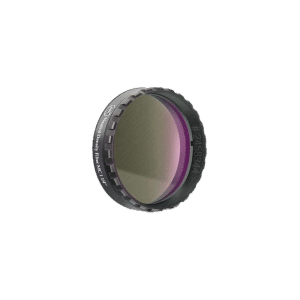
Kit Antlia ALP-T filters - SII&H-Beta and OIII&H-alpha
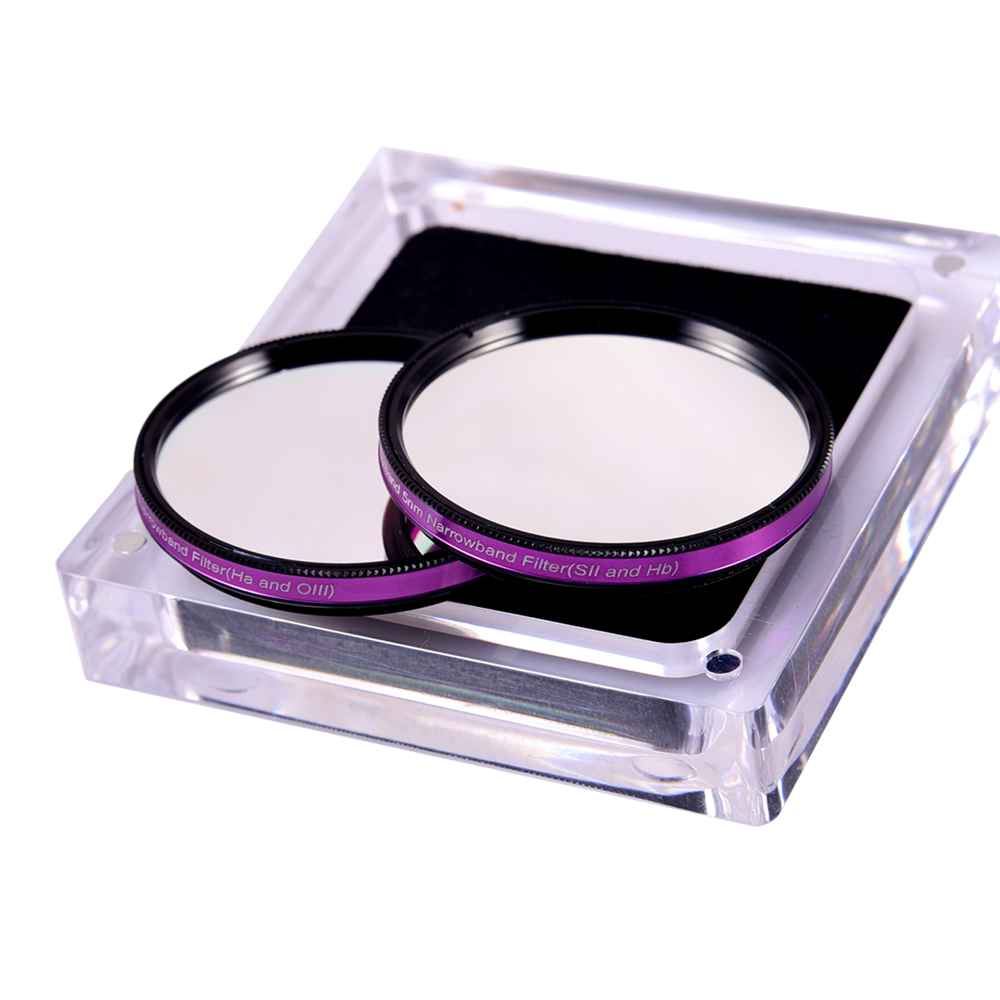
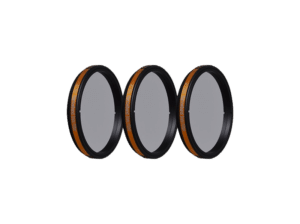
The Antlia ALP-T 5nm kit offers a complete solution for capturing the main deep-sky emission lines: SII (ionized sulfur), Hβ (hydrogen beta), OIII (doubly ionized oxygen) and Hα (hydrogen alpha). Designed to maximize contrast, improve separation of fine detail and reduce light pollution, these filters enable spectacular images to be produced with color cameras (OSC) as well as monochrome sensors.
Filters included in kit
- SII&H-Beta filter - Transmission centered on 672.4nm and 486.1nm
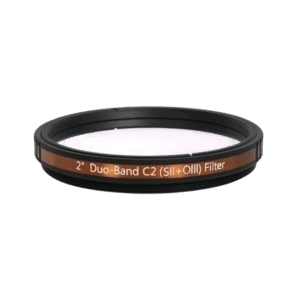
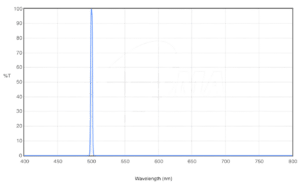
- Ha&OIII filter - Transmission centered on 500.7nm and 656.3nm
Key features
- Ultra-narrow bandwidth of 5nm for each filter
- High transmission: approx. 85% to 92% depending on the emission line
- OD4.5 out-of-band suppression (300nm to 1100nm) for maximum contrast
- Compatible with DSLR, CMOS and CCD cameras
- Designed for high-speed optics without noticeable band offset
- Ion Gun Assisted Deposition coating for maximum durability
- Effective NIR blocking
Ideal applications
- Astrophotography in false color palettes (H-O-Hb, S-H-O, H-S-OHb, H-O-O)
- Imaging emission nebulae, supernovae, Wolf-Rayet regions
- Use under polluted or lightly polluted skies (Bortle 1 to 8)
- Create separate channels to enrich traditional RGB compositions
Technical specifications
- Thickness: 2mm ± 0.05mm
- Optical quality: S/D 60/40
- NIR suppression: up to 1100nm
- Available sizes: mounted 2” (M48x0.75) or unmounted Ø36mm
- Ultra-thin cell to minimize vignetting
- Black anodized finish and durable laser engraving
Why include H-Beta in addition to OIII?
While the OIII line is well covered thanks to the RGGB arrangement of the color cameras, Hβ (486.1nm) reveals structures invisible via OIII or Hα. The addition of the Hβ filter makes it possible to capture subtle details in nebulae that would otherwise be overlooked, enhancing the spectral richness of the final images and offering greater flexibility during post-processing.
Recommendations for use
- Recommended for use exclusively in astrophotography
- Not recommended for night-time visual observation
- It is strictly forbidden to use this filter for solar observation.