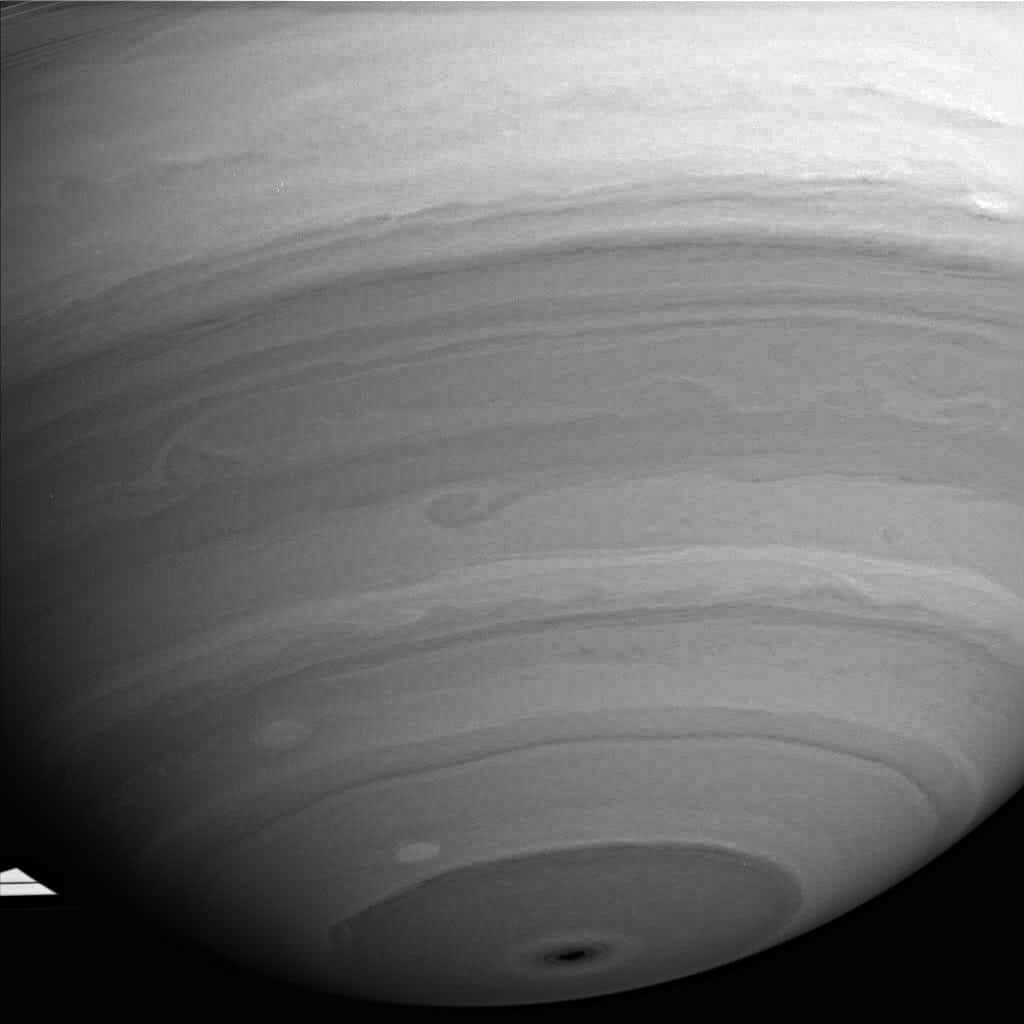
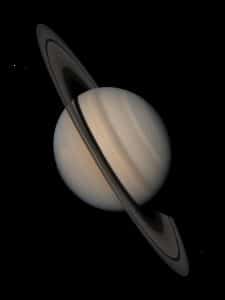
On October 4, 2026, at 12:21 UTC (2:29 p.m. Central European Summer Time), Saturn reaches opposition. The ringed planet will then be visible all night long, at its closest, brightest, and highest point in the sky for the year. This is the planetary event of the fall and the best time to observe the rings since the edge-on alignment of March 2025.
The Opposition's Figures
| Magnitude |
+0.33 (brighter than Deneb) |
| Apparent diameter (globe) |
19.70 arcseconds |
| Ring Opening Reaction |
9.15° (south-facing side visible) |
| Distance |
8,434 AU (1.262 billion km) |
| Travel time of light |
70 minutes |
| Constellation |
The Whale (Cetus) |
| Sunrise / Sun's highest point |
6:54 p.m. / 12:58 a.m. at an altitude of 39.4° |
Saturn is 8.434 astronomical units from Earth. Its light takes 70 minutes to reach us. The planet appears to be 19.70 arcseconds in diameter—too small for the naked eye, which sees only a dot, but easily observable with a telescope.
Opposition occurs in the middle of the day (12:21 UTC), but that’s not a problem. Saturn changes very little over several weeks. The nights of October 3–4 and 4–5 are also good, and the quality of viewing remains nearly as good throughout the first half of October.
The rings: finally wide open
This is the big highlight of 2026. In March 2025, Saturn’s rings were seen exactly edge-on. From Earth, they were invisible—just a tiny line—for several weeks. Saturn’s rings tilt like this every 13 to 15 years, when Earth crosses the plane of the rings.
In October 2026, the rings are open at 9.15°. This is the best opening in three years, and it changes everything. You can see the south face of the rings as a bright ellipse, with Cassini’s Division visible even through a 130-mm telescope. The tilt continues to change: 8.69° on October 15, 8.10° on October 31. The angle of opening decreases slowly but remains favorable throughout the fall.
Be careful with the figures circulating online: some websites report 7°, while others report more than 10°. The values given here are taken from the JPL Horizons ephemeris (PDObsLat), the standard reference for observational planetography. 9.15° on October 4.
Find Saturn in the Whale
Saturn is in Cetus (the Whale), not in Pisces. This is a detail that many summaries get wrong. Saturn crossed the boundary between the two constellations during the summer and is moving retrograde just south of the ecliptic.
It’s easy to find: Saturn is by far the brightest object in this region of the sky. At magnitude +0.33, it shines brighter than Deneb in Cygnus. Cetus is a constellation with few bright stars—Saturn has no rival in the vicinity.
From Switzerland, Saturn rises around 6:54 p.m. (local time) and reaches its highest point around 12:58 a.m. at an altitude of 39.4° due south. 39° is a comfortable angle for a telescope: not too high to avoid a stiff neck, yet high enough to avoid most atmospheric absorption. The time it reaches its highest point, around 1 a.m., is the best time to observe.
What do we see at what aperture?
The most important factor is not the aperture, but the stability of the air (seeing). In 2026, Saturn won’t rise very high (39°), and the air above the southern horizon may be turbulent. Wait until Saturn reaches its highest point, let the telescope cool down for at least 30 minutes, and avoid pointing the telescope above a heated roof.
Here's what we can look forward to with each opening:
10×50 Binoculars
Saturn appears elongated, «with handles.» There is no actual separation between the planet and the rings, but the oval shape is distinctive and suggests the presence of the rings.
70–80 mm: separate rings
The ring is clearly separated from the planet. Titan, the largest moon (magnitude +8.4), is visible as a small star nearby. This is the first step: the view that makes a child say, «That’s Saturn,» for the first time.
100–130 mm: Cassini Division
The Cassini Division—the dark line between Ring A and Ring B—becomes visible when the atmosphere is stable. The planet's shadow on the ring is visible. Three or four moons are visible: Titan, Rhea, Thetis, and Dione.
200 mm and beyond: a spectacular sight
The Cassini Division is clearly visible. The planet’s cloud bands come into view: the lighter equatorial and tropical bands alternate with darker bands. Five to six moons are visible, including Enceladus (magnitude +11.7) under poor seeing conditions. Under exceptional conditions, Encke’s Minimum (a narrower gap in the A ring) is visible.
Saturn's Moons in October 2026
As of June 2026, Saturn has 293 confirmed moons. Only the brightest ones are observable by amateur astronomers:
- Titan (mag +8.4): the largest moon, visible with a 70–80 mm telescope. It orbits in 16 days. Titan moves noticeably from one night to the next, first east and then west of Saturn.
- Rhea (magnitude +9.7): visible with a 100 mm telescope. Orbits in 4.5 days.
- Thetis (mag +10.2): visible at 130 mm or larger. Orbits in 2 days.
- Dioné (mag +10.4): visible with a 130 mm telescope. Orbits in 2.7 days.
- Enceladus (mag +11.7): visible with a 200-mm telescope under stable seeing conditions. Orbital period: 1.4 days.
- Mimas (mag +12.8): difficult; observable only with a 250 mm or larger telescope and excellent seeing conditions.
Sky and Telescope reports that on October 1 at around 11:00 p.m. EDT, Enceladus will partially eclipse Thetis—a rare «mutual eclipse» that occurs during the open-ring season.
Recommended magnification
When observing Saturn, the optimal magnification depends on the seeing conditions and the aperture. A rule of thumb:
- 80–100 mm : 100 to 150× maximum. Beyond that, image quality deteriorates.
- 130–150 mm : 150 to 200×. Cassini's division is visible at 150× under stable seeing conditions.
- 200 mm and above : 200 to 300×. Cloud bands and the faintest moons require 250×.
At magnifications below 100×, the rings are visible but lack detail. At magnifications above 300×, atmospheric turbulence degrades the image more than it adds detail. Patience is key: stay at the eyepiece for 10–15 minutes and take advantage of the brief periods of stable seeing that last just a few seconds.
The Star Chart: Finding Saturn from Switzerland
From Switzerland (~47° N), Saturn rises in the southeast around 6:54 p.m. in early October. It reaches its highest point directly south around 12:58 a.m. at an altitude of 39°. It sets in the southwest around 6:30 a.m.
To find it with the naked eye: go outside after 8:00 p.m. and face southeast. Saturn is the brightest star in the south-southeast, about 30° above the horizon. It has a yellowish hue that sets it apart from white or blue stars. There are no bright stars nearby—this is Cetus, a constellation with few stars.
An app (Stellarium, SkySafari, Sky Tonight) will confirm it in 10 seconds. Saturn is the bright yellow object in the southeast—period.
Astrophotography: Saturn in Pictures
Saturn is a feasible target even with a modest setup. The main methods are:
Planetary Camera + Telescope
A planetary camera (Player One Neptune, ZWO ASI662MC, or ASI224MC) mounted on a telescope with a 200 mm or larger aperture. High-frame-rate imaging (100–200 frames/s), selection of the best frames, and stacking with AutoStakkert or RegiStax. With a 200 mm telescope and decent seeing conditions, you can capture the Cassini Division, the cloud bands, and Titan.
Barlow and Deconvolution
A 2x or 3x Barlow lens (TeleVue; see our article on Barlow lenses and backfocus) can be used to magnify the image. The FWHM of the rings must be at least 4 pixels for deconvolution. BlurXTerminator (see our article on deconvolution) can then sharpen the image, but use it sparingly on planetary images: the signal-to-noise ratio is high, and the fine structures are real.
Smartphone behind the eyepiece
Even a smartphone attached to a 25-mm eyepiece on a 150-mm telescope produces a recognizable image of Saturn with its rings. The quality is limited, but for a first attempt, it’s good enough.
Nights Around the Opposition
The exact opposition occurs on October 4 at 12:21 UTC, but you don’t have to observe it on that specific night. Saturn is visible under nearly identical conditions throughout the first half of October. The time of culmination gets earlier: October 15 at 12:12 a.m., October 31 at 10:04 p.m. (standard time). By the end of the month, Saturn culminates before midnight—which is more convenient.
The waxing gibbous Moon on October 18 may interfere late in the evening. The nearly full Moon on October 24 is 5.7° from Saturn—which makes observation difficult. The best window is the first half of October, between the new Moon on the 10th and the first quarter on the 18th.
In a nutshell
Saturn at opposition on October 4, 2026: magnitude +0.33 in Cetus, 39° of culmination as seen from Switzerland. Rings open at 9.15°—the best view in three years. Cassini Division visible with a 130 mm telescope; cloud bands and five moons visible with a 200 mm telescope. The best viewing time is around 1:00 a.m., after the telescope has cooled down. The nights of October 3–4 and 4–5 are ideal, but the entire first half of the month is excellent. Seeing is more important than aperture: wait for culmination, let the telescope cool down, and take your time.
Sources : Sterngucker – The Sky in October 2026 (Alexander Merz, JPL Horizons Ephemeris); ; EarthSky – Saturn at Opposition in 2026 ; Sky and Telescope – Saturn's Moons ; High Point Scientific – Observing Saturn's Moons.
See also on Deep Space Astronomy: September Equinox, 2026 ; Neptune in opposition on September 26, 2026 ; Barlow and backfocus
Signature: CBurkhalter