In April or May 2024, an asteroid the size of a three- to six-story building struck the Moon. The impact carved out a crater 222 meters in diameter—the largest new crater ever discovered in the Solar System. Announced on September 15, 2026, in *Science Advances*, the event is described as a «once-in-a-century» occurrence. Here’s how NASA discovered it, what it tells us, and which craters you can observe yourself through your telescope.
The Discovery: A White Dot on a Map
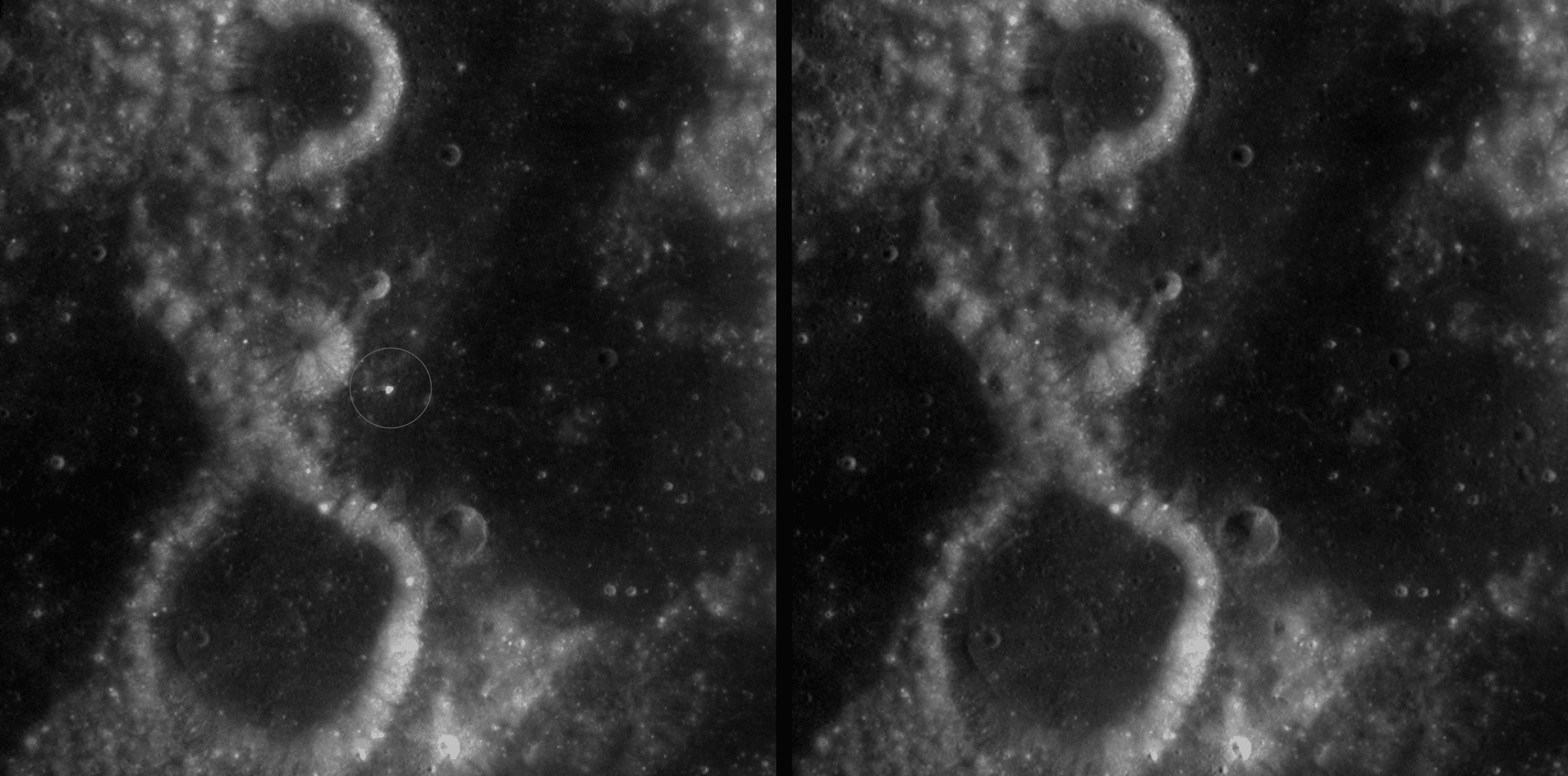
It all began with a routine data quality check. Robert Wagner, a scientist with NASA’s Lunar Reconnaissance Orbiter (LRO), was scanning a giant map of the Moon on his screen when an unusually bright spot, surrounded by a dark halo, caught his attention. This halo indicated that the surface material had been disturbed.
«I stopped, dropped everything, and started trying to figure out what it was,» Wagner said.
By comparing before-and-after images, Wagner realized he had discovered the largest newly formed crater ever found in the Solar System. The findings were published on September 15, 2026, in two articles in the journal *Science Advances*.
The McGetchin Crater: 222 meters, once a century
The crater has been officially named McGetchin, in honor of Tom McGetchin, a pioneer in lunar science. It formed on the eastern edge of the Moon, sometime between April 11 and May 22, 2024.
The impactor—an asteroid or a comet—was likely between 10 and 20 meters in diameter. Upon striking the surface at several kilometers per second, it released energy equivalent to that of hundreds of conventional bombs. The resulting crater is 222 meters wide, roughly the length of two soccer fields.
Scientists estimate that an impact of this magnitude occurs on the Moon about once a century—or even every 132 years, according to some models. It is a rare event, but not exceptional on a geological timescale. The Moon is constantly bombarded by small objects, and these impacts have been shaping its surface for 4.5 billion years.
The white spot visible in the LRO images is not the crater itself, but ejecta—freshly disturbed regolith that reflects sunlight more effectively than the surrounding surface. This contrast is the hallmark of a young crater.
How the LRO Detects New Craters
The Lunar Reconnaissance Orbiter has been orbiting the Moon since 2009. Its cameras—the Wide Angle Camera (WAC) and the Narrow Angle Camera (NAC)—map the surface with a resolution of up to 0.5 meters per pixel for the NAC.
The detection of new craters relies on comparing images. Wagner stacks hundreds of «before» and «after» frames using software designed to detect changes. The software looks for blurry halos around bright spots—the signature of regolith ejecta around a new crater.
Over the years and through thousands of flybys, scientists have created maps detailed enough to identify not only new craters, but also landslides, landers, seismic faults, and even evidence of lava tubes.
The McGetchin crater was first detected in visible-light images from the WAC. Thermal images from the Diviner instrument, taken between November 15, 2025, and February 18, 2026, subsequently confirmed the discovery and revealed the crater’s size and shape.
Why the Moon Is the Best Impact Laboratory
The Moon has no atmosphere. No erosion from wind or rain. No plate tectonics. The surface retains traces of impacts for millions, even billions, of years. A 222-meter crater formed in 2024 will remain visible as is for centuries, until new impacts or micrometeorite bombardment gradually erase its rays and halo.
This is what makes the Moon a unique archive of the history of impacts in the Solar System. Every visible crater is evidence of a past impact. By counting craters of different sizes in a given region, scientists can estimate the age of the surface—a method known as «crater counting.».
In comparison, Earth loses its craters due to erosion, subduction, and volcanism. The Moon is a witness that forgets nothing.
Observe the craters on the Moon through your telescope
The Moon is the most rewarding target for a beginner. It’s bright, easy to find, and its details are visible even with a small aperture. Here are the most notable craters to observe.
With the naked eye
The largest craters are visible to the naked eye as dark spots or bright spots on the surface. Tycho, in the southern hemisphere, is the most obvious: a bright spot surrounded by rays that extend for hundreds of kilometers. Copernicus, near the equator, is another bright spot visible to the naked eye.
With binoculars (10×50)
With stabilized binoculars, the large craters can be seen as circles with a bright rim. Tycho, Copernicus, Kepler, and Aristarchus are the easiest to spot. Plato, on the northern edge of Mare Imbrium, appears as a dark, oval-shaped patch.
Through a telescope (70–150 mm)
It is at this scale that the Moon becomes spectacular. The craters reveal their details: steep rims, central peaks, inner terraces, and ejecta rays.
Tycho (85 km in diameter): the most spectacular crater on the near side. At the terminator (the line between light and shadow), its rims glow brilliantly, and its rays extend across the entire southern hemisphere. A majestic central peak rises in the middle. Visible with a 60-mm telescope, spectacular with a 150-mm telescope.
Copernic (93 km): the «typical» crater for amateur observation. Terraced rims, a double central peak, and an extensive ray system. Located in Mare Insularum, it is well-suited for observation from first quarter to last quarter. At 150 mm, the inner terraces are visible.
Kepler (32 km): smaller than Copernic but with an impressive system of rays. Its rays form a star-shaped pattern that resembles a ninja star. Clearly visible at 100 mm.
Plato (101 km): A crater flooded by ancient lava, located on the northwestern edge of Mare Imbrium. Its floor is flat and dark—one of the darkest floors on the Moon. At 150 mm, you can look for the small satellite craters on the floor of Plato, a classic challenge for amateur astronomers.
Through a telescope (200 mm and larger)
At 200 mm, the details become sharper. The terraces of Copernicus reveal their faults. The central peaks of Tycho and Copernicus reveal their structure. The small satellite craters (Copernicus A, Kepler A) become targets. The Encke minimum within the radius of Tycho is visible under excellent seeing conditions.
When to Observe Craters
The best time to observe craters is not during a full moon. It is at the terminator—the line separating day from night on the Moon. At the terminator, shadows are long and the terrain appears exaggerated. A 50-km-wide crater can cast a 50-km-long shadow that stretches across its floor.
The ideal windows:
- First quarter (around October 18, 2026): The terminator passes over Mare Imbrium and Copernicus. Plato is in a good position.
- Last quarter (around October 3, 2026): The terminator passes through Tycho and the southern hemisphere.
- Full Moon : The rays of Tycho and Copernicus are spectacular, but the craters themselves appear flattened due to the absence of shadows. Save these images for the rays and bright spots.
In October 2026, the full moon falls on October 26 (the Harvest Moon has already passed; this is the Hunter’s Moon). The first quarter is on the 18th, and the last quarter is on the 3rd.
Is the McGetchin crater visible from Earth?
No. 222 meters is far too small to be resolved from Earth. The smallest crater visible through a 200-mm amateur telescope is about 1 to 2 km in diameter, under the best seeing conditions. Craters smaller than 1 km are only observable by lunar orbiters such as the LRO.
But McGetchin’s discovery reminds us that the Moon is not a dead, static world. It is constantly being bombarded, and every crater we see through our telescopes—Tycho, Copernicus, Kepler—was formed by an impact like this one, millions or billions of years ago. The Moon is a living archive of impact history, and the LRO is keeping watch.
In a nutshell
A 222-meter crater formed in April or May 2024 on the Moon, discovered by the LRO and announced on September 15, 2026, in *Science Advances*. It is the largest new crater in the Solar System, an event described as «a once-in-a-century event .» The LRO detects new craters by comparing before-and-after images, looking for halos of fresh regolith. The Moon preserves these traces because it has no erosion—each crater is a permanent record. To observe the craters from Earth: Tycho, Copernicus, and Kepler are visible even with binoculars and look spectacular at 150 mm at the terminator. The best time to view them is during the first and last quarters, when the shadows are long.
Sources : NASA – The «Crater of the Century» on the Moon» ; LPI – McGetchin Crater ; Tech Explorist ; Sky and Telescope – Lunar Craters Visible to the Naked Eye.
See also on Deep Space Astronomy: Saturn in opposition on October 4, 2026 ; Deconvolution in Astronomy
Signature: CBurkhalter